People who did not panic sometimes believed they still had control.
In the car, Javier adjusted Sofia’s seat belt so it crossed her chest without pressing her side. She held the strap with one hand, protecting herself.
He closed the door gently and circled to the driver’s seat. Only once he started the engine did he allow himself to shake.
His hands trembled against the steering wheel. Not wildly. Just enough to make the key ring tick against the column.
Sofia noticed. “Daddy?”
He swallowed. “I’m okay.”
She looked unconvinced, but she nodded because children often accept what adults say when they do not know what else to do.
They drove in silence for several blocks. Zapopan moved around them as if this night were like any other. Families outside small restaurants. A teenager on a bicycle. Two women carrying grocery bags.
A world continuing politely while something private cracked open.
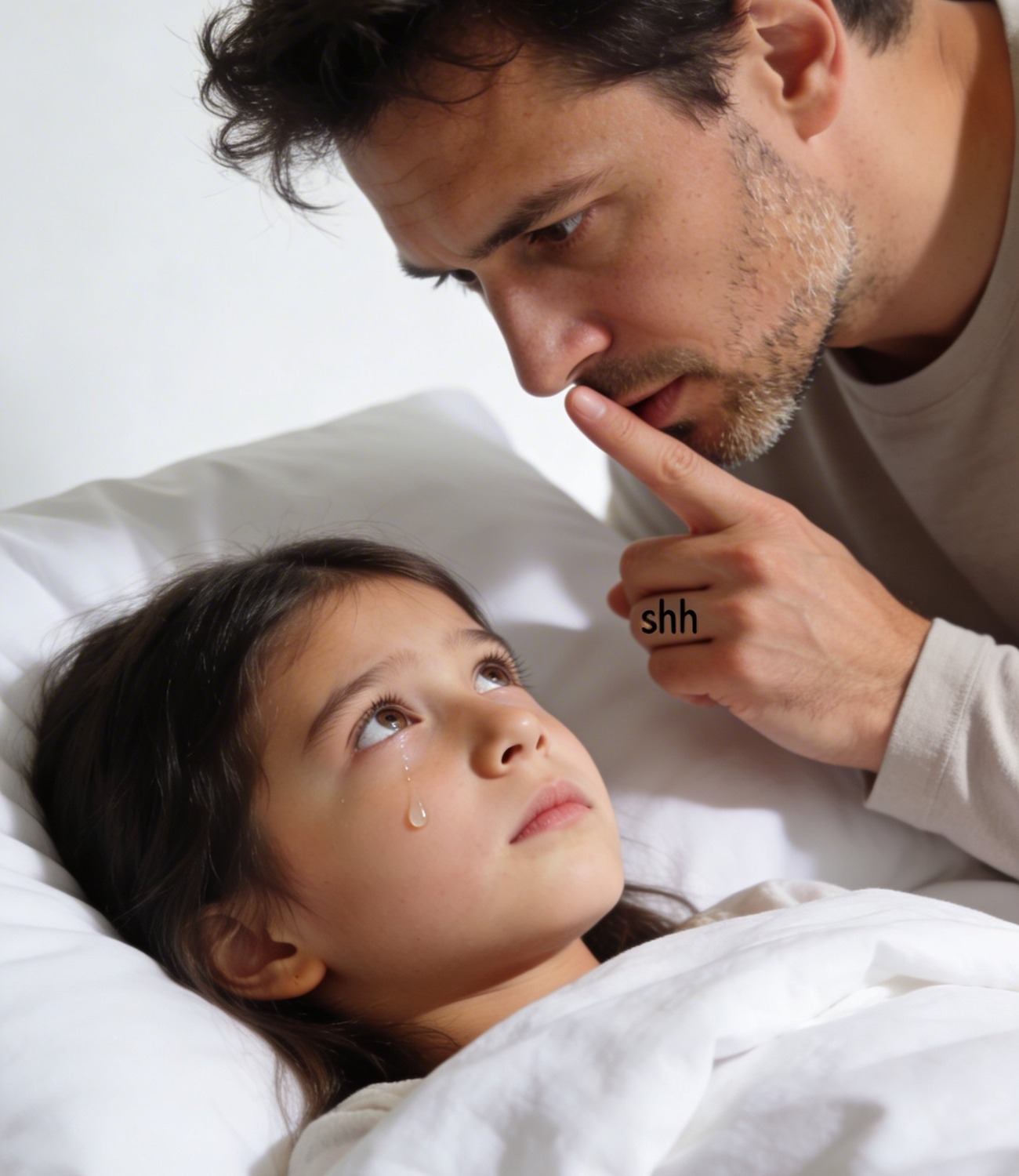
At a red light, Sofia whispered, “Are you mad at Mommy?”
Javier kept his eyes forward. The question was not simple. It asked more than emotion. It asked what would happen to the shape of her life.
“I’m mad that you’re hurt,” he said. “And I’m mad that you were told to hide it.”
She was quiet for a while. Then, “I didn’t want to lie.”
His throat tightened. “I know.”
“But I didn’t want her to cry again either.”
Again.
The word struck him harder than he expected. It carried history. Not one bad moment, but a pattern. A weather system in the house he had failed to map.
He turned slightly toward her when the light changed and traffic remained still. “What do you mean, again?”
Sofia rubbed her thumb against the seat belt. “Sometimes when she gets angry, after, she cries and says I make everything harder.”
Javier looked back at the road because if he looked at her too long, his control would vanish.
“Does she say that a lot?” he asked.
Sofia shrugged in the helpless way children shrug when they think grown-up pain is part of the furniture.
“Sometimes. When I spill things. Or talk too much. Or when she says I look at her like I’m judging her.”
No child should know a sentence like that.
By the time they reached the hospital, Javier had made one decision and was trying not to think about the next.
The first decision was easy: Sofia would be examined, no matter what.
The second was waiting like a closed door at the end of a long hall.
What would he do if the doctor confirmed what he already believed?
Inside the emergency department, fluorescent light flattened everything. Exhaustion. Fear. Anger. Everyone looked equally washed out beneath it.
Javier filled forms while Sofia sat curled carefully in a plastic chair, trying not to lean back. He watched her even while writing her name.
When the nurse called them, Sofia instinctively looked around as if asking permission from someone who was not there. Then she stood and followed.
The exam room smelled faintly of disinfectant and paper. The doctor, a woman in her forties with tired eyes and a precise voice, introduced herself as Dr. Cárdenas.
She spoke first to Sofia, not over her, not around her, and Javier felt immediate gratitude for that small dignity.
“Can you tell me where it hurts?” the doctor asked.
Sofia glanced at Javier. He nodded once.
“My back. And here.” She touched her ribs, then pulled her hand away quickly.
Dr. Cárdenas examined her gently, explaining each movement before she made it. Even so, Sofia stiffened, inhaled sharply, and bit her lip more than once.
Javier stood beside the bed, helpless in the oldest way a parent can be helpless: present, loving, and unable to absorb pain into himself.
After a few minutes, the doctor stepped back. Her expression had changed. Not alarmed exactly, but focused in a way that meant this was no longer routine.
“I want imaging,” she said. “X-rays first. Maybe more depending on what we see.”
Javier nodded. “Is it bad?”
“I don’t know yet,” she said. “But the tenderness and bruising are significant.”
Significant.
A careful word. Professional. Controlled.
Still, it hollowed something out inside him.
While they waited for radiology, Sofia leaned against him without fully resting her weight. He could feel how carefully she arranged herself around pain.
“Am I in trouble?” she asked.
He looked down at her. “For telling the truth?”
She nodded.
“No.” He paused. “You did exactly the right thing.”
She searched his face with the seriousness children have when choosing what belief will keep them alive.
“You promise?”
Read more by clicking the (NEXT »») button below!