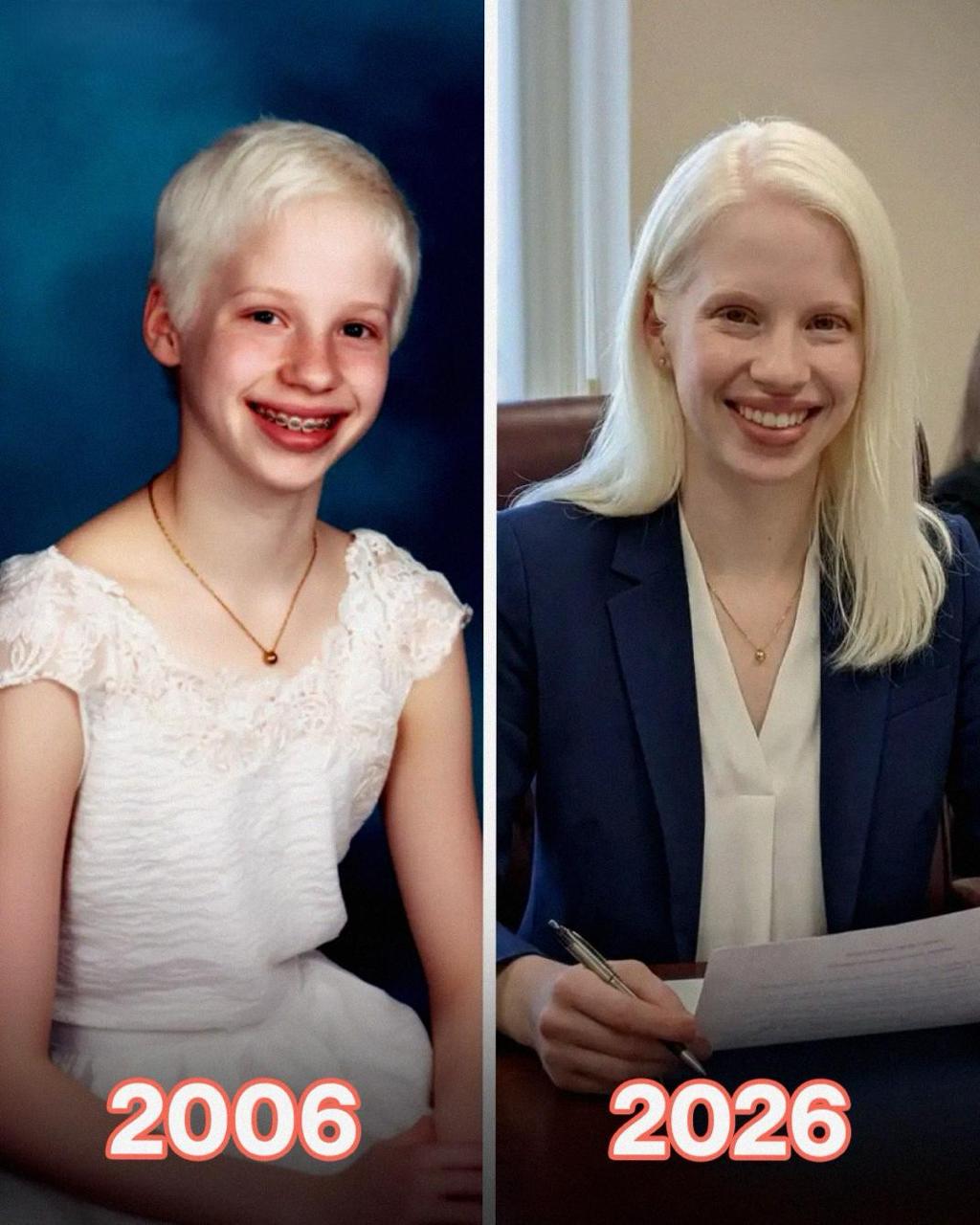
The Condition
His head came up sharply.
She told him she was approving the full amount, interest-free.
He stared at her as though he was not entirely sure he had heard correctly.
Then she told him there was a condition.
She slid the contract across the desk and asked him to read the bottom of the page.
She had added one handwritten clause beneath the formal loan terms.
He read it. Then he looked up at her with an expression that moved between disbelief and something close to panic.
He said she could not be serious.
She told him she was.
The clause required him to speak the following day at their former high school during the district’s annual student assembly. Not in vague, comfortable terms about youthful mistakes and personal growth. In specific terms. He was required to state her full name, describe exactly what he had done in that chemistry class, explain the nickname that had followed her for years, and acknowledge the full weight of what he had caused. The event would be recorded and distributed through the school’s official channels. If he softened the account or turned it into something meaningless, the loan would be voided immediately.
He told her she wanted to humiliate him in front of the entire town.
She told him she wanted him to tell the truth.
He stood and paced the length of the office, hands moving through his hair.
He reminded her that Lily’s surgery was in two weeks. He said he did not have time for this.
She told him the funds would be transferred the moment the agreement was fulfilled. Not a day later.
He turned back to face her.
He said her name. He told her he had been a kid.
She told him so had she.
That landed differently than anything else she had said.
She watched the conflict move across his face in real time. The old defensiveness. The shame underneath it. The terror of a father who had already imagined every possible outcome and found most of them unbearable.
Finally, he asked if doing this would mean they were finished.
She said yes.
He picked up the pen.
His hand paused above the signature line for just a moment.
Then he signed.
As he slid the papers back across the desk, his voice had broken open somewhere around the edges.
He told her he would be there.
The Morning of the Assembly
After he left, Claire sat alone in her office for a long time.
She had spent years imagining what it might feel like if life ever placed Mark in front of her again. She had imagined the sharp satisfaction of a clear and clean reversal of power.
What she felt instead was more complicated than that.
There was fear — not of him, but of walking back into that memory in a room full of people. Of hearing what had happened described out loud, in the open, where it could not be softened or redirected. Of finding out whether the closure she had been carrying as a concept would actually arrive when the moment came, or whether it would simply watch from a distance while she ached.
The next morning she walked into her old high school just before the assembly began.
The building looked almost exactly the same as it had the day she left it. The same floors. The same particular institutional smell. The same feeling that something had been preserved there that might have been better released years ago.
The principal greeted her warmly near the auditorium entrance, thanked her for participating in the school’s anti-bullying initiative, and said it meant a great deal to the students.
Claire smiled politely and said nothing else.
The auditorium was full. Students filled the seats in long rows. Parents and teachers lined the walls. Local board members sat near the front. A banner stretched the width of the stage.
She found a position near the back, arms folded, where she could watch without being drawn into the center of things before she was ready.
Offstage, Mark was pacing.
He looked exactly the way she had expected him to look. Not broken. Not weak. Just completely exposed, the way a person looks when they are about to say something true in front of a large crowd for the first time in their life.
When the principal stepped to the microphone and introduced him as a guest speaker with a personal story about accountability and change, the room offered polite, routine applause.
He walked to the podium like a man approaching something he could not avoid.
Claire watched from the back and waited to see whether he would find a way to soften it.
He cleared his throat.
Then he began.
He told the room he had graduated from this school twenty years ago. That he had played football. That he had been popular, and that he had confused popularity with importance.
His voice was unsteady.
Then he looked up and found her face at the back of the room.
She watched him make a decision.
He said there had been a girl in his sophomore chemistry class named Claire.
Her chest tightened.
He described exactly what he had done. The glue. The braid. The nurse cutting her free. The bald patch. The nickname he had invented and spread and encouraged until it became the way everyone in the building referred to her.
The auditorium went completely quiet.
He kept going.
He said he had told himself for years that they had simply been kids. He said that had been a lie. He said they had been old enough to know exactly what cruelty was and to choose it deliberately.
Students who had been slouching in their seats sat upright. Teachers who had been wearing polite, practiced smiles looked genuinely shaken.
Then he looked directly at Claire.
He said her name.
It carried across the room and filled it completely.
He told her he was sorry. Not because he needed something from her. Not because it was convenient. But because she had deserved to be treated with basic human respect, and he had treated her like entertainment instead.
He spoke about his daughter. He said that thinking about someone doing to Lily what he had done to Claire made him physically ill. He said that was the moment he had finally understood, in his bones, what the damage actually was.
Then he said something that had not been in the agreement.
He offered to come back. To work with students who were being hurt, and with students who were doing the hurting and did not yet understand where that path led. He said he knew that road from the inside, and he was willing to make himself useful in whatever way the school would allow.
He looked back at Claire one final time.
He said he could not undo what he had done. But he could choose, from this point forward, who he was going to be.
And he thanked her for giving him the chance to do it.
The applause came slowly at first, then built into something that did not feel like performance or pity. It felt like a room full of people recognizing something genuine when they encountered it.
Afterward, as the students filed out, several stopped near the stage to speak with him. Claire watched a teenage boy linger at the edge of the crowd, uncomfortable and uncertain. She watched Mark kneel to speak with him at eye level.
She could not hear what was said.
But she could see that he meant it.
What Came After
When the room had nearly emptied, Claire walked down toward the front.
She told him he had done it.
He let out a long breath that sounded like it had been stored up since the previous afternoon.
He said he had almost not gone through with it. That when he had paused at the podium, he had genuinely considered walking out.
Then he told her that seeing her at the back of the room, arms folded, had made him realize something. That he had already spent twenty years protecting the wrong version of himself. And that protecting it any longer would cost him far more than letting it go.
She told him to come back to the bank with her.
He looked surprised but followed without asking why.
Back in her office, she reopened his file.
She told him she had spent part of the previous evening looking more carefully at the full picture his finances presented. Not all of what had gone wrong was the result of poor decisions. Some of it was medical debt. Some of it came from professional contracts that had collapsed in circumstances largely outside his control, from which he had never fully recovered.
She told him she was going to restructure what he owed. Consolidate the high-interest accounts. Put together a one-year financial recovery plan with her personal oversight. If he followed it carefully, his credit standing would improve. He would have room to breathe. Lily would have her surgery. And his financial future would not be permanently defined by one very difficult season layered on top of old choices he had already acknowledged and begun to repair.
He sat across from her and stared at the papers as though she were describing something that was happening to someone else.
He asked if she would really do that.
She told him she was doing it for Lily. And because she believed that genuine accountability should lead somewhere worth going.
His composure gave out quietly and completely.
He told her he did not deserve it.
She told him that twenty years ago, he had not. But that the man sitting across from her right now was a different matter.
He nodded and could not speak for a moment.
Then he asked, very quietly, whether he could.
She understood what he was asking.
She said yes.
He stepped forward, and they embraced briefly — not the kind that erases what was done, because nothing can do that, but the kind that acknowledges it honestly and allows something real to exist on the other side of it.
When he stepped back, something about him looked lighter.
He told her he would not waste what she had given him.
She believed him.
What That Day Actually Was
Walking out of the building and into the clear morning light, Claire recognized that something had shifted inside her that she had not fully anticipated.
For twenty years, the memory of that chemistry lab had lived in her the way a splinter lives under skin. Invisible most of the time. But pressed in exactly the right place, still sharp enough to stop her breath.
It felt different now.
Not gone. She was clear-eyed enough to know that some things do not disappear simply because they have been addressed.
But finished.
Not because he had suffered. Not because she had used her position to make him feel what she had felt. She had not done either of those things, and that had been a conscious choice.
It felt finished because, when life had finally placed him in front of her again, she had been the one to decide what kind of person she wanted to be in that moment.
She had chosen accountability over revenge. She had chosen his daughter’s life over the satisfaction of a clean rejection. She had chosen to build something human out of a situation that could very easily have gone a different direction.
And in doing so, she had quietly, permanently closed the door on a version of herself that had been waiting sixteen years to be set free.
The memory of that room belonged to her past now.
Not her future.
And for the first time since she was a quiet girl in the back row of a chemistry class, that was exactly how it felt.

While I was at work, my mother-in-law sold my disabled daughter’s wheelchair and sneered that she should stop faking her condition for sympathy. When I got home,

We Were Orphans Who Built a Life Together—Until a Stranger Knocked and Revealed My Husband’s Hidden Past – latellagelato.com
I Wore My Late Granddaughter's Prom Dress to Her Prom – But What She Hid Inside Made Me Grab the Mic

At my daughter’s fu:neral, my son-in-law leaned in and murmured, “You have 24 hours to leave my house.” I met his eyes, smiled, and said nothing.

My Stepsister Mocked My Mom at Prom… Seconds Later, the Whole School Witnessed Her Karma