“That adults make mistakes, and safety matters.”
You close your eyes briefly.
“That’s fair.”
“They love you.”
“I love them.”
“I know.”
She looks at you.
“I need them to see a father who respects boundaries. Not one who buys his way back in.”
You nod.
“I understand.”
“Do you?”
“Yes.”
She studies you for a long time.
Then she says, “I’m willing to try more family time. Dinners. Outings. Maybe vacations someday. Not marriage. Not promises. Just time.”
Your heart pounds.
You want to say yes too quickly.
Instead, you breathe.
“I would be grateful for that.”
She smiles faintly.
“Grateful looks better on you than powerful.”
You laugh softly.
“It feels heavier.”
“It should.”
The first family dinner becomes two.
Then weekend breakfasts.
Then trips to the zoo.
Then one summer beach trip where Mateo gets sand in everyone’s shoes and Leonardo decides the ocean is suspicious.
You and Carmen do not become what you were.
That marriage died the night you did not believe her.
But something else grows.
Not from innocence.
From truth.
It is slower.
Less glamorous.
Stronger in different places.
One evening, at the beach, the boys fall asleep early after a day of sun and waves. You and Carmen sit on the balcony listening to the water.
She holds a mug of tea.
You hold nothing because your hands are nervous.
She notices.
“You look like you’re about to confess to another crime.”
You smile sadly.
“No. Just thinking.”
“Dangerous.”
You nod.
“I used to think love meant certainty. That if I loved someone, I would know. I would protect them. I would never be fooled.”
Carmen looks at the sea.
“And then?”
“Then I learned ego can sound like certainty.”
She says nothing.
“I didn’t protect you because I was protecting my pride.”
The waves move in the dark.
Carmen’s voice is quiet.
“I know.”
“I will be sorry for that until I die.”
“I know that too.”
You turn to her.
“Is that enough?”
She looks at you for a long time.
“No.”
Your chest tightens.
Then she continues.
“But enough isn’t always the point. Some things can’t be balanced. They can only be carried differently.”
You absorb that.
Carried differently.
Not erased.
Not repaid.
Not magically forgiven.
Carried.
Together, sometimes.
Apart, sometimes.
Honestly, finally.
Years later, people still tell the story wrong.
They say you exposed Valeria at a gala and won Carmen back.
They say the poor wife became rich again.
They say the villain went to prison, the husband repented, and the family was restored.
People love clean endings because they do not have to sit with the mess.
The truth is harder.
You did expose Valeria.
Carmen did survive.
Your sons did become healthy, loud, impossible little boys who filled every room with life.
But Carmen was not a prize returned to her rightful owner.
She was a woman who rebuilt herself from dust, hunger, fear, and betrayal. If she allowed you near her again, it was not because your apology healed the wound. It was because your actions, repeated over years, stopped reopening it.
And you?
You never became the hero.
You became accountable.
That is less glamorous.
It is also the only thing that saved you.
On the twins’ seventh birthday, Carmen hosts a gathering at the Rebozo foundation courtyard. Women and children fill the space. There is food, music, laughter, and a wall painted with bright colors where the boys have proudly added handprints.
Mateo runs toward you with frosting on his shirt.
Leonardo follows carrying a book he insists you must read immediately.
Carmen watches from across the courtyard, speaking to Doña Elvira and your mother.
Your mother has changed too.
She volunteers twice a week now, mostly folding donated clothes and crying with strangers.
Valeria’s name is rarely spoken anymore.
Mauricio’s empire never fully recovered.
Grupo Garza did.
But different.
You created an internal ethics office, not because it looks good, but because you learned too late that unchecked power makes lies easier to believe.
At sunset, Carmen joins you near the mural.
The boys are playing nearby.
She looks at their handprints.
“They’re happy,” she says.
“Yes.”
“They know they’re loved.”
“Yes.”
She turns to you.
“That matters more than what happened before.”
You swallow.
“I hope so.”
She reaches out and takes your hand.
Not dramatically.
Not like a movie.
Just her fingers resting over yours for one quiet moment.
You do not move.
You barely breathe.
Then she lets go.
“Don’t look so shocked,” she says.
“I’m trying not to.”
“You’re failing.”
You laugh.
She smiles.
It is not the smile from your first marriage.
It is older.
Wiser.
Earned.
You would not trade it.
Later, after the party ends and the boys fall asleep in the back seat of Carmen’s car, she stands beside you under the streetlight.
“You can come for breakfast Sunday,” she says.
“With the boys?”
“With us.”
The word lands softly.
Us.
Not a promise.
Not a return.
A doorway.
You nod.
“I’ll bring bread.”
“Bring the good one. Not the dry expensive one you like.”
You smile.
“Yes, Carmen.”
She gets into the car.
Before she drives away, Mateo rolls down the window and shouts, “Papá! Don’t be late!”
Leonardo adds, “And bring chocolate bread!”
You laugh.
“I will.”
The car pulls away.
You stand there until the taillights disappear.
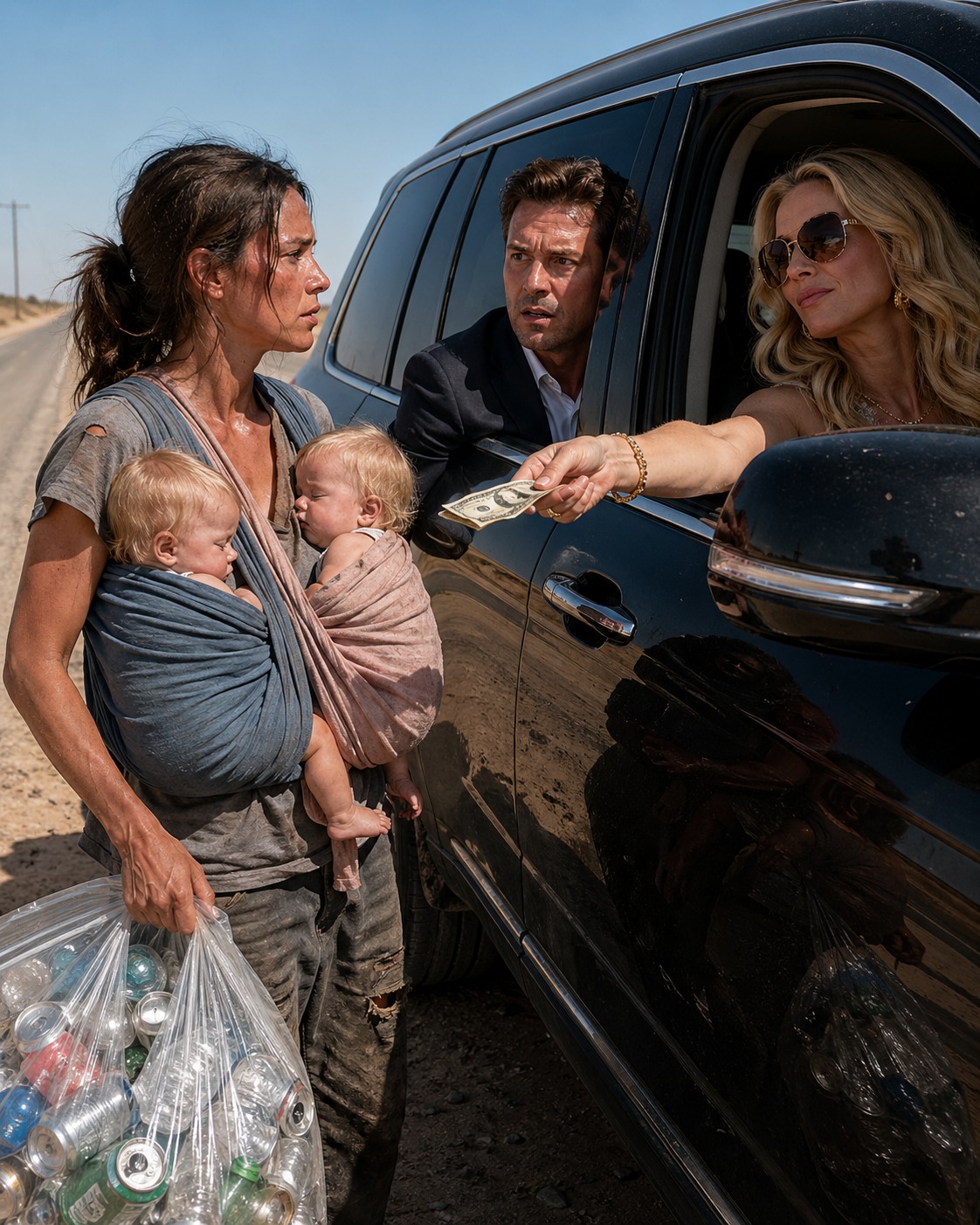
Years ago, you watched Carmen become smaller in your rearview mirror as she walked down a highway carrying your sons and a sack of bottles. That image will never leave you. It should not.
Tonight, you watch her drive away safe, strong, and free.
Not because you rescued her.
Because she survived you.
You look up at the dark sky over Monterrey.
The city glitters like it did the night of the gala, but you are no longer impressed by lights. You have seen how darkness hides behind chandeliers. You have seen how truth can walk barefoot beside a highway and still be more powerful than every diamond in a ballroom.
You get into your car and sit for a moment before starting the engine.
On the passenger seat is a drawing Mateo gave you.
Four stick figures.
Mamá.
Papá.
Mateo.
Leo.
Above them, in uneven letters, he wrote:
Family day.
Your eyes fill.
You place the drawing carefully in a folder, not because it is evidence, but because it is proof.
Not that everything was fixed.
Not that the past disappeared.
Proof that something living can still grow from ground someone tried to poison.
Sunday morning, you arrive early.
Not too early.
Carmen hates that.
You bring chocolate bread, fresh fruit, and the humility to knock instead of walking in.
The door opens.
Carmen stands there with flour on her cheek and a suspicious look.
“You remembered.”
“I was warned.”
Behind her, the boys shout your name.
The house smells like coffee, pancakes, and noise.
Carmen steps aside.
You enter slowly.
Not as the man who owns the room.
Not as the husband returning to his place.
As someone invited.
That difference is everything.
And when the door closes behind you, you understand the final truth.
You did not get your old life back.
You got something more difficult.
A chance to become worthy of the new one.
Read more by clicking the (NEXT »») button below!