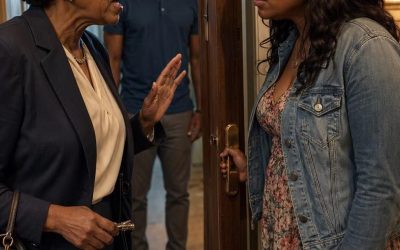
She almost smiles. Almost.
“I heard about Damian’s firm,” she says.
“I imagine a lot of people did.”
The cashier glances between you with the feral curiosity of retail workers who sense narrative. Rebecca shifts her grip on the orchids. “For what it’s worth,” she says quietly, “I didn’t know about the money.”
You look down at Mateo, who has discovered the strap of his stroller and is trying to eat it with deep conviction. Then you look back at her.
“I believe you,” you say.
That seems to surprise her more than accusation would have.
Her face tightens.
You are not cruel. You are simply done protecting other people from the outlines of their choices.
After a moment, she nods. “Yes.”
There is nothing more to say after that.
You pay for the herbs. She buys the orchids. The cashier exhales as if disappointed you did not throw anything. Life, stubbornly uncinematic, moves on.
By the time Mateo turns one, the worst of the legal fallout is behind you.
The settlement is complete. The house is secure. Damian’s supervised visits have expanded into a stable schedule because, to his credit, he did the work. Parenting classes. Counseling. Consistency. He remains flawed in ways that probably have no cure. But Mateo reaches for him now without fear, and that matters more than your bitterness.
Your own life begins, slowly, to widen again.
You return part-time to physical therapy at a new clinic where no one knows the whole story unless they choose to search court filings. Your coworkers know only that you are funny in dry bursts, fiercely good with elderly patients, and not to be trifled with around scheduling. You build a routine. Morning feedings. Workdays. Grocery lists. Pediatric appointments. Nights on the porch once Mateo is asleep, with tea in summer and blankets in fall.
Dignity, you discover, is not one grand reclaimed moment.
It is repetition.
It is paying your own bills from honest money. It is laughing in your own kitchen. It is no longer dreading the sound of a key in the front door because only people you choose are allowed one. It is your son growing up in a house where love may be imperfect, but deceit no longer sets the furniture.
And then, on a cool October morning one year after the divorce hearing, you find yourself back at the courthouse.
Not for litigation. For final custody review paperwork and a modification hearing so routine it barely deserves the name. Mateo is with your mother. Damian arrives on time and alone. No Rebecca. No swagger either. Just a navy suit, tired eyes, and a diaper bag slung over one shoulder because he is coming straight from having had Mateo overnight.
You look at the bag and then at him.
He catches it and gives a rueful half-smile. “I’m a different kind of prepared now.”
“That’s probably overdue.”
Inside, the hearing lasts fifteen minutes. The judge reviews compliance, notes improvement, signs the updated parenting order, and wishes you both luck in tones that suggest she hopes never to see either of you again. When it’s over, you step outside into crisp air and autumn sun.
For a second, neither of you moves.
Then Damian says, “This was supposed to be the day I started over.”
You glance sideways at him. “Was it?”
“That’s what I thought.” He looks out at the courthouse steps, at strangers coming and going with their own folders and futures. “Turns out it was the day I learned I’d been confusing escape with beginning.”
You tuck a loose strand of hair behind your ear. “Most cowards do.”
He accepts that without flinching.
“And you?” he asks after a moment. “What was it for you?”
You think of the rain that morning a year ago. The weight of your pregnant body. Rebecca’s little smile. Damian’s certainty. The sealed file waiting in Michael’s briefcase. The secret you carried then was not only financial evidence. It was knowledge of yourself. Knowledge that you were done begging for decency from people who mistook your patience for blindness.
You smile.
“It was the day I stopped being the woman either of you thought I was.”
That answer seems to settle something.
He nods once. “Yes. It was.”
When you get home, Mateo is in the kitchen in your mother’s arms chewing on a wooden spoon as if he has personally invented joy. He sees you and kicks both feet so hard your mother laughs in surrender. You take him, bury your face in his neck, and breathe him in. Milk, soap, applesauce, sunshine.
The ingredients of a better future are rarely glamorous.
That evening, after your mother leaves and Mateo finally sleeps, you carry a mug of tea onto the porch and sit in the long, blue hush of early fall. The maple out front has started turning. The air smells faintly of leaves and distant chimney smoke. From inside the house comes the soft electronic hiss of the baby monitor, that thin, miraculous tether every parent learns to worship.
You think about the woman you were on the day of the divorce.
Eight months pregnant. Betrayed. Publicly humiliated. Walking into court while the man who broke your marriage held the arm of the woman who helped him do it. On paper, you should have been the defeated one. The discarded wife. The grieving mother-to-be smiling through ruins because pride was all she had left.
But that was never the whole truth.
Because even then, with your body heavy and your heart bruised, you carried something none of them understood. Not just documents. Not just evidence. Not even the child inside you, though he would become the brightest consequence of all.
You carried timing.
You carried patience sharpened into strategy. You carried the final, quiet refusal to let liars narrate your ending for you. While they were busy celebrating what they thought they had stolen, you were already building the moment that would strip the glitter off their victory and expose the cheap machinery underneath.
That was your secret.
And now, a year later, sitting on your own porch with your son asleep in the next room and your name alone on the deed, you understand something even larger.
The smile you wore that day was never about revenge.
It was recognition.
You already knew what they did not. That some losses are really exits. That some humiliations are only bridges disguised as fire. That a woman can walk into a courthouse looking abandoned and still be the only person in the room who truly holds the future.
A breeze stirs the leaves.
Inside, the monitor crackles once, then settles.
You lean back, close your eyes, and let the quiet hold you without emptiness this time. No lies under the floorboards. No second life in the shadows. No need to guess whether love is being diluted elsewhere while you boil pasta and fold onesies and believe the wrong man’s tired mouth.
Just your life.
Hard-won, imperfect, honest.
And more than enough.
THE END
Read more by clicking the (NEXT »») button below!