He stirred while standing on a small stool, tongue slightly out in concentration. Then he asked if you thought people could tell when someone was bad by looking at them. You told him no, not always. Sometimes bad people look tired, charming, attractive, helpful, fun, even wounded. Sometimes the lesson isn’t to become suspicious of everyone. It’s to trust the strange feeling when kindness feels rehearsed and love feels like a performance.
He nodded like he was filing that away for later use.
Then he said, “I think Dad wanted to erase us because we reminded him he was already somebody.”
You turned off the stove and stared at him.
He shrugged, embarrassed by his own insight. “Like… if he started over, he didn’t want proof.”
Children say things therapists spend years helping adults admit.
The plea deal offer came just before trial.
Dana took one. Sergio didn’t.
Men like him often believe the right combination of charm, blame-shifting, and procedural delay can still open a door. So the case moved toward trial, and with it came preparation. Your testimony. Medical experts. phone records. insurance records. the feed store owner. the toxicologist. Detective Bennett. Maribel, eventually, under subpoena but shielded where possible. You hated that she had to be pulled into it more deeply after trying to help quietly, but she said something when you finally met her that stayed with you.
“I kept thinking,” she told you in Spanish, hands clasped tight in her lap, “if it was my son, I would pray someone warned me.”
You hugged her before either of you could cry.
At trial, Sergio watched you like he was still trying to solve for a weakness.
The prosecutor asked you to describe the dinner. Then the collapse. Then the phone call. Then the bathroom. Then the hospital. By the time you got to the sentence He won’t, the courtroom was so quiet you could hear the court reporter’s keys.
Sergio’s attorney tried to suggest confusion from sedation.
You answered clearly.
Tried to suggest marital stress.
You answered clearly.
Tried to imply that maybe you misunderstood what “disappear” meant.
The prosecutor objected before you could laugh in disbelief.
The most devastating witness wasn’t you.
It was Tomás’s pediatric intensivist, who explained exactly how close the dose had come to causing respiratory arrest in a child his size. Clinical voices can be merciless that way. They don’t dramatize. They measure. And measurement, in a courtroom, can sound more brutal than rage.
When the verdict came, you did not cry.
Guilty on the major counts. Guilty on the child-related enhancements. Guilty on conspiracy. Guilty on attempted murder. Dana too, though her cooperation affected sentencing later. Sergio sat absolutely still for about three seconds after the foreperson finished. Then he looked at the jury like they had failed him personally.
That was the final thing he ever gave you.
Proof that even at the end, he saw accountability as betrayal.
Outside the courthouse, cameras waited, but you didn’t stop. Neither did Tomás. He was older by then, taller, his face less round, the softness of childhood already reshaped by things he should never have learned so early. Yet as you walked down the courthouse steps together, he reached for your hand in full view of everyone.
You held it.
Not because he was weak.
Because surviving something like that does not make love less necessary. It makes it sacred.
Years later, the story would become one of those things strangers summarize badly.
The woman poisoned by her husband. The child who survived. The mistress. The trial. The insurance plot. People love clean labels because they save them from thinking too hard about how evil often enters a home wearing routine. But that is not how you remember it.
You remember the smell of cilantro and cooked chicken.
The way your son’s fingers shook against yours on the bathroom floor.
The unknown text.
The ceramic toilet lid in your hands.
The ambulance lights washing the walls red and blue.
The first meal Tomás cooked beside you after everything.
That last part matters most.
Not the courtroom. Not the mugshot. Not the headlines that eventually came when local news picked up the conviction. What matters is that he learned the kitchen was not forever owned by fear. What matters is that you did too.
On the second anniversary of the night Sergio tried to kill you, Tomás asked if he could make dinner himself.
You stood nearby but didn’t hover. He made grilled cheese, tomato soup from a carton, and brownies from a box mix because he said fancy was overrated. You let him set the table, and when he put down the napkins, he paused.
Then he looked up at you and said, “This smells like our house.”
You nearly broke.
Because healing is not loud when it finally comes. It doesn’t announce itself with dramatic music or speeches or one big perfect day. Sometimes it arrives in a bowl of tomato soup. In a child standing safely at the stove. In the moment your body realizes the person across from you wants you full, not gone.
That night, after dishes, after homework, after he went to bed, you stood alone in the kitchen with the overhead light low and your hand on the counter.
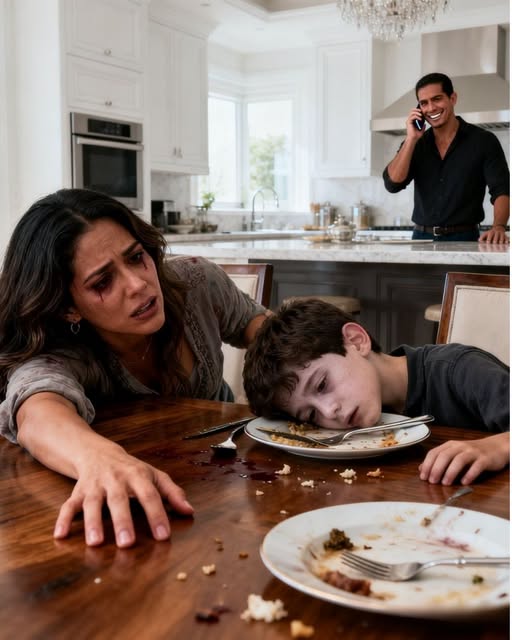
Once, this had been the room where death was plated and served with a smile.
Now it was only a kitchen.
Yours.
And for the first time in a very long while, that was enough.
Read more by clicking the (NEXT »») button below!