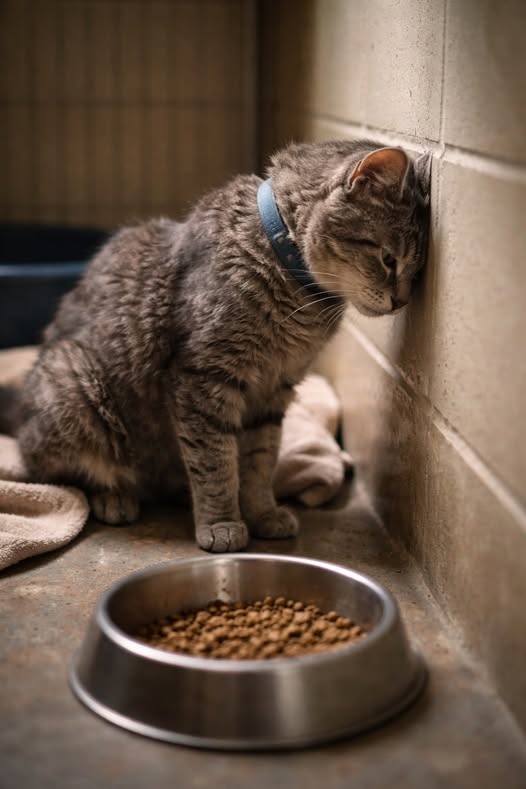
The kind that arrives disguised as responsibility and then starts rearranging your life while you pretend not to notice.
Winston had begun sleeping on my bed.
Not always near me.
Sometimes near the footboard.
Sometimes in the far corner like he wanted the option to leave.
But he stayed in the room.
That counted.
One morning, I woke up to find him standing on my chest, staring into my face with the grim intensity only old cats can pull off.
I laughed so hard I scared him.
Then he stayed anyway.
That counted too.
Cedar House called me two days after the article ran.
Not because they were angry.
At least not officially.
Their director sounded careful.
Professional.
Tired.
She said they had become aware of “community concern.”
That phrase almost made me laugh.
Community concern.
What a polished little coat to throw over heartbreak.
She said they wanted to discuss whether a limited exception might be possible.
I gripped the phone so hard my hand hurt.
“Is Walter okay?” I asked first.
There was a pause.
Then she said, “He has declined.”
I closed my eyes.
“Is he asking for Winston?”
Another pause.
“Yes.”
That yes cut deep.
Because it meant every day I had spent fighting policy had also been a day Walter spent waiting.
We arranged the visit for the following afternoon.
One supervised meeting.
Fifteen minutes.
A private room.
Vaccination records required.
Carrier required.
No roaming.
No public hallway contact.
A list of conditions long enough to make mercy sound like a hostage negotiation.
I agreed to every single one.
I would have agreed to worse.
The next day, I brushed Winston even though he hated it.
I wiped down his carrier.
I tucked Walter’s note into my bag, though I did not know why.
Maybe because it had gotten us there.
Maybe because some things deserve to be present for the ending they started.
Winston seemed uneasy the whole drive.
He cried once at a stoplight.
Just once.
A rough little sound like a hinge in an old door.
I reached through the bars and said his name softly.
He pressed his cheek into my fingers.
The room they gave us was small and sunlit.
Too bright for what it held.
A recliner.
A bed.
Two chairs.
A vase with flowers already starting to bend at the neck.
Walter was thinner than I expected.
That sounds cruel, but there is no kind way to say it.
He looked like the outline of a man who had once been sturdy.
Paper skin.
Hands with veins like blue threads.
Eyes so tired they seemed half underwater.
But when I walked in with the carrier, he sat up.
I have seen joy before.
This was something more fragile and more terrifying.
Like his whole body was afraid to believe what his eyes were seeing.
“Winston?” he whispered.
I opened the carrier.
Winston did not leap out.
Did not rush.
Did not perform the miracle people always want from reunion stories.
He stepped out slowly.
One paw.
Then the next.
Then another.
He stopped halfway between us and lifted his head.
Walter started crying before Winston even reached him.
Not loud.
Not theatrical.
Just tears falling down both sides of a face that had clearly practiced holding them back.
“Oh, buddy,” he said. “Oh, you’re here.”
Winston made a sound I had never heard from him before.
Small.
Broken.
Questioning.
Then he went the rest of the way.
He put his front paws against Walter’s blanket and stretched up.
Walter bent over him with both hands shaking.
The room went absolutely still.
I know people like to use the word sacred too casually.
This was sacred.
Not because it was perfect.
Because it was real enough to hurt.
Walter kept saying his name.
Over and over.
As if every repetition stitched him back to the world for one more second.
Winston pushed his face under Walter’s hand, into his wrist, into the blanket, into every inch of him he could reach.
Then Walter did something that broke me.
He apologized.
To the cat.
“I’m sorry,” he whispered. “I am so sorry. I tried, boy. I tried.”
Anyone who still thinks animals do not understand love has never seen a creature forgive in real time.
Winston climbed into his lap.
Not smoothly.
He was old too.
His back legs slipped once, and I moved instinctively to help, but Walter looked at me with a tiny shake of his head.
Let him.
So I did.
And Winston got there himself.
He turned once, painfully, then settled against Walter’s stomach and chest like he had never been anywhere else.
The sound Walter made when Winston finally lay down on him—
I will hear that sound for the rest of my life.
Relief.
Grief.
Love.
All one thing.
For a while nobody spoke.
Not me.
Not the nurse near the door.
Not Walter.
Only Winston’s breathing.
Walter’s breathing.
And the thin, shaking silence between them.
After several minutes, Walter looked up at me.
“You found him.”
I nodded.
“He found me too,” I said.
Walter smiled at that, and it changed his whole face.
For a moment I could see the man he must have been before illness got its hands on him.
“I knew he’d wait by the door,” he said.
“He did.”
“I knew he’d stop eating.”
I swallowed hard.
“He did.”
Walter closed his eyes.
“After my wife died, he didn’t leave my bed for eight days. Not even for tuna.”
That almost undid me.
Because grief recognizes grief.
Species does not matter.
Body does not matter.
Love leaves the same wreckage everywhere.
Walter told me about his wife, June.
How Winston had been her cat first.
How she used to call him “the gray supervisor” because he watched every chore like he paid the mortgage.
How after she died, Winston began sleeping pressed against Walter’s ribs every night, as if he understood exactly where the emptiness hurt most.
“He saved my life after she was gone,” Walter said.
A lot of people would hear that and think it was a figure of speech.
It was not.
I could tell.
Some creatures keep you alive not by drama, but by routine.
By insisting the bowl still needs filling.
By asking for the curtain to be opened.
By making you get up one more morning because somebody else still expects you to.
That is not small.
That is everything.
Walter asked whether Winston had suffered at the shelter.
I told him the truth, but gently.
I said Winston had been frightened.
Quiet.
Heartbroken.
But once I read the note to him, he came forward.
“Of course he did,” Walter whispered. “He always came for his name.”
Then he laughed softly and said, “He never respected anybody loud.”
Even the nurse smiled at that.
Walter’s energy faded in waves.
I could see it happening.
But he kept his hand on Winston the entire time.
Sometimes stroking.
Sometimes just resting there like contact itself was the point.
At one point, he looked at me and said, “I thought he’d think I threw him away.”
I said, “No.”
And I meant it.
I don’t know whether Winston understood the details.
I know he understood the grief.
And I know the moment he heard Walter’s voice, every piece of him that had been frozen in waiting began to thaw.
That matters.
Walter asked me then, very quietly, whether Winston could stay with me.
Not forever in a legal sense.
He did not talk like that.
He asked it like a dying man asks the only question left that still feels like love.
“Will he be yours?” he said.
That sentence hit harder than any adoption form ever could.
I looked at Winston curled on his lap.
At the old blue collar.
At Walter’s trembling hand.
At the sunlight on the floor that would be gone soon.
“Yes,” I said. “If you want that, yes.”
Walter nodded once.
Then again.
He looked relieved and destroyed at the same time.
“Good,” he whispered. “Because he chooses carefully.”
I laughed through tears.
“So do I.”
Walter asked if I would do one more thing.
He wanted me to take the note out of the collar after he was gone and write the date of their last visit on the back.
Not for him.
“For Winston,” he said.
So the cat would carry the whole story.
So the collar would hold more than abandonment.
So the final chapter would not end with a parking lot.
I promised.
Before I left, Walter bent his head close to Winston and murmured something I could not fully hear.
I only caught the end.
“…until it’s your turn too, and not a day sooner.”
Then he kissed the top of Winston’s head.
I carried Winston back to the car afterward, and for the first time since I had met him, he did not look at the front door behind us.
He looked back once at the window.
Just once.
Then he settled into the carrier and closed his eyes.
Walter died three days later.
Cedar House called in the morning.
The director’s voice was different this time.
Less guarded.
More human.
She said Walter had been peaceful overnight.
She said that after the visit, he ate half a bowl of soup.
She said he slept for hours with what one of the nurses described as “the first easy face we’d seen on him since intake.”
Then she cried.
Actually cried.
Not on purpose.
And in that moment, I understood something important.
A lot of the people inside broken systems are hurting too.
A lot of them know the rules are cruel.
They just live too deep inside them to believe change is possible until somebody outside says, loudly, that it should be.
That does not excuse everything.
But it does explain some of it.
I thanked her for making the visit happen.
She said, “You were right to push.”
That mattered more than she probably knew.
Because when you push against polite cruelty, people love to make you feel hysterical.
Overemotional.
Difficult.
Like caring too much is the embarrassing part.
Sometimes the most necessary person in the room is the one who is willing to be called difficult.
I took Winston outside that evening in my arms.
The air was cool.
The sky had that bruised gold look right before sunset falls apart.
He sat against my chest, heavier now than when I first carried him from the shelter, but still slight enough that I could feel every breath.
I told him Walter was gone.
I do not know whether cats understand death the way we do.
I think they understand absence immediately.
Winston looked toward the street.
Then up at me.
Then he pressed his face under my chin and stayed there.
That night he did something new.
He purred.
Very faint.
More vibration than sound.
A rusty little engine buried deep in his chest, like his body was remembering how.
I cried into the pillow so I would not startle him.
After Walter died, the post kept spreading.
People argued in the comments for weeks.
And honestly?
Good.
Some stories should make people argue.
Not about hate.
Not about cruelty.
About values.
About what kind of society we are building when convenience keeps beating compassion.
About why elders are so often treated like they stop being fully human the moment their needs become slow, emotional, inconvenient, unprofitable, or hard to standardize.
That is the part people don’t like saying out loud.
Everybody talks about respecting the elderly.
Then too often they stick them in systems built around efficiency and call it dignity.
Everybody says pets are family.
Then the second housing, illness, age, cost, or policy gets involved, suddenly that “family” becomes negotiable.
Those two lies crash into each other hardest at the end of life.
And the ones crushed between them are usually the quietest ones in the room.
The old.
The sick.
The grieving.
The animals.
That is why Winston and Walter hit such a nerve.
Not because it was unusual.
Because it was familiar enough to expose us.
A week later, I received a letter from Cedar House.
Inside was a short note from the director.
They were reviewing their animal visitation policy.
Not promising miracles.
Not pretending one story solves everything.
But reviewing it.
Training staff.
Exploring partnerships with local rescue groups and volunteer handlers for end-of-life visits.
I read that letter three times.
Then I sat at my kitchen table and cried again.
Because this is what people get wrong about stories that go viral.
They think the point is attention.
Sometimes the point is pressure.
Sometimes the point is making enough people look at one quiet cruelty that nobody can keep calling it normal.
I framed Walter’s original note.
Not the whole thing.
I made a copy and framed that.
The original went back into Winston’s collar after I added the date of their reunion on the back, exactly like I promised.
I stitched it closed by hand.
Crooked.
Nothing pretty about it.
My fingers are not made for delicate work.
But I wanted Walter’s last request held together by another imperfect human hand.
Winston watched me from the table the whole time.
Judging, probably.
That became more common as he settled in.
He started following me from room to room.
Not clingy.
Just present.
He supervised laundry.
Sat in the bathroom doorway while I brushed my teeth.
Stared at me every time I cried at commercials like he was embarrassed on my behalf.
He discovered the windowsill in the guest room got the best afternoon sun.
He discovered the heating vent near the couch made a noise he did not trust.
He discovered that if he yelled once around five-thirty, I would get up and feed him faster even if he had literally just eaten.
Old age had not dulled his ability to manipulate.
I respected that.
Sometimes at night he still stared at the front door.
But the waiting changed.
It did not feel frantic anymore.
It felt more like remembering.
As if the sharpest edge of the grief had shifted from where is he to I knew him.
That is a painful change.
But it is still a change.
I think a lot of healing looks exactly like that.
Not forgetting.
Not replacing.
Just learning to carry memory without bleeding every time it moves.
A month after Walter died, I got invited to speak at a small community event about senior pets and end-of-life companionship.
I almost said no.
Public speaking makes my skin try to leave my body.
But then I thought about every comment from every person who had written, This happened to my father. My mother. My aunt. Me.
So I went.
I brought Winston.
He hated the carrier.
Hated the folding tables.
Hated the microphone test.
But he tolerated the attention with the grim martyrdom of a cat who knows he has become a symbol against his will.
People lined up afterward to meet him.
Not because he was flashy.
Because he was ordinary.
And that was exactly the point.
He was not some extraordinary internet animal doing tricks.
He was an old gray cat with cloudy eyes, a thinning coat, and a history of loving one person so deeply that losing him nearly shut his body down.
People saw themselves in that.
Or their parents.
Or the part of them terrified of ending life in a room where the most important bond in it gets dismissed as optional.
One woman in her seventies held Winston for less than thirty seconds before she started sobbing.
She said she had surrendered her dog when she moved into assisted living two years earlier.
Nobody there allowed pets over twenty pounds.
The dog was placed elsewhere.
Safe, she said.
Loved, probably.
But not with her.
“He died with strangers,” she whispered.
Then she looked at me with a kind of anger I understood immediately.
“They kept telling me I should be grateful he got a home.”
I am going to say something harsh.
Safety is not always enough.
A clean room is not always enough.
Food is not always enough.
Survival without the one you love can still be a devastating kind of poverty.
No, that does not mean every situation has a perfect solution.
No, it does not mean every facility can allow every animal.
Real life is messier than slogans.
But we have got to stop hiding behind complexity as an excuse for emotional laziness.
Because when people say, “Well, what do you expect them to do?” what they often mean is, “I have decided the suffering involved is acceptable because solving it would inconvenience somebody.”
That is the controversy, isn’t it?
Not whether rules matter.
Of course they do.
It is whether love is allowed to count as a real need.
And apparently, in this country, that still starts fights.
Good.
Let it.
Some fights are worth having if the goal is more mercy.
Months passed.
Winston’s body got stronger, but age never left him.
He still moved slowly in the mornings.
Still took the stairs one deliberate step at a time.
Still had days when he seemed to carry invisible weather inside him.
On those days, I did not push.
I sat beside him in the armchair.
I read aloud sometimes.
Nothing fancy.
Grocery lists.
Newsprint.
Recipes.
The dullest things.
He did not care about the words.
He cared about the voice.
Walter had known that first.
I only learned it because he told me.
There is a lesson in that too.
Sometimes the most loving thing one person can do for another is leave instructions for how to be gentle after they are gone.
Walter did that.
In one note.
In crooked stitching.
In a collar around an old cat’s neck.
He taught a stranger how to reach Winston.
And because of that, Winston reached back.
I think about that whenever people act like small tendernesses don’t matter.
Say the name softly.
Move slower.
Put the water bowl near the chair.
Sit on the floor.
Read the note out loud.
These are tiny things.
Until they save somebody.
Winter came.
Winston became obsessed with the heating blanket and utterly shameless about claiming it.
If I stood up for tea, I lost my spot.
If I tried to move him, he turned into seventeen pounds of moral judgment.
He started sleeping pressed against the back of my knees every night.
Not every other night.
Every night.
The first time I woke up and realized it had become routine, I lay there in the dark and smiled so hard my face hurt.
Because that was the moment I knew he had stopped staying by accident.
He had decided.
I took him to the vet for a checkup around then.
Senior panels.
Joint pain talk.
Kidney numbers.
All the frightening language that starts showing up when love lives long enough.
The vet asked how long I had had him.
I said, “Not long. And completely forever.”
She smiled like she understood exactly what that meant.
On the drive home, Winston yowled the whole way.
His voice was stronger now.
Indignant.
Alive.
I thanked Walter out loud in the car.
Maybe that sounds strange.
I don’t care.
Grief does not end when the living stop hearing you.
Love does not either.
Around the holidays, I hung a stocking for Winston because apparently I had become that person.
My sister laughed at me.
Then bought him a little stuffed mouse and addressed the tag from “Uncle Walter in spirit,” which made both of us cry in my kitchen like idiots.
This is another thing people underestimate.
The dead do not vanish from a house when love keeps making room for them.
Walter stayed.
Not like a ghost.
Like a presence shaped by habit and gratitude and the fact that Winston still carried him everywhere in that blue collar.
Sometimes visitors would ask why I never replaced it with something new.
I always said the same thing.
Because some things are not meant to be upgraded.
Some things are meant to be honored.
Near the one-year mark of Walter’s death, Cedar House invited me back.
They had started a small companion-animal visitation program.
Case by case.
Carefully managed.
Volunteer supported.
Not perfect.
Not huge.
But real.
A start.
The director asked whether I would bring Winston for a quiet visit with a resident who missed her cat.
I looked at Winston asleep in his carrier and laughed softly.
“Do you think he knows he’s become an advocate?” I asked.
She said, “I think he’s the reason half our staff cried through training.”
So we went.
The woman we visited was named Elaine.
She had arthritis in both hands and a voice like tissue paper.
When Winston climbed onto the blanket over her lap, she didn’t say a word for almost a full minute.
She just rested her fingertips on his back and breathed differently.
Longer.
Deeper.
Like part of her had unclenched.
Then she whispered, “I forgot how warm they are.”
That line has stayed with me ever since.
I forgot how warm they are.
What a brutal sentence.
What a whole nation of loneliness packed into six words.
Winston visited three residents that winter.
He never became a cheerful therapy cat.
Let me be clear.
He remained opinionated, suspicious, and absolutely unwilling to perform beyond his terms.
But when somebody sat quietly enough, and their hands trembled for the same reasons Walter’s had, Winston seemed to understand.
He would go to them.
Not always.
But often enough to make the room go silent every time.
Maybe he knew grief by scent.
Maybe he knew stillness.
Maybe love leaves marks we do not have names for.
I only know that he kept choosing the people who looked most like they had run out of being held.
And every time he did, I thought:
How many animals have we separated from people who needed them most because somebody somewhere reduced the whole bond to a sanitation issue?
How many final days have been made colder by a rule written by someone who has never had to survive the night alone?
That is the part I hope people argue about in the comments.
Not whether this story is sad.
Obviously it is.
I hope they argue about priorities.
About what we call essential.
About why compassion is always treated like an extra service instead of core care.
Because here is the truth I learned from an old gray cat with a stitched note in his collar:
At the end of life, love is not a luxury.
It is not a cute add-on.
It is not something to permit only when convenient.
It is medicine of a kind our systems still do not know how to bill for, so they keep pretending it does not count.
But bodies know.
Animals know.
The dying know.
And the rest of us know too, if we are honest.
Winston is sleeping beside me as I write this.
He is older now.
Whiter around the mouth.
Slower to jump.
Faster to complain.
He still likes his name said softly.
He still watches the front door sometimes at sunset.
I let him.
Some waiting is no longer about return.
Some waiting is just another word for remembrance.
Every now and then, I touch the blue collar and feel the folded paper inside.
Walter’s note.
Walter’s date.
Walter’s proof that even when he had almost nothing left to offer, he still offered instructions for kindness.
That is one of the bravest things I have ever seen.
Not grand speeches.
Not dramatic sacrifice.
Just a man running out of time, trying to make sure the one creature who loved him would land in gentle hands.
And a cat, heartbroken enough to stop eating, still finding the strength to trust one more human when he heard love spoken the way he remembered it.
So yes, this is a story about a shelter cat.
But it is also about us.
About what we owe the vulnerable.
About how easy it is to call grief inconvenient when it belongs to someone with less power than us.
About whether we are brave enough to build systems that make room for love instead of treating it like a problem to manage.
That is the part I hope goes viral.
Not just the tears.
Not just the reunion.
The question.
The discomfort.
The comments from people saying, “This happened to my family too.”
The pressure that comes when enough people stop accepting quiet cruelty as normal.
Because Winston did not need fixing.
Walter did not need shame.
What they both needed was the same thing a lot of us need, whether we admit it or not—
to be treated like love is real, and therefore worthy of protection.
If you ask me what changed Winston, I could say time.
Routine.
Safety.
Soft voices.
Warm blankets.
And all of that would be true.
But it would not be the deepest truth.
The deepest truth is that he changed when he learned his goodbye had not been abandonment.
He changed when love became visible again.
Most of us do.
So here is the thing I want left in the comments long after this post sinks out of sight:
Stop calling it just a pet when it is clearly somebody’s last reason to keep reaching for tomorrow.
Stop treating emotional survival like a childish need.
Stop building care around everything except the bonds that make life feel worth staying for.
And if you ever have the chance to be the person who says, “Bring the cat in anyway”—
be that person.
Be difficult.
Be inconvenient.
Be the reason someone gets one more goodbye, one more breath, one more peaceful face before the end.
Some rules protect life.
Some rules protect paperwork.
Learn the difference.
Winston is asleep now with one paw over his nose, the way he used to do in the shelter.
But it means something different tonight.
Back then, he was shutting the world out.
Now he does it because he is warm.
Safe.
Home.
And loved enough to sleep deeply again.
That should not be rare.
But until it isn’t, I’m going to keep telling this story.
Thank you so much for reading this story!
I’d really love to hear your comments and thoughts about this story — your feedback is truly valuable and helps us a lot.
Please leave a comment and share this Facebook post to support the author. Every reaction and review makes a big difference!
This story is a work of fiction created for entertainment and inspirational purposes. While it may draw on real-world themes, all characters, names, and events are imagined. Any resemblance to actual people or situations is purely coincidental.
Read more by clicking the (NEXT »») button below!
ADVERTISEMENT ADVERTISEMENT