I took a breath.
Then I typed.
Not a rant. Not a lecture. Not a “you’re all monsters.”
Just the truth.
“That’s Jax. He’s a contractor. He built our fence yesterday in 95-degree heat. He also lost his home recently and had to place his dog with a foster family because shelters wouldn’t take large dogs. He’s not ‘suspicious.’ He’s human. Please don’t post photos of people working without context.”
I hesitated before hitting send.
Because I knew what would happen.
The internet doesn’t like nuance.
But I posted it anyway.
Within seconds, the replies flooded in.
So you’re paying homeless guys now?
That’s how you get robbed.
He’s playing you.
Good luck explaining that to your insurance.
You’re endangering the neighborhood.
This isn’t a charity zone.
We work hard for what we have.
And then, as if the universe wanted to make this more complicated, another comment appeared:
“Actually… I saw him at the hardware lot last week. He helped an older lady load her car and wouldn’t take money.”
Another:
“He fixed my gate latch two months ago. Didn’t charge me.”
Then a nasty one:
“That’s how scammers build trust.”
Megan read over my shoulder, lips pressed together.
“You see?” she said softly. “This is a war now.”
A war.
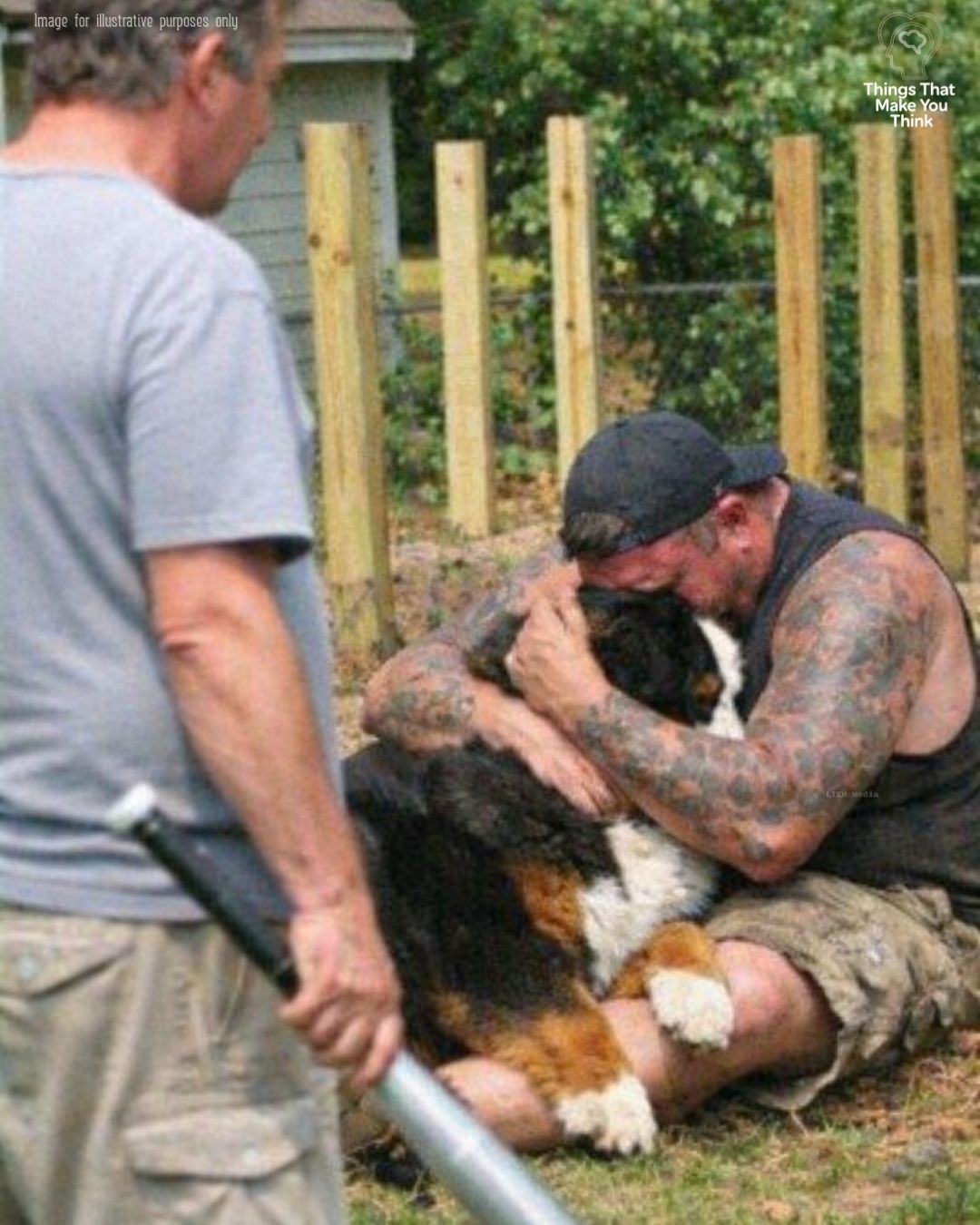
Over a man crying into my dog’s fur.
My phone buzzed again.
This time, it wasn’t a neighbor.
It was a number I didn’t recognize.
I answered anyway.
“Hello?”
A pause, and then a gravelly voice: “It’s Jax.”
My heart clenched. “Hey. You okay?”
Another pause. “I… I didn’t mean to cause trouble.”
“You didn’t,” I said quickly. “People are just—”
“People are people,” Jax cut in, like he’d already made peace with it. “Listen… I tried to cash that check.”
“And?” I asked, already fearing the worst.
“They said I need an account,” he muttered. “And an address.”
Of course.
Of course the system would do this.
You can’t rent without an address.
You can’t cash a check without an address.
You can’t get an address without money.
You can’t get money without an address.
It’s like the world turns into a maze the second you fall down.
“I can meet you,” I said.
Megan’s eyes snapped to mine.
I covered the phone and mouthed: He can’t cash it.
Megan closed her eyes and pinched the bridge of her nose like she was praying for patience.
Then she surprised me.
She nodded once.
Not happily. Not fully. But she nodded.
I spoke into the phone. “Where are you?”
“Parking lot behind the grocery,” Jax said. “Didn’t want to come by your house. Didn’t want—”
“Stay there,” I said. “I’m coming.”
When I hung up, Megan exhaled.
“Okay,” she said. “We’re doing this?”
“I guess we are,” I said.
She looked at Barnaby. “If we get murdered, I’m blaming the dog.”
Barnaby thumped his tail, blissfully unaware he’d just been promoted to accomplice.
The sun was already heating the asphalt when I found Jax’s truck tucked behind the grocery store like it was ashamed to exist.
Jax was sitting in the driver’s seat with the window down, forearm resting on the edge, staring at nothing.
When he saw me, he straightened, like he was bracing for a hit.
I walked up slowly, hands visible, like I was approaching a skittish animal.
“Hey,” I said.
“Hey,” he replied.
Up close, in daylight, he looked even rougher than yesterday. Not scary-rough. Just… worn. Like life had sanded him down.
I held up the check. “They wouldn’t take it?”
He shook his head, jaw tight. “They looked at me like I was trying to pass counterfeit money.”
My stomach twisted.
“They asked for an address,” I said.
He snorted humorlessly. “Yeah. I told them my address has four wheels.”
I leaned against the side of his truck. The metal was hot.
“Okay,” I said. “We’ll figure it out.”
Jax’s eyes flicked up. “You don’t have to—”
“I know,” I said. “But I’m going to anyway.”
He looked away, embarrassed. A man built like a tank looking embarrassed is a weird thing. It makes you realize how fragile pride is. How heavy it gets when you’re trying to carry it alone.
“We can’t put you on our address,” I said carefully, thinking of Megan, thinking of the neighbors, thinking of my son. “But… my friend with the duplex. We can use that address for paperwork. He already agreed, right?”
Jax nodded slowly. “Yeah. He said he’d run the application.”
“And?” I prompted.
Jax hesitated, then muttered, “He said he needs proof I can keep paying after the first and last.”
That wasn’t unreasonable.
But it was also infuriating.
Because Jax was working. He was literally working yesterday. He would be working today if he wasn’t stuck in a parking lot trying to convince someone he deserved to exist.
“I can call him,” I said.
Jax’s shoulders tensed. “Don’t.”
I blinked. “Why not?”
“Because I don’t want you begging for me,” he said, voice low. “I don’t want pity rent.”
That phrase.
Pity rent.
Like dignity was a currency too, and he was running out.
I swallowed. “Okay. Then what do you want.”
He finally looked at me. Really looked.
“I want to finish your fence,” he said. “I want to earn what you gave me. I want to feel like—” His voice cracked, and he cleared his throat hard. “Like I’m not just some charity case you tell stories about.”
That hit me in the gut.
Because I had already started forming the story in my head. The viral version. The version where I’m the good guy. Where Barnaby is the hero. Where Jax is the lesson.
And Jax—without even trying—had just called me out for it.
“I’m sorry,” I said quietly. “I didn’t think of it like that.”
He shrugged, but his eyes were raw. “People always need a villain or a saint. I’m tired of being either.”
Behind us, a shopping cart rattled in the wind like a ghost.
I took a breath. “Let’s do this differently.”
Jax frowned. “How.”
“I’m not going to beg anyone,” I said. “But I can offer you more work. Real work. I can call a buddy who needs help with a deck project. And another who flips old houses. Not a brand, not a company. Just people. Jobs. Pay stubs. Proof.”
Jax stared at me like he didn’t trust hope.
Then he whispered, “Why would you do that.”
I thought of the comment: If you can’t afford rent, don’t have a dog.
I thought of Barnaby’s head on Jax’s shoulder.
I thought of how easy it is to be “responsible” when you’ve never had to choose between love and survival.
“Because you didn’t dump your dog,” I said. “You sacrificed your comfort for him. And that tells me everything I need to know.”
Jax’s throat bobbed.
He nodded once. “Okay.”
Then, quieter: “But there’s something else.”
My stomach tightened again. “What.”
He rubbed his face with his palm. “The foster family… they said I can see King. Today. For a visit.”
My chest warmed instantly. “That’s good.”
Jax’s eyes glistened, and he blinked hard like he hated tears.
“They said,” he continued, “I can’t take him back until I have keys in my hand. They said they’ve been burned before.”
I nodded slowly. I couldn’t even blame them. When you’re the one holding someone’s heart—on four paws—you get cautious.
Jax stared at the steering wheel. “I’m scared he won’t remember me.”
I almost laughed, but it came out like a sob.
“He’ll remember,” I said.
Jax’s jaw clenched. “You don’t know him.”
“No,” I admitted. “But I know dogs.”
He looked at me, skepticism fighting hope.
“You want to come?” he asked, like he didn’t want to ask, like it cost him something.
I hesitated.
This was where most people stop helping.
This was where the story gets neat and clean.
Check written. Lesson learned. End credits.
But life doesn’t end when the comment section starts.
I pictured Megan. I pictured my son. I pictured the neighborhood app exploding.
Then I pictured Jax sitting alone in that truck after seeing King and having to give him back again.
“I’ll come,” I said.
The foster home was in a different part of town—older streets, smaller houses, less polished. The kind of place people call “sketchy” when they really mean “not mine.”
Jax parked at the curb and sat there for a moment, hands gripping the wheel.
“You okay?” I asked.
He exhaled. “No.”
Fair.
We walked up the cracked sidewalk toward a small house with a chain-link fence. Wind chimes clinked softly on the porch.
A woman opened the door before we even knocked. Middle-aged, kind eyes, tired smile. She didn’t look like a saint. She looked like someone who had seen too much and kept going anyway.
“You must be Jax,” she said gently.
Jax nodded, throat tight.
“And you are?” She looked at me.
“A friend,” I said quickly. “Just… here.”
She studied me for a second, then stepped aside. “Okay. Come on.”
Inside smelled like lemon cleaner and dog.
Not one dog.
Many.
A chorus of nails clicking on linoleum. The soft whine of excitement. A bark from a back room.
Jax froze like he’d been hit.
“You have a lot,” he murmured.
“We do what we can,” the woman said. “No names on paperwork here. Just ‘the network.’ Safer for everyone.”
Smart.
She led us down a hallway and opened a door.
And there he was.
King.
Smaller than I expected. Thick chest, graying muzzle, eyes that looked older than his body. He stood up slowly, like his joints didn’t love mornings anymore.
For half a second, he just stared.
Jax didn’t move.
He didn’t rush.
He didn’t make a big dramatic noise.
He just dropped to one knee like his legs had decided on their own.
“Hey, buddy,” he whispered.
King’s ears twitched.
His nose lifted.
And then—like someone flipped a switch—King lunged forward with a deep, breathy sound that wasn’t a bark and wasn’t a cry, and he slammed into Jax’s chest so hard it almost knocked him backward.
Jax caught him, arms wrapping around that dog like he was trying to fuse their bones together.
King’s tail whipped the air. His whole body shook. He licked Jax’s face like he was erasing three months of grief with saliva.
And Jax—
Jax made a sound I can’t describe without making you uncomfortable.
A grown man’s sound.
The kind you only make when something you loved comes back from the dead.
I stood in the doorway, throat burning.
The foster woman watched, arms crossed, expression soft.
“You see why we’re strict,” she murmured to me.
I nodded, unable to speak.
Because this wasn’t a pet.
This was a lifeline.
Jax pressed his forehead to King’s, eyes shut.
“I’m trying,” he whispered into the dog’s fur. “I’m trying so hard.”
King whined and leaned into him like he understood every word.
I felt something shift in my chest.
Not inspiration. Not some fluffy “faith in humanity restored” nonsense.
Something sharper.
Anger.
Anger that we live in a world where a man has to prove he deserves his own dog.
Anger that we accept rent hikes like weather, like it’s just a season we can’t control.
Anger that the comment section had more sympathy for trimmed lawns than for a living creature who loved one person on this earth more than anything.
After a few minutes, the foster woman cleared her throat gently.
“Jax,” she said. “We need to talk about next steps.”
Jax stiffened, still holding King. “Okay.”
“You get keys,” she said. “You show us the yard is secure. You show us you’re stable. Then we sign him back over. No drama. No judgment. Just… safety.”
Jax nodded, jaw tight. “I get it.”
“And,” she added, voice firm but not cruel, “you keep doing what you’re doing. Working. Showing up. That matters.”
Jax swallowed hard. “Yeah.”
King licked his chin like he was sealing the deal.
I stepped forward finally. “He’ll get keys,” I said.
The foster woman looked at me.
I expected suspicion.
Instead, she just nodded like she’d seen this story play out a hundred different ways.
“Then we’ll be here,” she said.
When we got back outside, Jax leaned against the porch railing, breathing like he’d run a marathon.
I didn’t talk. I didn’t try to wrap it in a moral bow.
Some moments don’t need commentary.
Jax wiped his face with his sleeve. “He remembered.”
“Yeah,” I said. “He did.”
Jax looked at me, eyes raw. “I can’t lose him again.”
I nodded.
And that’s when my phone buzzed again.
Another notification from the community app.
I glanced down.
A new post had been added under the photo of Jax.
Someone had tagged it with a warning label.
“UPDATE: Homeowner admits he’s homeless. This is a safety issue.”
And underneath it—
A comment from someone I recognized. A guy who always smiles too wide at block parties. The kind of man who calls himself “a straight shooter.”
He wrote:
“This is what happens when people reward bad choices. Personal responsibility matters.”
I stared at the words.
Reward bad choices.
As if losing an apartment was a moral failure.
As if loving a dog while poor was a crime.
As if grief was a scam.
Jax saw my face. “What.”
I turned the screen toward him.
He read it.
His expression didn’t change much.
But his eyes did.
They got colder.
Not angry.
Just… tired.
“See?” he said quietly. “This is why I don’t want to be your story.”
My chest tightened.
“Jax,” I said, voice low, “you’re not my story.”
He snorted. “Everyone makes you into one.”
I thought about my bat.
About how quickly I’d built a villain in my mind.
About how my neighbors were doing the same thing.
The fence we build isn’t always wood.
Sometimes it’s words.
Sometimes it’s assumptions.
Sometimes it’s a comment typed with one finger while holding coffee in the other.
I looked at Jax and made a decision right there, on that porch, in that imperfect neighborhood, under that hot American sun.
“Then let’s give them a different story,” I said.
Jax frowned. “How.”
“By letting them meet you,” I said. “Not the rumor version. The real version.”
Jax stared like I’d suggested walking into a fire.
“I don’t do crowds,” he muttered.
“You built fences for a living,” I said. “You can handle a few nosy people.”
He almost smiled at that.
Almost.
“Look,” I continued, “they can argue online all day. They will. People love arguing. But in real life? Most folks get quiet when they have to look you in the eyes.”
Jax’s jaw clenched. “Or they call the cops.”
I held his gaze. “Not if I’m standing next to you.”
For a long moment, the only sound was King’s nails tapping inside the house.
Then Jax exhaled.
“Okay,” he said. “But I’m not begging.”
“Good,” I said. “Neither am I.”
That evening, I did something that made Megan stare at me like I’d lost my mind.
I invited people over.
Not a big party. Not some staged “look how good I am” circus.
Just… an open invitation in the community app.
“If you’re worried about the contractor who worked at my house, you’re welcome to meet him tomorrow at 6 p.m. in my backyard. No speeches. No pressure. Just a conversation.”
Megan read it and then looked at me slowly.
“You realize,” she said, “this could go very badly.”
“I know,” I admitted.
“And you still want to do it.”
“Yes.”
She stared at me for a long moment, then sighed.
“Okay,” she said. “If we’re doing this… we’re doing it right.”
I blinked. “What does that mean.”
It meant Megan made lemonade.
It meant Megan put out chips.
It meant Megan moved the patio chairs into a circle like we were hosting group therapy for suburban guilt.
And it meant Megan, who had been terrified that morning, stood in our kitchen and said something that stunned me:
“I want to meet the man I’m apparently fighting with online.”
I laughed, surprised. “You’ve been commenting?”
She shot me a look. “Not under my real name.”
Of course.
At 5:58 p.m. the next day, my backyard looked normal.
Fence posts. Fresh boards. Barnaby prancing like he was the host of a talk show.
At 5:59, I thought nobody would come.
At 6:00, the first couple showed up.
At 6:05, three more.
By 6:15, there were over a dozen people standing awkwardly near the patio like they didn’t know whether to sip lemonade or clutch their judgment.
Jax arrived at 6:17.
He didn’t come in the truck.
He walked.
Like he didn’t want the truck to speak for him.
He wore a plain dark shirt, sleeves still showing the ink, but the skulls looked less like warning signs and more like… drawings. Like someone’s past written on skin.
He stopped at the edge of the yard, eyes scanning faces.
Barnaby trotted up to him immediately and leaned his full weight into Jax’s thigh like, You’re safe here.
That dog has no idea how powerful he is.
People went quiet.
Not because they were intimidated.
Because they were embarrassed.
Because it’s easy to label someone “suspicious” when they’re a blurry photo on a screen.
It’s harder when they’re standing ten feet away, shoulders tense, hands empty, eyes honest.
Megan stepped forward.
“Hi,” she said, voice calm, steady. “I’m Megan.”
Jax blinked. “Ma’am.”
“Don’t ‘ma’am’ me,” Megan said, and a few people chuckled nervously. “We’re not doing that. We’re just people.”
Jax swallowed. “Okay.”
Megan nodded toward Barnaby. “He likes you.”
Jax looked down at Barnaby, who was basically trying to crawl into his lap while standing. “Yeah,” he murmured. “He does.”
And that’s when it happened.
The thing I didn’t plan.
A guy in the back—Mr. “straight shooter”—cleared his throat.
“So,” he said loudly, like he needed an audience, “are we supposed to clap because someone made bad choices and got a handout?”
A ripple went through the group.
There it was.
The comment section, now with a face.
My blood rose.
But before I could speak, Jax did something I didn’t expect.
He didn’t get angry.
He didn’t puff up.
He didn’t threaten.
He just nodded slowly.
“You’re not wrong,” he said.
The man blinked, thrown off. “Excuse me?”
Jax looked him right in the eyes. “I made bad choices,” he said. “I’ve made plenty. Some cost me years. Some cost me people. Some cost me my dog.”
The yard went silent. Even Barnaby paused like he was listening.
Jax continued, voice low, steady. “But you know what else? I made a good choice last Tuesday.”
He swallowed hard.
“I gave up the one thing that kept me alive,” he said, “because I couldn’t give him a safe place anymore. I didn’t dump him. I didn’t abandon him. I handed him to strangers and walked away while he cried. That was my ‘personal responsibility.’”
You could hear someone inhale sharply.
Jax glanced around at the faces—some hard, some soft, some confused.
“I’m not asking you to like me,” he said. “I’m not asking you to trust me. I’m not asking you for money.”
His eyes flicked briefly to me and Megan.
“I didn’t ask them either,” he added.
Then he looked back at the man.
“But don’t you dare call love a bad choice,” Jax said. “Because if loving a dog when you’re broke is a crime… then a lot of you are one layoff away from being criminals.”
That line landed like a punch.
People shifted uncomfortably.
Because he was right.
Nobody wants to admit how thin the line is.
The man scoffed, but his voice wasn’t as strong. “So what, we’re supposed to just—”
A woman cut in. Older, silver hair, trembling hands. “My son lost his job last year,” she said quietly. “He lived in his car for two months. You didn’t know. Because he showered at the gym and wore clean clothes to interviews.”
She looked around, eyes wet.
“You would’ve called him suspicious too,” she whispered.
The yard stayed quiet.
Megan’s hand found mine.
And in that moment, I realized something that made my throat tighten.
This was controversial.
Not because it was political.
Because it was personal.
Because it forced people to choose what they believe:
That struggle is a character flaw.
Or that it’s just… life.
After people left, the backyard looked like it had after a storm—empty cups, chairs out of place, grass flattened.
Jax stood by the fence, staring at the fresh boards he’d built.
“You finish it,” I said softly.
He nodded. “Yeah. Had to.”
Megan approached him slowly. “About the check,” she began.
Jax stiffened.
Megan raised a hand. “Not to take it back,” she said quickly. “To clarify something.”
Jax’s brow furrowed.
Megan looked him straight in the eye. “This isn’t charity,” she said. “This is a bridge. You cross it. And then you build your own.”
Jax’s throat bobbed.
He nodded once. “Yes, ma’am.”
Megan sighed. “I told you not to ‘ma’am’ me.”
Jax let out a rough laugh.
It wasn’t big.
But it was real.
Then he looked at me.
“Your neighbors,” he said, “they still think I’m dangerous.”
“Some do,” I admitted.
“And some think you’re stupid,” he added.
I nodded. “Probably.”
He stared at the fence. “Why’d you do it,” he asked quietly, “even after your wife got mad. Even after the app. Even after all that.”
I looked down at Barnaby, who was pressed against Jax’s leg like a loyal shadow.
“Because yesterday,” I said, “I saw a man in my backyard who didn’t need a lecture.”
I swallowed.
“He needed a dog,” I finished. “And we had one.”
Jax’s eyes shone again, but he blinked it back.
“I get keys tomorrow,” he said, voice rough. “The duplex guy… he said he’ll give me a chance. Month to month. Yard’s fenced.”
My chest loosened. “You serious?”
Jax nodded. “Yeah.”
“And King?” I asked.
Jax looked out at the fence, like he could already see the dog in that yard.
“I pick him up this weekend,” he whispered.
Megan exhaled behind me like she’d been holding her breath for days.
Jax turned to leave, then paused.
He looked back at me and Megan.
“I’m gonna pay you back,” he said firmly.
Megan started to speak, but Jax cut her off.
“Not with money,” he said. “With work. With showing up. With being the kind of neighbor you won’t regret helping.”
He nodded at Barnaby. “That dog… he saved me.”
Barnaby wagged, smug as ever.
And then Jax walked out through the gate like a man carrying something fragile and precious—hope.
That night, after our son went to bed, Megan and I sat at the kitchen table where it all started.
She ran her finger over a water ring on the wood.
“Do you think,” she asked quietly, “we were naive?”
I stared at the empty chair where Jax had sat.
“Maybe,” I said.
Megan nodded slowly. “Do you think it was worth it?”
I thought about the community app. The comments. The fear. The judgment.
I thought about King’s tail slamming against Jax’s leg.
About Jax saying don’t call love a bad choice.
And I thought about how fast people decide who deserves comfort.
I looked at Megan.
“I don’t know,” I said honestly. “But I know this—”
I swallowed hard.
“If helping someone who’s fallen makes people angry,” I said, “maybe the problem isn’t the help.”
Megan stared at me for a long moment.
Then she nodded once.
And we sat there in the quiet, listening to Barnaby breathe, feeling the fence outside like a line drawn through our lives.
Because the truth is—
We don’t just build fences to keep people out.
We build them to keep ourselves from seeing what’s on the other side.
And Barnaby?
Barnaby didn’t care about either side.
He just cared about the heart.
So here’s the question that’s been gnawing at me since that bat day in my backyard:
If a man you were scared of sat on your grass and cried into your dog—would you close the door… or would you open it?
Thank you so much for reading this story!
I’d really love to hear your comments and thoughts about this story — your feedback is truly valuable and helps us a lot.
Please leave a comment and share this Facebook post to support the author. Every reaction and review makes a big difference!
This story is a work of fiction created for entertainment and inspirational purposes. While it may draw on real-world themes, all characters, names, and events are imagined. Any resemblance to actual people or situations is purely coincidenta
Read more by clicking the (NEXT »») button below!
ADVERTISEMENT ADVERTISEMENT