The old line I had clung to for months—that dangerous things look dangerous—collapsed a little more.
Because the real danger on our street had not been a scarred dog or a quiet veteran with insomnia.
It had been a neighborhood full of comfortable people, myself included, who believed appearances were not just clues but verdicts.
Summer settled in heavy after that.
The oaks thickened. Lawnmowers started up every Saturday. Children biked in swerving packs from one end of the block to the other. Sprinklers ticked across front yards like metronomes.
And still the campaign against David did not ease.
If anything, it became more polished.
Polished cruelty is harder to fight than blatant cruelty because it comes dressed for dinner.
Instead of anonymous notes, there were formal emails.
Instead of gossip, there were “community safety concerns.”
Instead of saying they did not want a scarred pitbull and a tattooed veteran on their street, people talked about preserving a “family-friendly atmosphere.”
Language, I realized, is one of the most elegant weapons we ever invented. It lets people wound while pretending they’re arranging flowers.
Then one morning I saw something that made me grip my porch railing hard enough to hurt.
Someone had spray-painted MONSTER DOG GO HOME across David’s side fence.
The black letters dripped in the sun like fresh oil.
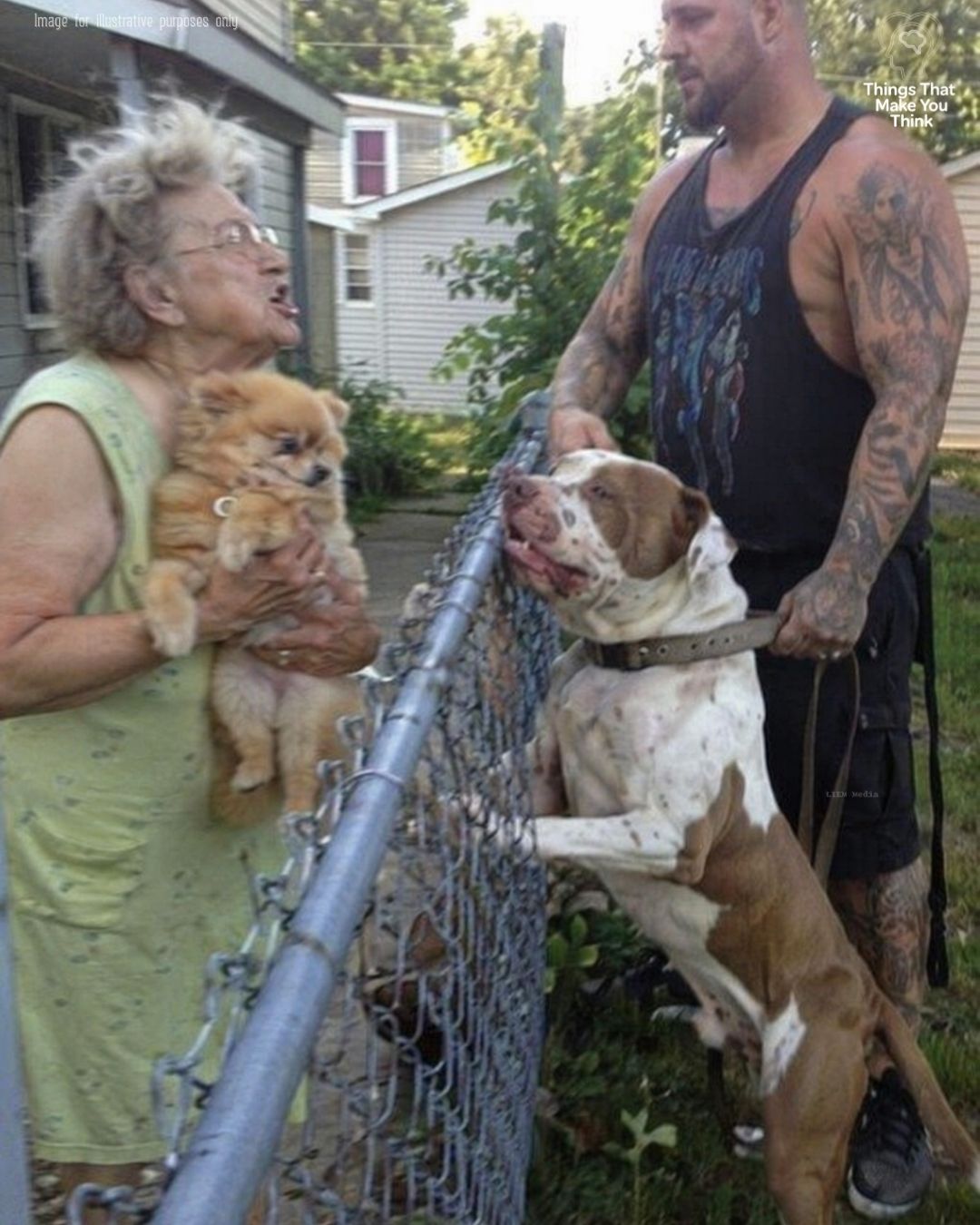
David was already out there with a can of primer by the time I shuffled across the grass. He stood in an old gray T-shirt, paint roller in one hand, jaw set so tightly the muscle ticked in his cheek. Samson sat nearby on leash, perfectly still.
Barnaby barked from my arms. Not his fierce bark. His upset one.
I stopped a few feet away because I suddenly did not know what an apology looks like when the thing you helped start grows teeth of its own.
“David—”
“I know,” he said.
“I didn’t—”
“I know that too.”
He rolled white paint over the O in MONSTER until it vanished.
The silence between us pressed in.
Then I heard myself say, “I lit the first match.”
He stopped rolling.
I hated the rawness in my own voice, but I kept going.
“I may not have sprayed that fence. I may not have written those posts. But I made it easier. I taught people how to talk about you. I made my fear sound respectable, and now they’re repeating it like scripture.”
David leaned the roller tray down on the grass and looked at me with something I still cannot fully name. Not forgiveness. Not exactly. More like grief without surprise.
“That’s how it works,” he said. “Most hate doesn’t start with the loudest people. It starts with the respectable ones giving it a nicer vocabulary.”
I put one hand over my mouth.
Because it was true.
And because I had been one of the respectable ones.
That evening I did not sleep.
Not because of weather. Not because of old age. Because once you understand the size of your own failure, rest becomes a difficult privilege.
So I made another foolish decision.
I volunteered to speak at the neighborhood summer gathering.
The event happened every year in late July at the little common green by the mail kiosks. Foldout tables. Potluck casseroles. Paper flags. Lemonade sweating in plastic dispensers. Children with chalk-stained knees and adults pretending not to notice which marriages were strained and which teenagers had started lying.
A perfect little portrait of civilized suburbia.
This year the community board had attached a “public safety listening session” to the end of the gathering, because of course they had. It is very American, I think, to hide conflict behind potato salad and call it togetherness.
David wanted no part of it.
“Absolutely not,” he said when I told him.
“Absolutely yes.”
“I am not turning my life into a demonstration.”
“It already is one.”
He rubbed both hands over his face.
“I hate when you make sense.”
“That’s because I’ve had decades of practice being unbearable.”
He did laugh then, but the tension in him never fully left.
I spent three days preparing remarks I would later abandon. I ironed a blouse I had not worn since my husband’s memorial. I made deviled eggs because people listen to a woman holding deviled eggs with more goodwill than they do to one holding a manifesto.
When the afternoon arrived, the heat sat over the neighborhood like wet wool. The grass smelled baked. Children screamed through the sprinkler arc set up near the sidewalk. Someone had strung cheap red-and-white bunting around the pavilion, though it kept sagging in the humidity.
David came late and stood at the far edge of the green under a sycamore tree, one hand on Samson’s leash, the other in his pocket. Barnaby, traitor that he was, could hardly contain himself when he spotted them.
So there I was, old bones and all, half-running across the grass after my tiny blind dog while a hundred eyes watched.
Barnaby made it to Samson first and bumped directly into one of his front legs. Samson looked down, patient as ever, and lowered himself onto the grass so Barnaby could climb over him like a monarch reclaiming a throne.
A ripple went through the crowd.
People always say they only care about danger. What they really care about is whether the picture makes sense to them. A tiny fluffy old dog draped over a pitbull short-circuits something in their brains. It forces complexity where they prefer symbols.
I took that as a good omen.
I should have known better.
The board chairwoman called everyone together after the food had been picked over and the children were sticky with sugar. Folding chairs scraped. Paper plates rustled. The usual speeches began—thank-yous, announcements, reminders about trash pickup and drainage maintenance.
Then the floor was opened for comments.
I stood.
This time there was no shock. Only anticipation.
I set my untouched plate on the table beside me and faced my neighbors.
“I know some of you think I’ve lost my judgment,” I began. “That old age, grief, loneliness, or sentiment has made me careless. I understand why you think that. It is easier to assume I have changed because I’m confused than because I finally saw something clearly.”
Nobody moved.
“When I first complained about David and Samson, many of you agreed with me. Some of you encouraged me. Some of you thanked me for saying what you didn’t want to say out loud. So let me say this plainly: if you believed me then, you should hear me now.”
The air felt electrified.
“I was wrong then. And some of you were relieved to borrow my fear because it sounded respectable in my voice.”
That made people stir.
Melissa looked offended. Mr. Becker went rigid. Mrs. Hensley stared as if she’d been slapped with a lace glove.
I did not stop.
“We say we honor service, but only when it comes packaged in a parade or a speech. We say we support rescue animals, but only the pretty ones. We say we care about mental health, but only when it doesn’t live next door or wake up sweating in the middle of the night or need a dog bigger than our comfort level to get through fireworks and storms.”
A man in the back muttered, “That’s not fair.”
“No,” I replied, my voice rising. “What’s not fair is praising bravery in theory and punishing it in person.”
The silence after that felt huge.
I could see it in their faces then: not conviction, not yet, but discomfort. That precious, necessary beginning.
And perhaps, if the story had been simple, that might have been enough.
But life rarely waits for speeches to end before throwing its own.
At the far end of the pavilion, somebody started shouting.
At first I thought children were roughhousing.
Then I heard the tone.
Not laughter. Panic.
People turned all at once. Chairs tipped. The crowd surged toward the picnic tables where Frank Hensley—Mrs. Hensley’s husband, a broad man who spent most community meetings discussing drainage as if it were a moral issue—had gone an alarming shade of red.
He was on his feet but only barely, both hands clamped to his throat.
For one suspended second, nobody moved correctly.
That is what emergencies do to untrained crowds. They strip us down to noise.
Someone screamed for water. Someone shouted to call 911. Somebody else kept saying “Oh my God” as if repetition were a plan.
David was already running.
He crossed the grass with the speed of pure instinct, dropping Samson’s leash into my hand as he went.
The crowd hesitated when they saw who it was.
Even then.
Even with a man choking in front of them, I saw it. That tiny hitch of uncertainty because the rescuer did not look soft enough, harmless enough, suburban enough.
David got behind Frank, wrapped both arms around him, and gave one hard upward thrust.
Nothing.
Another.
A chunk of food flew onto the table.
Frank collapsed sideways into a chair, gasping like a man dragged up from deep water.
The entire green went silent except for Frank’s awful, desperate sucking breaths.
David dropped to one knee beside him, checking pulse, asking calm direct questions, telling someone—finally, specifically—to keep the emergency call active in case they still needed evaluation. His voice was clipped and steady in a way that made every other adult there seem suddenly ornamental.
And through it all, Samson did not lunge, bark, strain, or create chaos.
He stood beside me, body taut but controlled, while Barnaby pressed himself against his leg and trembled.
The paramedics arrived seven minutes later. Seven long, hot minutes during which half the neighborhood stared at David as if seeing him for the first time and the other half stared as if looking for some way not to.
That, more than anything, may have been the truest moment of the day.
Not gratitude.
Conflict.
Because reality had walked right across their assumptions in broad daylight and many of them still did not know what to do with it.
Mrs. Hensley was crying when the paramedics loaded Frank onto the stretcher for observation. She caught David’s arm with both hands and whispered something I did not hear.
He nodded once and stepped back.
No victory. No performance. No swelling music, if life had any sense of theater about it.
Just competence, then distance.
By the time the ambulance left, the summer gathering had dissolved into clumps of stunned conversation. Children were pulled close. Paper plates blew across the grass. A sprinkler still ticked pointlessly at the edge of the green.
David came back to retrieve Samson’s leash from my hand.
“We’re leaving,” he said quietly.
I stared at him. “Now?”
“Yes.”
“David, after that—”
“Especially after that.”
I followed him a few steps away from the others.
“You saved him.”
He looked toward the road where the ambulance had vanished.
“I did my job.”
“You’re retired.”
He finally met my eyes.
“That part of me isn’t.”
Then he took Samson and walked home.
That night the neighborhood page exploded.
Words like hero and miracle were flung around by some. Others immediately insisted the incident had nothing to do with the broader safety concerns. A few even claimed David’s presence near the food tables with such a large dog had “contributed to the chaos,” which was such a breathtaking act of moral acrobatics that I actually laughed when I read it.
Not because it was funny.
Because hypocrisy, when cornered, becomes absurd.
The next board meeting was scheduled for the following Tuesday. Cedar Glen’s representative would be there. So would the chairwoman. So, apparently, would half the neighborhood.
David told me he wasn’t coming.
“I’m done putting my life on display for strangers,” he said.
I understood that.
I also understood something else.
“If you don’t come,” I said, “they will discuss you like a filing cabinet with teeth.”
He gave me a tired look. “That may still happen if I do come.”
“Then at least let them do it while facing you.”
He was silent.
Then he surprised me.
“I’ll come,” he said. “On one condition.”
“What?”
“You stop trying to save me by yourself.”
I opened my mouth to protest.
He shook his head. “No. Hear me. You don’t get to carry the whole story because you feel responsible for its beginning. Other people know the truth now too. Let them risk something.”
I sat with that for a long moment.
He was right, which was becoming an increasingly irritating habit of his.
So Tuesday arrived, and for the first time since this whole miserable saga had begun, the room was not divided between one loud old woman and a silent man at the center of speculation.
It was full of witnesses.
The shelter director came.
The mail carrier came.
Luis and his mother came.
The middle-school girl with the purple ink statement came clutching a library book to her chest.
Even Mrs. Hensley came, pale and stiff beside her husband, who looked embarrassed to be alive in public.
When the leasing representative from Cedar Glen reviewed the “pattern of resident concern,” the board chairwoman’s tone remained procedural, but the current in the room had changed.
Because now every complaint had a face beside it and a contradiction standing up behind it.
I rose first.
“I am here to state for the record,” I said, “that the original complaints I filed were based on fear and assumptions, not verified misconduct. I ask that they be reclassified accordingly.”
A ripple.
Then Mrs. Hensley stood.
Her voice shook, but she stood.
“My husband would be dead if not for David.”
Frank stood too, one hand on the back of his chair. “I owe him my life,” he said gruffly. “And that dog never moved an inch wrong.”
After that, the dam broke.
The shelter director spoke about Samson’s documented temperament and David’s volunteer work.
The mail carrier spoke.
Luis’s mother spoke.
The girl with the library book took a breath that seemed too big for her small chest and said, “He makes scary dogs feel less scary because he is kind to them first.”
I nearly cried then.
Not because it was eloquent, though it was.
Because children often see the moral center of a thing before adults bury it under policy.
When it was finally David’s turn, he stood with his hands at his sides and said the shortest thing of all.
“I’m not asking anyone to like me,” he said. “I’m asking to be judged by what I do, not what you think I look like.”
That should not have been a radical statement.
And yet it landed like one.
The Cedar Glen representative shuffled papers, retreated into phrases about ongoing review and updated information and the need to consider all resident input. Corporate cowardice, translated into bureaucratic fog.
But fog is weaker when enough people insist on naming what’s behind it.
By the end of the meeting, the non-renewal decision was “under reconsideration pending review of corrected records and additional community testimony.”
It was not justice. Not yet.
But it was retreat.
And sometimes retreat is the first honest thing power does.
Outside, the evening air was soft with cut grass and distant barbecue smoke. People lingered in awkward little groups, suddenly unsure how to resume the easy social geometry that had existed before the room forced them to confront themselves.
Melissa approached me in the parking lot.
For a moment I braced for more caution dressed as virtue.
Instead she looked down at her hands.
“I still worry about my boys,” she admitted.
“That’s your job.”
She nodded. “But I think… maybe I’ve been teaching them the wrong kind of caution.”
That was not an apology exactly.
But it was closer to one than many adults ever get.
I surprised both of us by touching her arm.
“Fear is a poor teacher,” I said. “It makes neat little lessons out of human beings.”
She swallowed hard and walked away.
Two weeks later, Cedar Glen sent a revised notice. David’s lease would be renewed.
The official language cited updated community review, corrected documentation, and absence of verified nuisance violations. It was dry as toast. Bloodless.
I suppose that is fitting.
Institutions rarely blush when they back down.
David read the letter on my porch while Samson snored under the swing and Barnaby slept on Samson’s ribcage like he owned the world.
“Well?” I asked.
David folded the paper. “Looks like we’re staying.”
The “we” in that sentence did something tender and almost painful inside me.
I sat back in my chair and let out a breath I felt I’d been holding for months.
Across the street, Mrs. Hensley waved. Not extravagantly. Just once. Small, but there.
Down the block, Luis biked past and called Samson’s name.
On the sidewalk, two little girls dragging chalk buckets stopped to ask if they could pet the “big one first.”
The neighborhood had not transformed into paradise.
Some people remained stiff. Some crossed the street anyway. Some probably always would. Prejudice does not evaporate because it got embarrassed in public once.
But something had shifted.
The spell of certainty was broken.
And once people are forced to admit they can be wrong about who is dangerous and who is safe, they have a harder time returning to their smug little myths.
As for me, I kept going to the shelter.
I kept speaking at meetings.
I kept telling the truth about what I had done, even when it made me look terrible, because I had finally learned something old age should have taught me sooner: shame is useless if all you do with it is hide.
Use it.
Let it make you braver than your pride.
By early fall, David and I had fallen into a rhythm that would have amused my late husband and scandalized the old version of me. Morning coffee on my porch. Shared grocery trips. Quiet Sunday afternoons when David fixed things around both houses while I pretended not to notice he was doing labor I could not repay. Barnaby and Samson together always, the tiny and the enormous, the vulnerable and the misjudged, each making nonsense of the story strangers would have assigned them.
Sometimes, when the light hit just right in the late afternoon, I would sit there and think about the woman I had been six months earlier.
The woman glaring through lace curtains.
The woman writing anonymous notes.
The woman convinced she was the guardian of decency.
I do not hate her. That may be the hardest part to admit.
I pity her.
Because she was lonely. And frightened. And so used to mistaking control for safety that when something unfamiliar moved in next door, she reached for the only power she thought she still had—suspicion.
That does not excuse her.
It explains her.
And if I am telling this story at all, it is because explanation matters.
Not to soften wrongdoing.
To stop repeating it.
People love to imagine cruelty as the work of monsters. It comforts them. Monsters are rare. Monsters are easy to condemn. Monsters are nothing like us.
But most harm is done by ordinary people with neat yards and decent intentions and very selective compassion.
By people who tell themselves they’re just asking questions.
By people who call exclusion caution.
By people who would never say anything ugly outright, but who sign the petition, forward the rumor, nod in the meeting, preserve the atmosphere.
By people like me.
That is the uncomfortable truth at the center of this whole story, and perhaps it is why stories like mine upset people.
Because it is much easier to praise the pitbull for being gentle than to ask why a whole neighborhood needed him to save a tiny dog and then watch his owner save a man’s life before they would reconsider their opinions.
It is much easier to thank a veteran on a holiday than to make room for one when his trauma is inconvenient and visible.
It is much easier to donate to a shelter than to welcome a scarred rescue dog onto your street.
It is much easier to post about kindness than to risk your standing for an actual person.
America, I think, is full of people who adore redemption from a safe distance.
We clap for it in movies.
We share it in short clips.
We cry over it when the hero is neatly framed, captioned, edited, and gone in ninety seconds.
But let that same complicated, imperfect, scarred redemption move into the rental next door, and suddenly we want background checks, restrictions, committees, disclaimers, clauses, distance.
We want bravery—just not on our lawn.
Healing—just not on our block.
Compassion—just not if it lowers our comfort.
That is why I keep talking.
Because I was given the ugly privilege of seeing exactly how fast fear can organize itself into policy, and exactly how much work it takes to undo even a fraction of that damage.
If the storm had never come, I might still be standing at those meetings, speaking fluently in the dialect of respectable prejudice, never once realizing what kind of person I had become.
Instead, the real storm arrived.
And it turned out the people I thought would ruin my peace were the very ones protecting what little heart I had left.
This morning, as I write this, David is on my porch with his coffee. Samson is asleep in the sun. Barnaby is sprawled across his back like a tiny king on a ridiculous throne. Across the street, the Hensleys’ grandson is drawing with chalk on the sidewalk while Samson opens one eye every few seconds to supervise. Melissa’s boys wave when they ride by. Luis stops sometimes on his bike just to scratch Samson behind the ears before school.
Not because the world became perfect.
Because enough people were finally forced to look twice.
And sometimes looking twice is the beginning of a moral life.
So here is the lesson I almost learned too late:
The most dangerous thing in my neighborhood was never a scarred pitbull.
It was certainty without curiosity.
It was fear with good manners.
It was my willingness to mistake appearances for evidence and comfort for character.
And if that sentence stings, perhaps it should.
Because if your compassion only works on the people and creatures who already look easy to love, then that is not compassion.
That is preference wearing a halo.
Thank you so much for reading this story!
I’d really love to hear your comments and thoughts about this story — your feedback is truly valuable and helps us a lot.
Please leave a comment and share this Facebook post to support the author. Every reaction and review makes a big difference!
This story is a work of fiction created for entertainment and inspirational purposes. While it may draw on real-world themes, all characters, names, and events are imagined. Any resemblance to actual people or situations is purely coincidenta
Read more by clicking the (NEXT »») button below!
ADVERTISEMENT ADVERTISEMENT