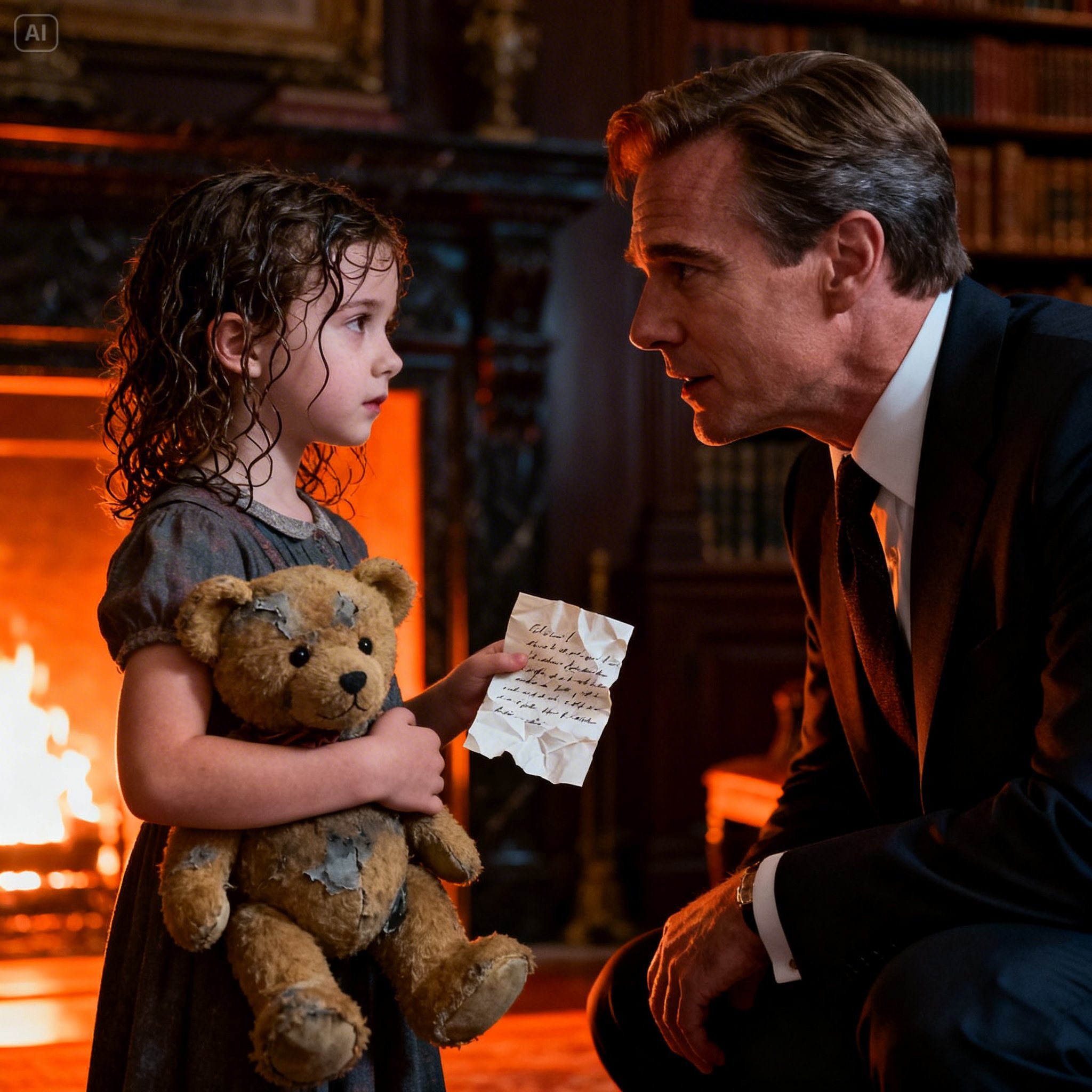
He took her icy little hands in his own.
—You’re not going to die. I swear.
Then she threw herself into his arms. It was the first time she had done so of her own free will. And Damian held her with a fierce tenderness that no one in the city would have believed possible.
That same night he declared war on Víctor Montalvo.
It wasn’t a long war. It was precise.
Damián handed over information he had been holding onto for years to the prosecutor’s office and, at the same time, shut down all the rival empire’s escape routes. Federal agents conducted raids. Allies turned against them. Iván Salcedo fell first. Víctor Montalvo was arrested in Querétaro two weeks later, trying to smuggle false documents across the border.
The threat is over.
And with that, another battle began: the legal one.
Detective Sara Mejía arrived with a welfare check order. She expected to find fear in the girl’s eyes and signs of manipulation in the house. Instead, she found Emilia clean, fed, hugging her teddy bear, and looking at Damián as if he were the safest place in the world.
“If you wanted to leave,” the detective said gently, “you could tell me.”
Emilia denied it with unexpected firmness.
—I don’t want to leave. This is my home.
The child psychologist confirmed the obvious: separating her from him now would break something that was just beginning to heal.
Rosa testified. Marcos testified, his arm still sore. Father Tomás Ortega, the old priest who had known Damián since he was a child, looked at the judge and said:
“I’m not going to lie to you. This man has lived surrounded by darkness. But with that little girl, I’ve seen something I thought was dead. I’ve seen true care.”
The judge granted six months of provisional protection.
They were enough.
Emilia started school in February. She made a friend named Sofia. She laughed out loud again. She hung drawings in the kitchen. One of them showed a large house and two figures holding hands under a crooked sun. Above it, she had written, in shaky letters: My family.
Damian began to distance himself from the dirty business. He relinquished power, closed accounts, and cleaned up what he could. Marcos handled the transitions. Rosa filled the house with plants, sweet bread, and normalcy.
In April, sitting on the terrace at sunset, Emilia asked him a question:
Are you happy?
Damian took a while to respond.
—I don’t know if I remember exactly how it feels.
She thought about it with all the seriousness in the world.
—Then we’ll learn it together.
He looked at her. And, for the first time in decades, he genuinely smiled.
A year after that rainy night, they returned to the courthouse. Emilia wore a yellow dress with small flowers on the hem. Mr. Botones rested in her arms, no longer as a shield, but as a companion.
The judge signed the final papers.
—Permanent guardianship is granted.
Emilia turned her face towards Damian.
—What should I call you now?
His throat closed up.
—You can call me dad… if you want.
The smile that appeared on the girl’s face was so big, so bright, that it seemed to erase all the winters they had endured at once.
“Dad,” he repeated, testing the word. “Yes. I like it.”
They hugged right there in the courtroom, while Rosa cried without any shame and Marcos looked at the ceiling to hide his emotion.
As she stepped outside, the November air was no longer harsh. Emilia skipped down the steps.
“Dad,” he said suddenly, “if another child appeared at our gate in the rain… would we open the door for him?”
Damian looked at her and thought of Elena, of Lucia, of the soaked girl who a year ago had knocked on the door of the most feared man in the city and had given him back his heart.
“Always,” he replied. “Our door will always be open.”
Emilia nodded, satisfied, and shook his hand.
Sometimes, family isn’t born of blood. Sometimes it’s born from an old debt, a promise kept, a storm, a door opened just in time. And sometimes, the person who arrives seeking refuge finds more than just a home.
Read more by clicking the (NEXT »») button below!