A microphone in the center aisle.
A poster board on an easel showed photographs of my garden.
Unflattering ones.
Taken at odd angles.
Close-ups of dry stems.
A tilted pot.
A vine climbing the mailbox post.
Trent stood beside it in a charcoal suit.
He had dressed for victory.
His hair shone under the fluorescent lights.
“Thank you all for attending this special compliance hearing,” he said.
His voice filled the room.
He loved a microphone.
“Tonight’s matter concerns a difficult but necessary enforcement action regarding 1123 Honeysuckle Lane, owned by Mrs. Miriam Weller.”
Every head turned toward me.
I walked to the front row.
Ruth patted the seat beside her.
I sat.
Alan and Denise sat behind me.
I could feel their embarrassment like heat.
Trent continued.
“Let me be clear. This board respects all residents. We respect age, history, grief, and personal taste.”
Ruth whispered, “Here comes the butter before the burn.”
“But we cannot allow one homeowner’s refusal to maintain standards to endanger the beauty, safety, and value of our entire community.”
He clicked a remote.
A photo of my yard appeared on the screen.
Gasps came from the front row.
Not because it was shocking.
Because Trent had darkened the image.
The garden looked tangled and gray.
Like a haunted roadside.
Someone muttered, “That’s not how it looks.”
Trent spoke over them.
“We have offered Mrs. Weller multiple chances to comply. Sadly, she has chosen defiance.”
I raised my hand.
He ignored me.
“She has accumulated over eleven thousand dollars in fines and associated fees.”
More murmurs.
“This is not punishment. This is protection.”
I raised my hand higher.
“Mrs. Weller,” Trent said, smiling, “you will have time to speak after the board presentation.”
“I would like to correct the record now.”
His smile stayed.
His eyes did not.
“Procedure matters.”
“So does accuracy.”
A few people chuckled.
Trent looked toward the board secretary.
“Please note Mrs. Weller’s interruption.”
“Please also note,” I said, “that the photograph on the screen has been altered.”
The room shifted.
Trent’s head snapped toward me.
“It has not been altered.”
“Yes, it has.”
I stood.
“My granddaughter is a photographer. I know a contrast slider when I see one.”
A man in the third row said, “My grandson could check that.”
Trent lowered the remote.
“This is exactly the kind of distraction—”
“Show the next photo.”
He hesitated.
“Show it,” Ruth said.
Others joined.
“Show it.”
“Let us see.”
“Go on, Trent.”
His jaw worked.
He clicked.
The next photo appeared.
My milkweed.
But this photo, unlike the first, showed a monarch butterfly near the top left corner.
Someone said, “Oh, that’s pretty.”
Trent clicked too fast.
I lifted my voice.
“You skipped that one.”
“Mrs. Weller—”
“You skipped beauty because it weakens your case.”
The room went quiet.
Trent set down the remote.
His voice turned cold.
“This hearing is not about butterflies. It is about repeated noncompliance.”
“Actually,” I said, “this hearing is about repeated theft.”
The word did not explode.
It sank.
Then the room erupted.
Trent laughed.
A sharp little laugh meant to make me look confused.
“Mrs. Weller, I understand this is emotional for you.”
“No, you don’t.”
“Miriam,” Denise whispered behind me.
I did not turn around.
Trent raised both hands.
“This is what happens when residents spread rumors instead of reading bylaws.”
“I read the bylaws.”
“I’m sure you did.”
“And the amendments.”
His smile flickered.
“And the annual budgets.”
Less smile.
“And the vendor contracts.”
No smile.
“And the state filings for twelve companies connected to invoices paid by this HOA over the last four years.”
The room became so still I could hear the ice machine in the clubhouse kitchen.
Trent stared at me.
For the first time since I had known him, he looked his age.
Not polished.
Not powerful.
Just young enough to have believed no one would check.
I walked to the center aisle.
Ruth handed me the first binder.
Red.
I placed it on the table.
The sound echoed.
“This is not rumor.”
Then the blue binder.
“This is not emotion.”
Then the green.
“This is not grief.”
Then the black.
“This is five hundred pages of records, invoices, filings, meeting minutes, homeowner statements, payment trails, and account references.”
Trent’s face went pale under his tan.
Carol from the board reached toward the black binder.
He snapped, “Do not touch that.”
Everyone heard him.
Carol froze.
I looked at her.
“You should touch it, Carol.”
Her hand trembled.
Trent stood.
“This is absurd. This woman is attempting to defame the board because she refuses to mow her lawn.”
“No,” I said. “I am explaining why Willow Creek paid for pond safety pruning when we do not have a pond.”
A murmur rolled through the room.
Mr. Alvarez stood.
“We don’t have a pond.”
“No,” I said. “We have a drainage ditch.”
Ruth added, “With very proud frogs.”
A few people laughed nervously.
I opened the red binder.
“Invoice 4471. Greenline Outdoor Management. Fourteen thousand two hundred dollars for clubhouse entrance restoration.”
I held up a photograph.
“This is the restoration. Six shrubs and mulch.”
Someone whistled softly.
“Invoice 5098. Brighter Path Landscape Consulting. Six thousand five hundred dollars for native plant removal evaluation.”
I looked at Trent.
“That company was registered three days before the invoice.”
Carol whispered, “What?”
“Same mailing address as Greenline. Same filing agent. Same suite number. Same pattern.”
Trent grabbed his microphone.
“I will not allow this circus.”
“Then you should not have sold tickets.”
Ruth whispered, “Amen.”
I turned a page.
“Carmichael Residential Consulting was formed three weeks before Mr. Carmichael became HOA president.”
A woman in the back gasped.
“Carmichael?”
Trent’s voice rose.
“My last name is not rare.”
“No,” I said. “But your signature is.”
I lifted a page from the binder.
“Your signature appears on the initial filing as authorized representative. You signed in blue ink. Then the same consulting company billed this HOA through three separate vendor names over four years.”
The board treasurer, a thin man named Walt, pushed back his chair.
“I never approved that.”
Trent turned on him.
“You approved every annual budget.”
“I approved totals. Not this.”
“That is your failure, Walt.”
Walt’s mouth opened.
Then closed.
Then opened again.
“I trusted you.”
Those three words moved through the clubhouse like a door opening in every chest.
Because that was the whole story.
People had trusted him.
They had trusted the polo shirt.
The handshake.
The polished newsletter.
The confident tone.
They had trusted him because he looked like order.
And he had looked at us and seen easy marks.
Old people.
Widows.
Lonely men.
Folks with hearing aids and aching knees and grown children who sighed at paperwork.
He had judged the book by its cover.
He had forgotten that some books have indexes.
I opened the black binder.
“Several invoices reference digital reserve transfers. I have provided those documents, along with account strings and email records, to state financial investigators.”
Trent stared.
Not at me.
At the side door.
That was when two people in plain clothes stood up near the back.
A man and a woman.
They had arrived early and sat by the coffee urn.
I had noticed their shoes.
Comfortable.
Government shoes.
The woman walked forward and held out identification.
“Mr. Carmichael,” she said, “we need you to come with us.”
The clubhouse burst into sound.
Chairs scraped.
People stood.
Carol began crying.
Walt put both hands on his head.
Trent stepped back.
“This is a misunderstanding.”
The investigator’s voice stayed calm.
“You’ll have the opportunity to discuss it.”
“You can’t do this here.”
“We can.”
He looked at the room.
Then at me.
For one second, the mask fell completely.
Not fear.
Hatred.
Pure and bright.
“You ruined me,” he said.
I shook my head.
“No, Trent. I cataloged you.”
The investigator guided him away.
No shouting.
No struggle.
No grand scene.
Just a man in an expensive suit being walked past the folding chairs of people he thought would never stand up.
As he passed my row, Alan stood halfway, then sat down again.
Denise covered her mouth.
Trent disappeared through the side door.
The clubhouse remained silent for three full seconds.
Then June McAllister began to clap.
Softly at first.
One pair of hands.
Then Mr. Alvarez.
Then Ruth.
Then the whole room.
I did not raise my hands.
I could not.
I sat down because my knees had decided drama was over.
Ruth grabbed my fingers under the table.
“They clapped for you,” she whispered.
“No,” I said.
I looked at the binders.
“They clapped for themselves.”
After that night, Willow Creek changed faster than anyone expected and slower than everyone wanted.
That is how communities heal.
The state investigation did not end at the clubhouse.
There were interviews.
Letters.
Restitution hearings.
Insurance claims.
New board elections.
Emergency votes.
Temporary committees.
People learned words they never wanted to know, like forensic accounting and fiduciary duty.
I refused to be board president.
Ruth told everyone I had “retired from saving fools from themselves.”
That was only partly true.
I agreed to chair the records committee.
One meeting a month.
Two cookies per person.
No navy polo shirts.
The fines against me were erased.
Every one.
The foreclosure threat vanished like a bad smell after opening a window.
But something had shifted inside me that no apology could put back.
A week after the hearing, Denise came over alone.
She stood on my porch holding no casserole.
That was progress.
I was deadheading coneflowers.
She watched me for a while.
Then she said, “I’m sorry.”
I kept working.
“For what part?”
She swallowed.
“All of it.”
I clipped a brown bloom.
“That’s broad.”
“For not asking what you found.”
Clip.
“For assuming you were confused.”
Clip.
“For caring more about being embarrassed than about you being scared.”
That one stopped my hand.
I looked at her.
Her face had no defense in it.
Just my daughter.
The girl who used to crawl into my lap when thunderstorms shook the windows.
“I was scared,” I said.
“I know.”
“No,” I said. “You don’t. I wasn’t scared of Trent.”
Her eyes filled.
I set down the clippers.
“I was scared that my children had already decided I was a problem to manage.”
Denise sat on the porch step.
A bee circled the lavender near her ankle.
She did not move away.
“I think we did,” she whispered.
The honesty hurt.
But it also opened something.
I sat beside her.
Neither of us spoke for a while.
Across the street, Ruth pretended not to watch from behind her blinds.
Denise wiped her eyes.
“Alan feels awful.”
“Alan feels inconvenienced by guilt.”
She laughed through tears.
“You’re not wrong.”
“He’ll call when he can do it without making a speech.”
“He loves you.”
“I know.”
“He’s just…”
“Like me,” I said.
Denise looked surprised.
“Like you?”
“Bossy when frightened. Organized when helpless. Allergic to being wrong.”
That made her smile.
I touched her hand.
“Your father saw it too.”
“Dad never said that.”
“Your father kept his observations folded neatly behind jokes.”
She looked out at the garden.
“I didn’t understand this place.”
“No.”
“I thought it was you refusing to move on.”
I followed her gaze.
The milkweed pods were forming.
The asters were just beginning to open.
A hummingbird flickered near the salvia.
“It is me moving on,” I said.
“How?”
“Your father planted the first row because he couldn’t mow anymore. I kept planting because I needed something alive that didn’t ask me to be cheerful.”
Denise cried quietly.
I let her.
Sometimes children need to grieve their parents while their parents are still sitting beside them.
Two weeks later, Alan came.
He did bring a speech.
He made it three sentences in before I held up one finger.
“Start again,” I said.
He stared.
Then his face crumpled in that little-boy way mothers never forget.
“I was ashamed,” he said.
“Of me?”
“Of being unable to fix it.”
That was closer.
He sat at my kitchen table.
The same place where the rebellion had been born.
“I thought if I paid, it would prove I was taking care of you.”
“I don’t need you to take care of me by silencing me.”
“I know.”
“You need to know longer.”
He nodded.
“I’m trying.”
I poured coffee.
He picked up Henry’s pencil mug.
“I miss him.”
“I do too.”
“He would’ve loved this.”
“Your father would have pretended to be nervous and then bragged about me at the hardware store for six months.”
Alan smiled.
Then he looked at me carefully.
“Denise said you’re changing the estate plan.”
I leaned back.
There it was.
The second storm.
“I am.”
His shoulders tensed.
“Because of us?”
“Yes.”
He flinched.
I let that sit.
Then I said, “But not as punishment.”
He looked doubtful.
“Mom.”
“This house has become too heavy for you two. I see that now. Not because you’re greedy villains. Because you have lives elsewhere. Mortgages. College bills. Retirement fears. You looked at this place and saw responsibility.”
He said nothing.
“I looked at it and saw your father. Bees. Soil. A chair I finally sat in again.”
Alan rubbed his forehead.
“So what are you doing?”
“I’m placing the property into an ecological trust.”
He blinked.
“A what?”
“A protected land trust for small native habitat preservation. The house will remain mine while I live. After I’m gone, the trust maintains the garden and property under specific conditions.”
His mouth opened.
“You can do that?”
“I can do many things.”
“But the house…”
“Will not be sold for quick cash.”
His face changed.
There it was.
Not greed.
Grief’s practical cousin.
Loss wearing a calculator.
“You and Denise will receive other assets,” I said. “What remains. Modest, but fair.”
“Mom, that’s not what I meant.”
“It is part of what you meant.”
He looked down.
“I guess.”
“I’m not angry about it.”
“You sound a little angry.”
“I am seventy-five, Alan. I can hold two truths and a cup of coffee.”
That made him laugh despite himself.
I reached across the table.
“This garden saved me. I want it to keep doing that for someone else.”
“For who?”
“For whoever walks past and needs to see that not everything old should be trimmed down to look convenient.”
He looked toward the window.
A monarch moved over the milkweed.
After a long time, he said, “Dad would understand.”
“Yes.”
“I want to.”
“That’s a start.”
The new HOA board was elected in October.
Ruth ran for secretary and won by a landslide after promising meetings under ninety minutes and snacks without raisins.
Mr. Alvarez became facilities chair.
Carol resigned from the board and wrote every resident a letter.
Not a polished one.
A real one.
She said she had ignored her doubts because Trent made disagreement feel foolish.
She said she was sorry.
Some people forgave her right away.
Others needed time.
That was fair.
Forgiveness should not be another HOA rule.
The first new board meeting was packed.
Not because people expected scandal.
Because they expected transparency.
Every invoice was projected on the clubhouse screen.
Every vendor had a name, number, and physical address.
Every homeowner could ask questions without being called disruptive.
At the end, Walt stood up.
He looked ten years older than he had a month before.
“I should have watched closer,” he said.
Nobody argued.
Then June McAllister stood.
“My Harold always said trust is not a filing system.”
People laughed gently.
Walt nodded.
“He was right.”
The community changed in other ways too.
Lawns remained tidy for those who wanted tidy.
But native gardens were allowed with simple guidelines.
No blocked sidewalks.
No unsafe visibility issues.
No pretending a butterfly bush was a felony.
We started a garden walk in the spring.
Ruth insisted on calling it the “Weed Tour” until I threatened to remove her cookie privileges.
Children and grandchildren came.
So did residents who had once complained.
A retired accountant named Stanley stood in front of my milkweed patch and said, “I used to think this looked messy.”
“And now?” I asked.
He frowned, thinking hard.
“Now I think maybe neatness is not the same as care.”
I liked that.
I wrote it on an index card later.
By November, the legal papers for the trust were ready.
I will not pretend it was simple.
There were appointments.
Reviews.
Explanations from patient professionals who knew better than to call me “sweetie.”
I signed the final document at my dining room table.
Denise sat on one side.
Alan on the other.
Ruth stood behind me like a guard dog in pearl earrings.
The trust had a name.
The Henry and Miriam Weller Living Garden Trust.
I had argued about putting my own name in it.
Ruth told me not to be ridiculous.
“You did not uncover corruption, humble a tyrant, and save the bees just to make yourself a footnote.”
So my name stayed.
The terms were clear.
The property could not be sold for private development.
The garden would remain a native habitat.
The house could be used for community education, small gatherings, reading groups, and seasonal garden tours after my lifetime.
No one in my family could force a sale.
No future HOA board could demand turf grass in place of the meadow.
Henry’s blue chair would stay on the porch as long as weather allowed.
That last part was not legally important.
It was spiritually essential.
When I finished signing, my hand shook.
Denise noticed.
She covered it with hers.
“Are you okay?”
I looked at the papers.
Then at the window.
Outside, the garden had gone brown and gold for winter.
Some people think a garden is dead when it dries.
They do not know how much life hides in stems.
“Yes,” I said. “I’m lighter.”
Alan’s voice was quiet.
“I’m proud of you.”
I looked at him.
This time, he did not look embarrassed saying it.
So I believed him.
That winter, Trent Carmichael’s name appeared in the local paper.
Not on the front page.
Inside, below a story about a new senior center art class.
Former HOA president charged in community fund scheme.
I did not clip the article.
People expected me to.
Ruth even brought me three copies.
“I thought you’d want them for your files.”
I looked at the headline.
Then handed them back.
“No.”
She stared at me as if I had refused oxygen.
“No?”
“I have enough of him in binders.”
“But history—”
“History also knows when to stop inviting a man into your kitchen.”
Ruth considered that.
Then she folded the papers and tucked them into her purse.
“I’ll keep one.”
“I assumed you would.”
Trent’s house eventually sold.
A retired music teacher bought it.
She planted roses.
Not square shrubs.
Real roses.
Messy, thorny, fragrant things that leaned over the fence like gossip.
In March, my garden woke up.
Not all at once.
It never does.
First the tiny green fists of the milkweed.
Then the purple tips of the coneflowers.
Then bees nosing through the early blooms like they had appointments.
I stood barefoot on the front walk one morning with coffee in my hand.
The new HOA president, a quiet man named Leonard, came by with his dog.
He stopped at the edge of my yard.
“Morning, Miriam.”
“Morning.”
He looked at the little trust sign near the mailbox.
Not big.
Not flashy.
Just cedar with neat lettering.
PROTECTED NATIVE HABITAT
HENRY AND MIRIAM WELLER LIVING GARDEN TRUST
“Looks good,” he said.
“It looks alive.”
He smiled.
“That too.”
His dog sniffed the stone border.
Leonard looked uncomfortable for a second.
Then he said, “I owe you thanks.”
“For what?”
“For reminding this place that rules are supposed to serve people. Not scare them.”
I took a sip of coffee.
“Well. Try to remember it before anyone forms a committee.”
He laughed and walked on.
A few minutes later, a young grandmother from two streets over stopped with her grandson.
The boy had red hair and serious eyes.
He pointed at a caterpillar on the milkweed.
“What’s that?”
“A monarch caterpillar,” I said.
He leaned closer.
“It’s eating your plant.”
“Yes.”
“Aren’t you mad?”
“No.”
“Why?”
“Because that is what I planted it for.”
He thought about this.
Then he looked at me with the deep suspicion children reserve for adults who make sense.
“You planted something so bugs could eat it?”
“Yes.”
“That’s weird.”
“It is.”
He grinned.
“I like it.”
His grandmother mouthed thank you.
I nodded.
That was the legacy.
Not the house.
Not the headline.
Not the five hundred pages.
A child learning that being eaten is not always loss.
Sometimes it is purpose.
That afternoon, Denise came over with sandwiches from the diner on Route 6.
The local place where the waitress calls everyone honey and the pie case rotates like a stained-glass window.
We ate on the porch.
She had stopped asking if I wanted the garden “cleaned up.”
Now she asked what was blooming.
I told her the names.
Not all at once.
Children do not learn their parents in a single afternoon.
“Golden alexanders,” I said, pointing.
“That sounds like a man who wears a velvet jacket.”
“It does.”
“And that?”
“Bee balm.”
“Obvious.”
“And that?”
“Joe-Pye weed.”
She raised an eyebrow.
“Now that one sounds like it owes someone money.”
I laughed so hard I spilled iced tea.
Later, Alan sent a photo from his own backyard.
Three pots on his patio.
Milkweed.
Coneflower.
Aster.
The message read:
Don’t get excited. It’s a trial program.
I showed Ruth.
She snorted.
“That boy is halfway to a meadow and doesn’t know it.”
In April, Willow Creek held its first garden walk.
There were printed maps, though Ruth complained about the font.
Twenty-three homes participated.
Some had porch pots.
Some had full beds.
Mr. Alvarez built a little bee house with his grandson.
June planted lavender by her mailbox.
Carol planted zinnias and stood outside handing out lemonade.
People came from neighboring communities.
Some asked practical questions.
Some just walked slowly.
One woman touched my arm and whispered, “My husband died last year. I haven’t known what to do with the yard.”
I looked at her face.
I knew that kind of lost.
It has no map.
I handed her a packet of seeds.
“Start small,” I said. “Grief likes small doors.”
She pressed the packet to her chest.
“Thank you.”
After she left, Ruth leaned toward me.
“Are you giving advice now?”
“No. Seeds.”
“Thin line.”
At the end of the day, I sat in Henry’s blue chair.
My feet hurt.
My back complained.
My hands smelled like soil and lemonade.
The garden moved around me in the evening light.
Not tidy.
Not approved by people who fear softness.
Not designed to impress passing cars.
Alive.
Denise and Alan stood by the mailbox reading the trust sign.
They did not know I was watching.
Denise touched the edge of the cedar.
Alan said something I couldn’t hear.
She nodded.
Then he looked back at the house.
At me.
For once, he did not look like he wanted to manage anything.
He just looked.
I lifted my hand.
He lifted his.
The sun slipped behind the rooftops.
A monarch drifted over the milkweed.
The first one of the season.
I had thought I would cry when I saw it.
Instead, I laughed.
Softly.
Because Henry had always said monarchs looked like stained-glass windows that got tired of churches.
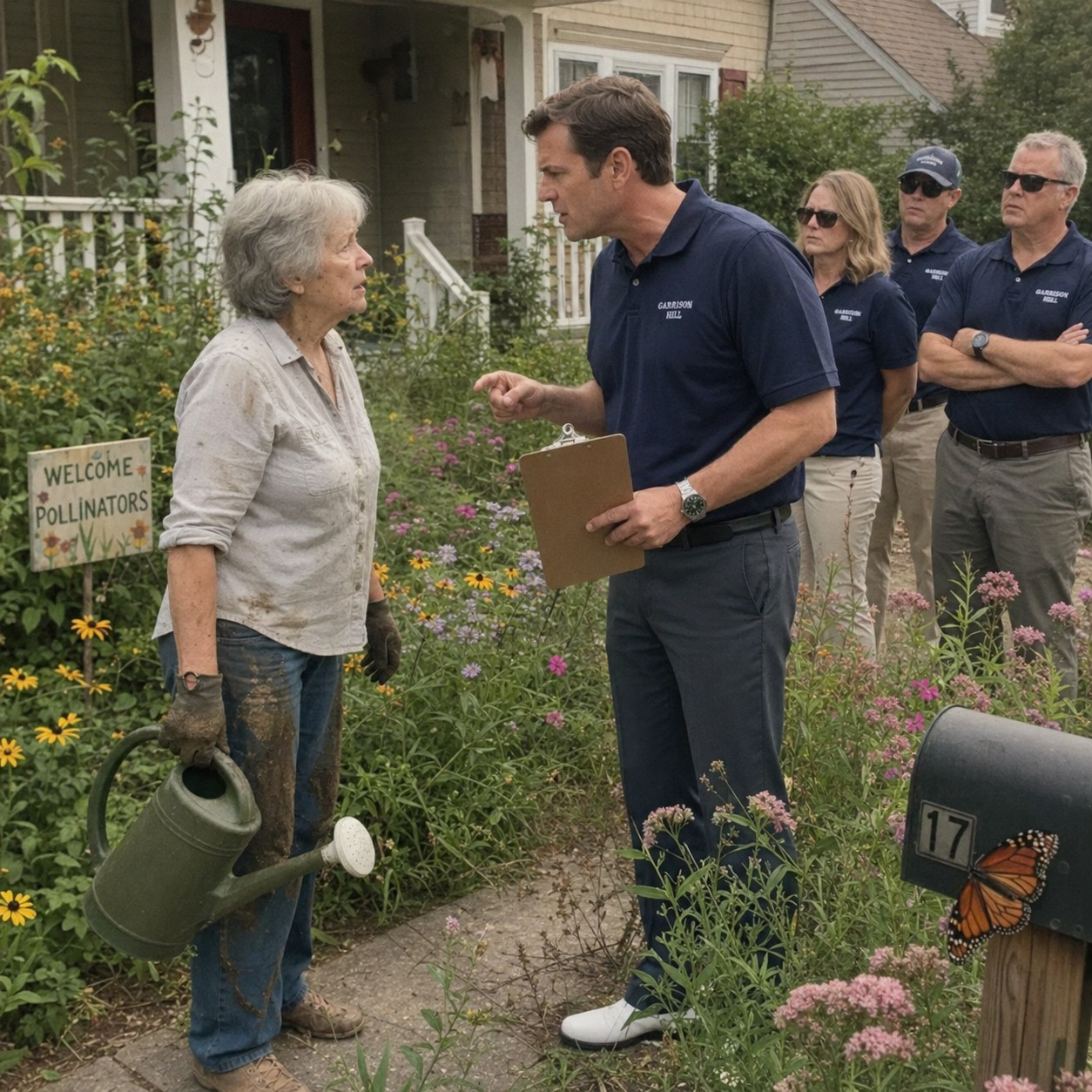
The butterfly landed on the old welcome sign.
WELCOME POLLINATORS.
The paint had faded.
The wood had cracked.
One corner dipped lower than the other.
Trent Carmichael would have called it a violation.
I called it perfect.
People think rebellion belongs to the young.
They picture loud voices, fast cars, slammed doors, and midnight plans.
But sometimes rebellion is an old woman refusing to write a check.
Sometimes it is reading the footnotes.
Sometimes it is planting milkweed where a lawn used to be.
Sometimes it is telling your grown children, gently but firmly, that love does not give them ownership of your courage.
And sometimes, if you are very lucky, rebellion outlives you.
It grows roots.
It drops seeds.
It waits through winter.
Then one morning, long after the people who tried to cut it down are gone, it rises again in a place nobody can sell.
Read more by clicking the (NEXT »») button below!