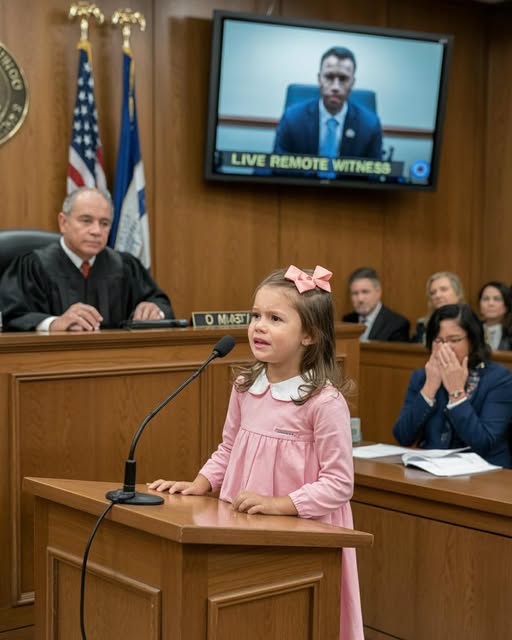
She rested her head on my shoulder. Her body was shaking, the fine tremor of a child who has been holding herself rigid for a very long time and has finally been given permission to stop.
We stayed like that on the floor of the judge’s chambers while the room emptied around us. Caleb left first, moving quickly, his attorney close behind him, neither of them speaking. My attorney touched my shoulder once and said she would call me that afternoon. The judge’s clerk closed the door softly on his way out, and then it was just the two of us, my daughter and me, kneeling on the carpet of an office that smelled like paper and old coffee, holding each other in the silence that comes after something has finally been said.
The weeks that followed moved with the particular momentum of a legal process that has been given new evidence and new urgency. The forensic accounting review found the Arizopa account within days. It contained nearly two hundred thousand dollars that Caleb had moved in increments small enough to avoid automatic detection, routed through three intermediary accounts, and parked in a structure designed to be invisible during asset disclosure. His attorney withdrew from the case. His custody petition was denied. The financial settlement was restructured under court supervision with terms that reflected what the judge now understood about how Caleb operated.
I do not take pleasure in describing his undoing. I take something quieter than pleasure and more durable. I take the knowledge that the truth, which I had been trying to speak for months in rooms where no one was willing to hear it, was finally audible. Not because I found the right words. Because my daughter found the right evidence.
Harper started seeing a therapist in December, a woman named Dr. Adeyemi who specialized in children who had been placed in the middle of adult conflicts and who had learned, out of necessity, to carry responsibilities that should never have been theirs. The sessions were private, and I did not ask Harper what she discussed. I only asked, each week when I picked her up, whether she felt okay, and she said yes with increasing conviction as the weeks passed, and I believed her because the evidence supported it. She was sleeping better. She was talking more. She was drawing again, elaborate scenes of castles and forests and rivers that she taped to the refrigerator with the confident asymmetry of a child who has decided that the surfaces around her are safe enough to mark.
One evening in January, after dinner, she was doing homework at the kitchen table and I was washing dishes, and she said, without looking up from her math worksheet, “Mom, I don’t feel like I have to watch anymore.”
I turned off the water. “Watch what?”
“Everything.” She erased something and blew the shavings off the page. “I used to watch everything all the time. Like if I stopped paying attention something bad would happen and I wouldn’t have proof.”
I dried my hands and sat down across from her. “And now?”
She looked up. Her eyes, brown and serious and so much older than ten, held mine for a moment. “Now I don’t think I need proof anymore. I think people just believe us now.”
I reached across the table and put my hand over hers. She let me hold it for a few seconds, then pulled away gently and went back to her math, and I sat there watching her work, watching her erase and rewrite and move on to the next problem, and I thought about the folder she had named on that tablet, the folder that contained the video that had changed everything, the name she had chosen for it with the devastating precision of a child who had learned too early how truth works and how lies work and what it costs to carry the difference between them in secret.
For when I no longer believe you.
Read more by clicking the (NEXT »») button below!