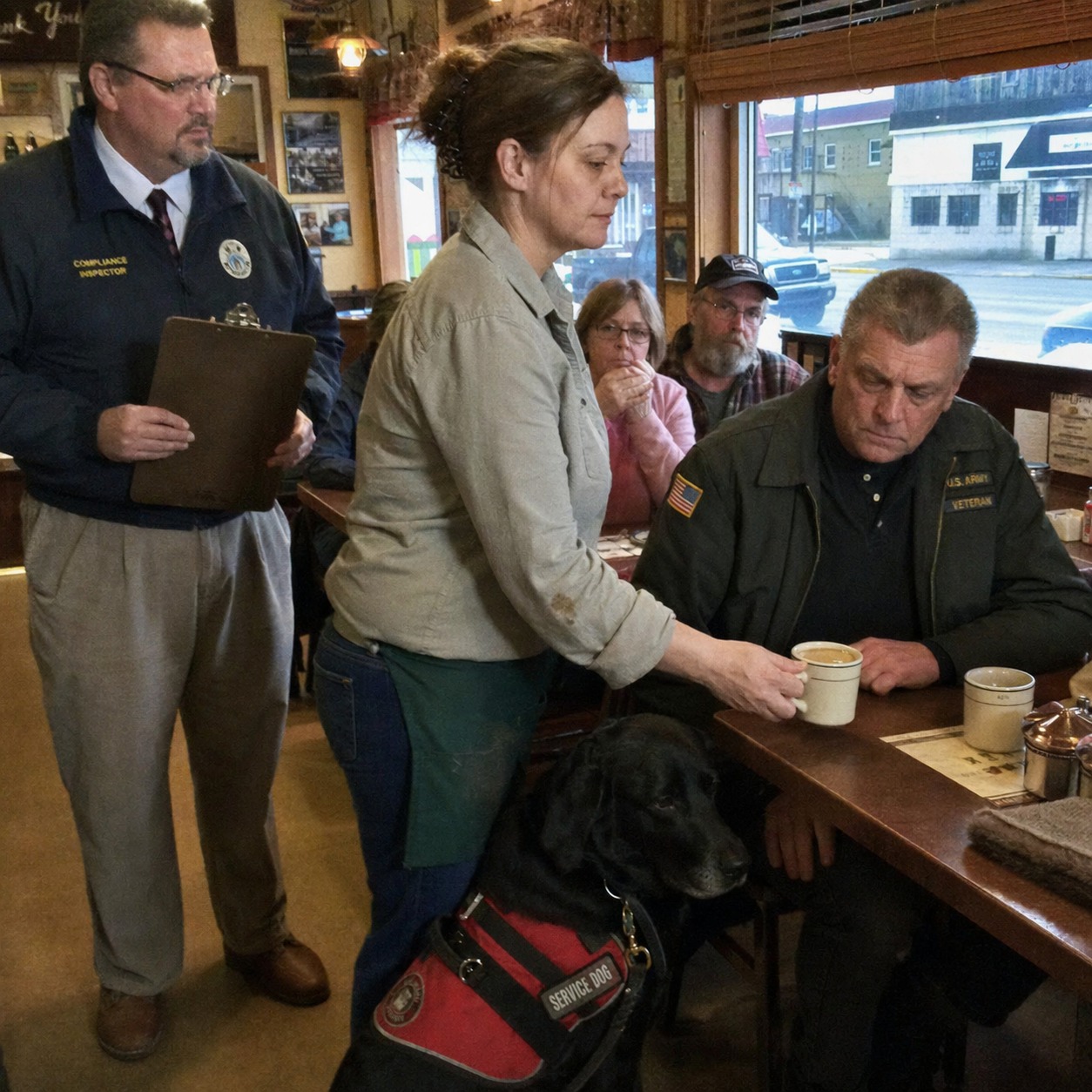
“I’ve watched this five times,” he said. “Not because I enjoy watching people fail each other. Because I wanted to be sure I understood what I was seeing.”
Grace looked away from the screen.
“That woman in the video,” he said, “is exactly who we’ve been trying to find.”
She frowned.
“For what?”
Colonel Keller tucked the phone away.
“There’s a program on base. Small, underfunded, mostly ignored. It was built to help veterans transition back into ordinary life without feeling like they were being processed through another system. Coffee, conversation, practical support, peer groups, family nights, quiet rooms, service dog accommodations, community connection. We’ve had plans for it for over two years.” He paused. “We haven’t had the right person.”
Grace stared at him.
“I’m not a counselor.”
“I know.”
“I’m not licensed for anything.”
“I know that too.”
“I ran a café.”
He nodded.
“Yes. You ran a place where people felt safe enough to come back.”
Grace folded her arms against a cold she suddenly felt in her bones.
“That’s not a résumé.”
“No,” he said. “It’s better.”
She almost laughed from nerves.
“This sounds very generous, Colonel, but I just got fired from one coffee shop. I’m not sure that qualifies me to run anything on a military base.”
His expression did not change.
“Your husband served under my command for a period of time.”
Grace stilled.
That was not information he needed to use.
Because he used it, she knew he had thought carefully before doing so.
“He spoke about you more than once,” Keller said. “Not in formal settings. Just the way men talk when they’re trying to explain what home means.”
Grace’s eyes burned.
The colonel went on quietly.
“He said you had a way of making people feel less alone without forcing them to admit they were lonely.”
That line landed so hard she had to look down.
It sounded exactly like Michael.
Exactly like the kind of beautiful thing he would say in the middle of an ordinary story and never realize it deserved to be written down.
Keller gave her a second.
“We need someone who understands that healing isn’t always a clipboard and a fluorescent room. Sometimes it’s routine. Sometimes it’s a familiar mug. Sometimes it’s the same person remembering your name over and over until you start believing you still belong somewhere.”
Grace stared at the pavement.
Cars passing.
Flag snapping lightly over the street.
The whole town unknowingly holding its breath.
“What are you asking me?” she said.
“I’m asking whether you’ll come to base headquarters this afternoon and let me show you the program.”
Grace looked up.
“That’s all?”
“That’s all for today.”
Something in his face told her it was not all in the larger sense.
But for today, yes. That was all.
Before she could answer, the café door opened again.
Ray stepped outside.
Shadow moved with him, close and steady.
Ray came to a stop a few feet away, clearly unsure whether he was interrupting.
Grace turned toward him.
“You okay?”
It slipped out again before she could help it.
Ray exhaled, almost a laugh.
“No,” he said. “But I wanted to say something before you left.”
Grace waited.
He rubbed a thumb once over the leash.
“I spent a long time not going anywhere I didn’t have to go.”
His eyes stayed on the dog as he spoke.
“Then a guy at the VA office told me about your Wednesdays. Said there was a woman near the old courthouse who made coffee like it was church and didn’t pry.” He swallowed. “He was right.”
Grace blinked fast.
Ray looked up then.
“When I came in the first time, I was already halfway out the door in my head. You saw that and acted like there was nothing unusual about me being there.” He glanced back toward the café. “That matters more than people who haven’t lived it understand.”
Grace could not trust her voice yet, so she just nodded.
Ray took one more breath.
“When that man started in on Shadow, I was about to leave. I would have left too. But you didn’t make me carry that alone.” His throat worked. “Nobody’s done that for me in public in a very long time.”
There it was.
The real wound.
Not the coffee.
Not the firing.
The old humiliation underneath it.
Grace stepped closer.
“You didn’t do anything wrong,” she said.
He nodded once, but his face said he was still trying to believe it.
Colonel Keller looked between them, then at the row of uniforms waiting nearby.
And in that moment Grace understood why they had come.
Not intimidation.
Correction.
Witness.
A public answer to a public failure.
Keller spoke again, but now more softly.
“Come to the base at two o’clock,” he said. “No obligation. Just come see.”
Grace looked toward the café window.
Lena watching from inside.
Ben standing like a stubborn old oak by the door.
The regulars crowded shoulder to shoulder.
Her life as she had known it until breakfast.
Then she looked at Ray.
At Shadow pressed against his leg.
At the row of people who had shown up not because she was important, but because what happened in that room mattered.
“Okay,” she said.
She did not realize how much that one word would change.
Back inside, the mood had shifted from shock into something else.
Not celebration.
Reckoning.
Diane stood by the register with her leather folder clutched to her chest.
The inspector had retreated near the pie cooler, somehow looking both indignant and embarrassed, which Grace would not have believed possible at ten that morning.
Lena hurried to Grace first.
“Are you coming back?” she blurted.
Grace touched her arm.
“Not today.”
Lena’s eyes widened.
“Then what’s happening?”
Grace almost said I have no idea.
Instead she smiled weakly.
“Apparently I’m going to the base.”
That moved through the room like wind through curtains.
Ben barked out one short laugh.
“Of course you are.”
Diane finally stepped forward.
“Grace.”
Grace turned.
Diane’s expression had changed in the strangest way.
Not warmer.
More careful.
As if she had suddenly remembered that public decisions sometimes grew legs.
“I acted based on the information available to me.”
Grace looked at her.
Then at the inspector.
Then back.
“No,” Grace said. “You acted based on what was easiest to protect.”
Diane opened her mouth, shut it again.
That was the thing about Grace.
People often mistook her softness for fog.
But when the moment came, there was rock under it.
The inspector cleared his throat.
“There are still sanitation concerns,” he said, though weaker now, as if even he no longer believed in the grand authority of his own performance.
Ray said quietly from behind Grace, “Shadow has more discipline than most people.”
A few customers laughed before they could stop themselves.
The inspector reddened.
Grace should have let it rest.
She knew that.
But something in her had reached the clean, exhausted honesty that comes only after humiliation.
She turned toward him fully.
“You walked into a room full of people,” she said, “and the one person you decided to challenge was the man doing his best not to make trouble. I want you to sit with that.”
He stared at her, stunned.
Grace did not raise her voice.
She did not have to.
She picked up nothing from the café.
Not the apron.
Not the extra sweater she kept in the back.
Not the notebook in the drawer with birthdays and drink orders and quiet private reminders that helped her care for people without making a show of it.
That notebook mattered.
But she left it.
Because some part of her already knew the version of life she had built in this room was ending.
Not dying.
Changing.
She hugged Lena.
Nodded to Ben.
Touched Shadow between the ears one more time.
And went home again to wait for two o’clock.
The drive to Langford Base took eighteen minutes if you caught the lights right.
Grace had made it dozens of times over the years.
Family days. Volunteer deliveries. Memorial gatherings. Once, after Michael came home on leave and wanted real pie instead of cafeteria dessert, she had driven out there just to meet him for twenty-seven minutes in a parking lot while he inhaled peach pie from a paper box and kissed sugar off her thumb.
She remembered that now and almost had to pull over.
Memory was rude that way.
It did not ask whether today was a good day.
The gate guard checked her ID and waved her through after a quick call.
By the time she parked near headquarters, her stomach was in knots.
Base buildings had their own smell.
Coffee, printer toner, floor polish, effort.
Inside, a young staff sergeant led her down a long hallway where framed photographs lined both sides.
Unit portraits.
Retirements.
Ceremonies.
People smiling the careful smiles of official history.
At the end of the hall, Colonel Keller waited by an open door.
He was no longer in full dress uniform.
Just service khakis, sleeves crisp, face tired in a way she had not noticed before.
“Thank you for coming,” he said.
Grace gave a little shrug she hoped passed for composed.
“You sent half the town into cardiac arrest. Seemed rude not to.”
Something close to amusement flickered in his expression.
“Come on.”
He led her into a building annex she had never seen before.
The room inside was larger than she expected and emptier too.
Fresh paint.
Old linoleum.
A stack of folding chairs against one wall.
Boxes labeled DONATIONS in black marker.
A coffee station not yet assembled.
Three offices with open doors.
A quiet room with soft lighting and two recliners.
A bulletin board still bare.
And at the far end, painted in neat block letters on a temporary sign:
TRANSITION HOUSE
A PLACE TO LAND
Grace stopped walking.
“It’s not much yet,” Keller said.
“No,” she replied softly. “It’s not.”
But she did not mean it the way it sounded.
Because even empty, the room felt like possibility.
And possibility was dangerous for a widow who had already buried one future.
Keller seemed to sense that.
“We got approval, funding, and a building,” he said. “What we didn’t get was soul.”
Grace looked at him.
He gestured around them.
“We can pay for furniture. Schedules. Contracts. Training consultants. We can fill shelves with brochures and call it support. But if the people walking in feel managed instead of welcomed, it won’t matter.”
A young woman emerged from one of the side rooms carrying a box of paper cups.
She wore jeans and a base volunteer badge and had scars climbing along one side of her jaw and down both hands, pale and ropey against brown skin. She couldn’t have been more than twenty-six.
When she saw Grace, she froze.
“Oh,” she said. “That’s her.”
Grace blinked.
The woman set the box down quickly and wiped her palms on her jeans.
“Sorry. I didn’t mean to point.”
Keller’s tone gentled.
“Grace, this is Tessa Morales. Former Army medic. Volunteer here while we get the place moving.”
Tessa stepped closer.
Her left sleeve slid back just enough to show more scar tissue at the wrist. She tugged it down without seeming embarrassed, just practiced.
“I saw the video,” she said. “Everybody saw the video.”
Grace winced a little.
“Wonderful.”
Tessa smiled.
“No, I mean it. Wonderful.”
Grace wasn’t sure what to do with that.
Tessa shifted her weight.
“I haven’t been in a regular coffee shop since I got home,” she said. “Too noisy. Too many people staring if I flinch at something dumb like a blender.” She gave a self-conscious half laugh. “But when I saw you stand there and make room for that man and his dog like it was the most normal thing in the world…” She lifted one shoulder. “I thought maybe if you were running a place, I could walk into it.”
The room went very still.
Grace felt something open in her chest and ache there.
Keller did not interrupt.
He let Tessa’s words do their work.
Finally Grace said, “I’m glad you’d try.”
Tessa nodded quickly like that was more emotion than she had meant to reveal, then escaped back toward the supply room.
Grace watched her go.
“That,” Keller said quietly, “is why you’re here.”
Grace looked around the bare space again.
The coffee station.
The quiet room.
The bulletin board waiting to become something.
The folding chairs that would one day hold people trying to remember how to sit with themselves in company again.
“What exactly are you asking?” Grace said.
His answer came without hesitation.
“Director of operations and community culture.”
Grace stared.
“That sounds fake.”
“It’s very real.”
“I have zero qualifications for a title that long.”
He almost smiled.
“You have six years of building trust in a town where people don’t trust easily. You have lived military life from the family side. You have run staff, schedules, inventory, and personalities. You know how to create rhythm. And most important, you do not mistake authority for care.”
Grace turned that over.
It still sounded impossible.
“I’d need help,” she said at last.
“You’d have it.”
“I wouldn’t pretend to be something I’m not.”
“Good,” Keller said. “That’s one of the reasons I’m asking.”
She walked slowly toward the coffee station area.
There was an unopened box of mugs on the floor.
She crouched and peeled one flap back.
Plain white ceramic.
Nothing special.
Still, the sight of them hit her in a deep place she couldn’t explain.
She thought of all the mugs at the café.
The chipped green one Ben insisted on using every week.
The wide blue one Ray preferred because the handle was easier when his hands were tight.
The flowered one Louanne from church always picked because it reminded her of her mother’s kitchen.
Objects could carry safety if used with enough consistency.
She stood back up.
“What would I actually do?” she asked.
Keller spoke plainly.
“You’d build the front-facing life of the center. Coffee hour. family support nights. service dog accommodation. volunteer coordination. welcome routines. peer connection. relationships with small businesses willing to help veterans transition into ordinary civilian rhythm again. You’d help shape what this place feels like from the first ten seconds a person walks in.”
Grace let out a slow breath.
That was not counseling.
That was architecture of atmosphere.
She understood that.
Keller stepped closer, but not too close.
“You can say no.”
She appreciated that more than he knew.
Not because she planned to say no.
Because grief had taught her the value of being offered a real choice.
She walked to the quiet room and stood in the doorway.
Soft light. Two chairs. A shelf with puzzle books and tissues and nothing patronizing.
Good start, she thought.
Then she imagined Ray there.
Tessa.
The old men from Wednesday mornings.
Young spouses waiting in parking lots because they didn’t know whether to come in.
Children who had learned to read the adults in their houses the way other children read weather.
She imagined a place where nobody had to earn gentleness first.
Her eyes burned again.
Behind her, Keller said nothing.
He was smart enough to know silence was sometimes the cleanest kind of pressure.
Grace turned back toward him.
“When would you need an answer?”
“You’re asking like I haven’t already printed the paperwork.”
That made her laugh despite herself.
Then it made her cry a little.
Not hard.
Just enough that she had to press fingers under her eyes.
“I hate when days do this,” she said.
Keller’s face softened.
“So do I.”
Grace looked around once more.
At the bare walls.
At the unopened mugs.
At the future sitting there bold as daylight and terrifying as grief.
“I’ll do it,” she said.
Keller did not grin.
Did not clap.
Did not make a speech.
He just nodded the way serious men nod when something important has settled into place.
“Good,” he said. “Then let’s build it right.”
That night Grace stayed later than planned.
Paperwork blurred.
Introductions came and went.
Someone found a key ring.
Someone else asked where the donated couch should go.
A civilian admin named Paula brought in a crockpot of soup like of course she had.
Tessa reappeared with labels and a label maker and a fierce need to make the supply closet make sense.
By seven-thirty the space still looked half-finished, but it no longer felt empty.
Grace pinned Michael’s photo to the bulletin board in her new office.
No frame.
Just one pushpin.
Him laughing at something off camera.
She stepped back and looked at it.
“I hope this counts as moving forward,” she murmured.
Then she got in her truck and drove home under a sky the color of old denim.
Three weeks later, Transition House opened quietly.
No ribbon-cutting circus.
No brass band.
No giant banner.
Grace insisted on that.
“If we’re serious,” she told Keller, “then let people discover it by need, not marketing.”
He agreed.
Word spread anyway.
Word always did.
By the end of the first week, the coffee station needed restocking twice a day.
By the end of the second, the quiet room sign-out sheet had names on it from morning until near closing.
By the end of the month, every folding chair had a permanent scratch on the floor underneath it from being pulled out and pushed back by people who kept saying they’d only stay ten minutes.
Ray came every Tuesday and some Thursdays.
Shadow picked a corner near the front windows and claimed it like a union contract.
Tessa started leading a sketch table for people who wanted their hands busy while they talked.
Lena showed up every Friday after her shift, still in her visor, carrying pastries the café would have thrown out at day’s end but now saved on purpose.
Yes, the café.
Because things there changed too.
The video had spread far beyond town.
Not nationally in the ridiculous way rumors later claimed.
But enough.
Enough that corporate offices several states away asked for reports.
Enough that Diane stopped answering local calls for a while.
Enough that the owner group quietly announced “leadership restructuring” and appointed an interim manager who, on his first day, moved the seating around so there was always a quiet corner available for service dogs and veterans who needed less noise.
Lena called Grace laughing when that happened.
“They put a little sign by the back table,” she said. “‘No one sits alone here unless they want to.’”
Grace stood in the supply room at Transition House with a box of tea in her hand and had to lean against the shelf.
Because life was strange.
Because justice did not always arrive with trumpets.
Sometimes it arrived as a sentence on cardstock near a sugar caddy.
Not everybody approved of Grace’s new role.
That became clear soon enough.
Some people on base thought the center should be run by licensed professionals only.
Some town folks whispered that she had gotten the job because her husband died in uniform, as if grief were an advantage instead of a crater.
One man at a county mixer told her, smiling too hard, “Funny how serving coffee can turn into a government position these days.”
Grace looked him in the eye and said, “Funny how kindness still makes some people nervous.”
Then she walked away and got another deviled egg.
Keller nearly choked laughing when she told him later.
Still, the scrutiny was real.
Auditors visited.
Program analysts came through with clipboards.
A woman from headquarters in a navy suit asked pointed questions about “measurable outcomes.”
Grace gave honest answers.
Attendance numbers.
Repeat engagement.
Volunteer hours.
Family participation.
Then she added things the spreadsheets could not hold.
“The man who sat in the parking lot for forty minutes before finally walking in.”
“The spouse who came to one coffee hour and then slept through the night for the first time in months because she met another spouse who understood.”
“The young veteran who now takes off his cap indoors because he doesn’t feel the need to hide his face.”
The woman in the navy suit blinked at her.
“That’s not exactly how we document success.”
Grace smiled politely.
“Maybe that’s why your forms keep missing it.”
Word of that answer spread too.
By then Grace had stopped trying to keep her life small enough to avoid notice.
The old version of her would have hated that.
The widow version of her after Michael died had done everything possible to become background.
Background was safe.
Background did not get publicly fired.
Background did not go viral inside military circles.
Background did not get asked to build things that mattered.
But background also did not heal much.
One rainy Tuesday, about two months in, Ray stayed after everyone else had left.
Shadow slept under the table, paws twitching in a dream.
Grace was wiping down the coffee counter.
Ray stood by the bulletin board of handwritten notes people had started pinning up.
Need a ride to outpatient Thursday.
Looking for a used bookshelf.
Thank you to whoever left the peppermint tea.
My son wants to know if anyone here fishes.
Small things.
Ordinary things.
Proof that ordinary life was returning in pieces.
Ray read them for a long minute.
Then he said, “You ever miss the café?”
Grace looked over her shoulder.
“Every week.”
He nodded.
“But?”
She set the towel down.
“But I think the café taught me what this place needed to be.”
Ray glanced around the room.
“You know what I think?”
Grace smiled faintly.
“What?”
“I think the café didn’t end. I think it just got bigger.”
That hit so close to the truth she had to look away for a second.
Shadow let out a sleepy sigh.
Ray rubbed the back of his neck.
“There’s something else.”
Grace waited.
He almost changed his mind. She could see it.
Then he pushed through.
“When you got fired that morning, I went home and didn’t leave the house for three days.”
Grace’s chest tightened.
Ray stared at a thumbtack on the bulletin board.
“I kept thinking I’d brought trouble to the one place that felt manageable.” He swallowed. “Then Colonel Keller called. Said if I didn’t show up at the center opening, he’d come drag me by my pride.” A tiny smile. “So I came.”
Grace said softly, “I’m glad.”
Ray nodded.
“I am too.” He looked down at Shadow. “But I need you to know something. That day in the café…” He stopped. Tried again. “You standing there mattered to me. Not because I needed somebody to rescue me. I’m past wanting rescue. It mattered because it reminded me I wasn’t the kind of burden people automatically move away from.”
Grace did not trust herself to answer quickly.
Finally she crossed the room and stood beside him at the board.
“You were never that,” she said.
He looked at her.
“I’m getting there,” he admitted. “Believing that, I mean.”
She nodded.
“Keep coming.”
He smiled then.
Real smile. Brief, but real.
“Bossy.”
“Consistent,” she corrected.
That became one of the inside jokes around Transition House.
Not nice.
Not inspirational.
Consistent.
Because that was the thing people needed most.
Not grand speeches.
Not once-a-year ceremonies.
Consistency.
The same door opening.
The same coffee smell.
The same safe faces.
The same answer when shame came looking for a place to sit.
You belong here.
By fall, the center had become the heart of more lives than Grace could track.
Spouses started a monthly potluck that always exceeded fire code in spirit if not technically in numbers.
A retired carpenter named Earl built low bookshelves for the kids’ corner because he said store-bought ones looked “mean.”
Tessa’s sketch table turned into a standing Thursday art hour that nobody called therapy but everybody protected like it was.
Ben led a veterans’ breakfast once a month and barked lovingly at anyone who tried to skip eating.
Lena redesigned the front desk volunteer board after teaching herself basic web design at night and announced, with delight, that “your place has a real website now.”
Grace rolled her eyes.
Then cried in the supply closet for reasons she refused to examine too closely.
In November, an evaluation team arrived from Washington.
Not the dramatic kind.
No cameras.
Read more by clicking the (NEXT »») button below!