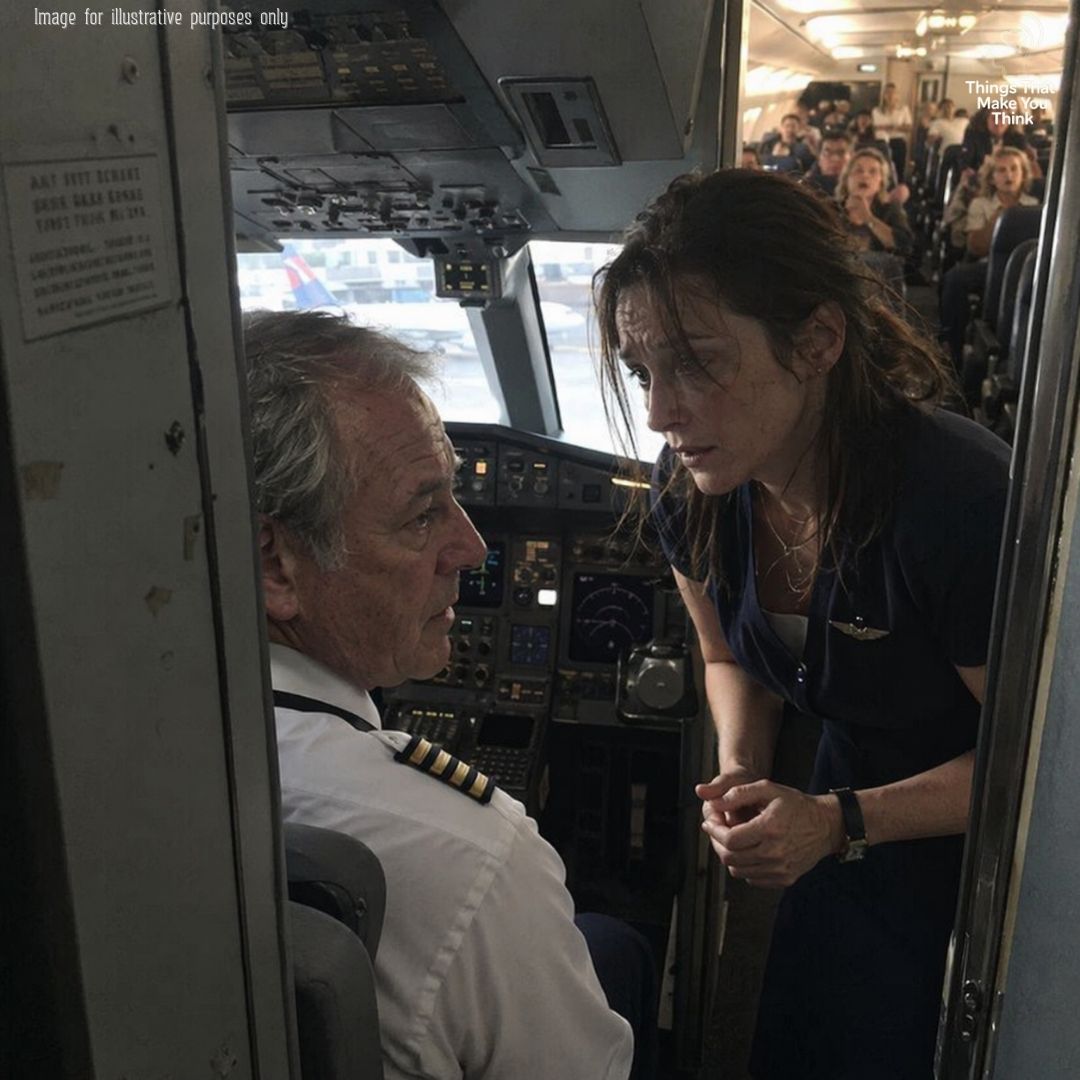
“Ma’am,” she said, softer now, “I understand. Please step into the aisle and we’ll help you get off quickly.”
But the woman wasn’t done. People like that rarely are—because what they’re fighting isn’t really the delay.
“It’s not fair,” she said. “I’m sorry for them, I am, but this is not… this is not a funeral home. This is a plane.”
A hush moved through the front rows like someone had opened a freezer door.
Sarah paused.
I knew that pause. I’d felt it myself a thousand times in the air. It’s the moment you decide whether you’re going to protect peace or tell the truth.
Sarah chose peace.
“Yes, ma’am,” she said. “Let’s get you where you need to go.”
The woman huffed and shoved past a man who was still standing in the aisle with his bag half out of the bin, frozen by what he’d just heard.
As she moved toward the exit, I saw her face briefly—eyes wide, jaw clenched, cheeks flushed.
Not cruel.
Terrified.
I leaned back in my seat and stared at the dark glass of the cockpit window. My own reflection looked older than it had that morning.
This is what people don’t understand about grief.
It doesn’t stay neatly inside the family who earned it.
It spills.
It touches strangers.
It disrupts schedules.
It forces your hand to pause on a zipper and your mind to remember that we’re all one bad phone call away from being the couple in row 24.
And that is exactly why some people fight it.
Because if they admit it can happen to them, the whole illusion of control collapses.
The last of the passengers filed out. Sarah gave me the all-clear. The cabin finally quieted down, that hollow calm after a storm.
I unlatched my harness and stood.
My knees actually protested.
I’m not fragile, but I’m not twenty-five anymore. I’ve carried a lot of turbulence in these bones.
When I stepped into the empty cabin, it looked different without the people. Every seat held the faint warmth of the bodies that had been there. A forgotten water bottle rolled gently under a row. A crumpled boarding pass lay by the galley like a shed skin.
Sarah met me near the front.
“They’re waiting,” she said.
“Who is?”
She nodded toward the open aircraft door. “The escort. And the family. They asked if you could come out for a second.”
My heart gave a strange, sharp pull.
“Where are they?” I asked.
“Jet bridge,” she said. “Before the terminal.”
I took a breath and stepped out of the cockpit.
The jet bridge smelled like hot metal and stale air-conditioning. The fluorescent lights made everything look slightly unreal, like a memory.
Halfway down the bridge stood the young Sergeant in dress blues. His posture was perfect. His hands were clasped behind his back. His eyes were fixed on a point that wasn’t there.
Beside him were the parents.
The mother’s tissue was now a damp wad in her fist. The father’s faded ball cap sat low on his brow. I could see his hands trembling slightly, like the clapping had taken whatever strength he had left.
When they saw me, the father straightened.
He took one step forward, and I noticed something I hadn’t from the cockpit: he was walking like a man with a bruise on the inside. Each step cautious, as if the floor might tilt and he might slide into a place he couldn’t crawl out of.
“Captain,” he said.
His voice didn’t break. That almost made it worse.
“I’m sorry,” I blurted, immediately hating the words. Sorry for what? That his boy was in a box beneath my feet?
But the father shook his head.
“Don’t be,” he said quietly. “You… you gave him something today.”
Read more by clicking the (NEXT »») button below!