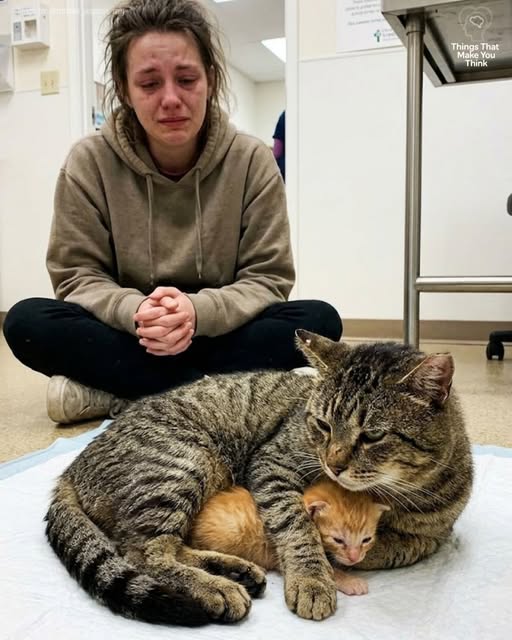
Not at that woman, exactly.
Life is messy.
People get overwhelmed.
Housing rules are real.
Money is real.
Exhaustion is real.
But I could not stop thinking about how quickly the world teaches us to sort living things by convenience.
Young is easier.
Healthy is easier.
Quiet is easier.
Cute is easier.
Anything that needs too much, takes too long, costs too much, sheds too much, cries too much, slows down too much—well.
Suddenly people start talking about practicality.
And once practicality takes over, tenderness goes first.
I sat on the edge of my bed that night with Sunny asleep against my thigh and thought something that made me uncomfortable because it felt too true.
A lot of people do not know how to love once love stops being easy.
They know how to enjoy.
They know how to choose.
They know how to claim.
But staying, really staying, once something becomes inconvenient or expensive or old or hard—that is where the numbers get small.
The next morning I went back to the clinic with coffee and a bag of paper towels.
No reason.
No appointment.
Just an awkward feeling that I should do something with the ache that had been sitting in me since I heard that woman say nobody really wants old cats.
The assistant with tired eyes laughed when she saw me.
“Back again?”
I held up the bag.
“I promise I’m not trying to move in.”
She smiled.
“We’ve had worse ideas.”
That was how it started.
Not with a grand decision.
Not with some dramatic vow to change my life.
Just with me coming by once in a while.
Dropping off supplies.
Holding a carrier while someone filled out paperwork.
Folding donated blankets in the back when they were short staffed.
Refilling water bowls.
Sweeping fur from corners.
I did not become some kind of hero.
I became useful.
And useful, I learned, can heal a person in ways attention never does.
Sunny kept getting stronger.
By the end of the month he was climbing onto the windowsill again.
He was eating like he had a personal grudge against the food bowl.
He pounced on my shoelaces.
He attacked dust motes.
He ran sideways down the hall at midnight for reasons known only to cats and whatever strange weather lives in their brains.
Sometimes I would wake up in the dark to the sound of him batting at a crumpled receipt like it had insulted him personally.
And I would lie there smiling.
Not because my life had become perfect.
It had not.
The bills were still there.
The job was still the job.
The apartment was still too quiet in certain corners.
I was still me.
But I was no longer just moving through my days waiting to get through them.
That is not a small difference.
It is the difference between surviving a life and belonging to it.
I started bringing Sunny with me sometimes when the clinic was calm and the staff said it was okay.
He was due for checkups anyway, and by then everybody knew him.
“He’s the orange baby Moose adopted,” the desk woman joked once.
Sunny, who had grown exactly enough confidence to become a menace, acted like he was famous.
He would come in puffed up with importance, then melt into complete devotion the second Moose appeared.
It happened every time.
Moose would round the corner.
Sunny would go still.
Then he would make that same tiny chirp and lean forward in the carrier.
And Moose—old, unhurried, dignified Moose—would come over and greet him like no time had passed.
I started watching for it.
Needing it, maybe.
The weird thing was, Sunny was different after those visits.
Calmer.
Not sleepy.
Settled.
As if something in him got reset by being near the cat who remembered the worst version of him and met the better one without surprise.
I understood that too.
Some people know the moment they met you.
Very few know the version of you that almost disappeared and do not look away from the version that came back.
About six weeks after Sunny got sick, I took a picture that changed more than I expected.
It was a simple one.
Moose curled on a folded blanket near the recovery room door.
Sunny sitting beside him, upright and alert now, his orange coat finally starting to look full again.
Moose looked like weathered wood and old patience.
Sunny looked like sunlight learning how to take shape.
Their bodies were not touching.
But they were close.
Close in the deliberate way that says connection without needing to prove it.
I posted it late that night because I could not sleep.
No plan.
No strategy.
Just the picture and the truth.
I wrote about the morning I thought Sunny would die.
I wrote about the clinic floor.
I wrote about Moose laying down beside him like he remembered what it was to be too weak to lift your head.
I wrote about the note in the frame.
About how Moose had once been the sick one.
About how he stayed.
About how I had been lonelier than I admitted, and how one orange kitten and one scarred old tabby had dragged me back toward life without either of them knowing it.
I expected maybe a few friends from work to click the heart button.
Maybe a comment or two.
That was it.
By the next afternoon, thousands of people had shared it.
I wish I could tell you that was purely beautiful.
It was not.
Some of it was.
A lot of it was.
People wrote about dogs who stayed by hospital beds.
Cats who waited in windows.
Old pets who held them together through divorces, layoffs, funerals, empty houses, panic attacks, grief so heavy it made the dishes in the sink feel impossible.
People wrote, “I needed this today.”
People wrote, “I haven’t stopped crying.”
People wrote, “This old cat understands more than most people I know.”
But the internet is still the internet.
And the bigger the story got, the uglier some of the responses became.
People said I was making too much of an animal.
People said folks in this country would spend money on cats while ignoring human beings.
People said pets had become emotional replacements because adults no longer knew how to build real lives.
People said old animals were a financial black hole and clinics should focus on “cases with actual long-term value.”
That one sat with me.
Actual long-term value.
As if worth could be measured like a return on investment.
As if being old automatically makes a life less deserving of care.
As if comfort only matters when it comes from something still young enough to be considered promising.
I kept reading even when I knew I should stop.
Sunny was asleep on the couch with all four paws in the air.
The room was dim.
My phone kept lighting up against the armrest.
And there I was, letting strangers tell me what counted as meaningful love.
One comment said, “People call this heartwarming, but this is why everyone’s so soft now. Not every weak thing needs saving.”
I stared at that one for a long time.
Not every weak thing needs saving.
It was such a brutal sentence.
And not because it was loud.
Because it was efficient.
It took the whole messy, sacred, exhausting business of caring for something vulnerable and flattened it into logic.
There are ideas like that everywhere now.
Not just about animals.
About people too.
If you are too slow, too old, too sick, too needy, too expensive, too inconvenient, too complicated to fit neatly into somebody else’s schedule or worldview, a certain kind of mind starts calculating your worth right in front of you.
They call it realism.
They call it discipline.
They call it common sense.
What it often is, is fear dressed up as wisdom.
Fear of burden.
Fear of dependence.
Fear of being asked for more than comfort.
Fear of having to admit that love costs.
The post kept spreading.
The clinic’s phone started ringing more than usual.
People wanted to donate.
People wanted to send blankets, food, toys, heating pads.
People wanted to know if Moose was adoptable.
That part made the staff laugh darkly.
“Moose would never forgive us,” the desk woman said.
People also wanted pictures.
Meet-and-greets.
Updates.
Daily content.
A woman drove forty minutes because her teenage daughter had seen the post and wanted to “hug the miracle cat.”
The clinic had to put up a small sign asking visitors not to crowd the lobby or photograph animals receiving treatment.
That was when I learned another hard thing.
The internet loves tenderness in theory.
But once it decides something is beautiful, it can consume it.
It does not always know how to protect the very thing it claims to love.
Moose handled the attention exactly the way you would expect Moose to handle anything.
He ignored most of it.
He moved when he wanted.
Slept when he wanted.
Chose who got his attention and who did not.
Children adored him.
He tolerated them if they were gentle.
Adults bent themselves into emotional shapes around him.
He acted as if human projections were weather.
But he was getting older.
That part was easy to see once I had begun really looking.
He slept harder.
Moved slower.
His hips seemed stiff some mornings.
There were days he did not come out to the front at all.
And when I finally asked about it, the assistant with tired eyes looked away before answering.
“He’s fine,” she said first.
Then, because she was honest, she added, “He’s old.”
There it was again.
Old.
Such a neutral word.
Such a frightening one when it touches something you love.
I think people imagine that fear of loss arrives in one big dramatic wave.
Sometimes it does.
But often it comes in smaller moments.
A pause before a jump.
A slower walk.
A body that once moved through the world like certainty beginning, very gently, to negotiate.
I started coming by more.
Not because anyone asked me to.
Because I had begun to understand that time with something precious does not become more valuable after it is gone.
It is valuable while you still have it.
That should be obvious.
It is not.
One Thursday afternoon I was helping sort donated food in the back when I heard voices at the front desk sharpen.
Not shouting.
That was almost worse.
A man in a clean jacket was standing at the counter with a carrier at his feet.
Inside was a thin brown tabby missing part of one ear.
The cat’s face was swollen on one side.
He looked feral.
Or close to it.
The man’s mouth was set the way people set it when they want to seem reasonable while saying something cruel.
“I’m not paying that much for a stray,” he said.
The desk woman kept her voice calm.
“He has an abscess and likely an infection. If you want him treated, that’s the estimate.”
The man let out a hard breath.
“For a cat that’s just going to go back outside?”
Read more by clicking the (NEXT »») button below!