A tiny smile flashed across her face before discipline reclaimed it.
The room blurred unexpectedly. You blinked hard, annoyed by your own eyes. Beside you, Marisol noticed and said nothing, which was one of the kindest things anyone had ever done.
After the ceremony, Lucía held up her certificate like a legal document proving she belonged in the world.
“I told you I’m good at numbers now,” she said.
“You did,” you replied.
She pointed at the twins. “They eat too much.”
“That is generally considered a positive development.”
She nodded gravely. “Also Mateo bit a teacher.”
“He has leadership energy,” you said.
For the first time, Marisol laughed so freely that strangers turned to look.
It changed her whole face.
There are moments when you realize your life has shifted beyond revision. Not because of contracts or acquisitions or losses publicly acknowledged. Because of quieter things.
A child handing you a crayon drawing. A woman leaving tea outside your study because you forgot dinner again. The sound of twin boys running through a courtyard that used to echo with nothing but filtered fountains and controlled silence.
You had spent years building a fortress.
Then hunger, rain, and one fearless little girl had turned it into a home before you fully understood you wanted one.
The proposal did not happen dramatically.
No orchestra. No rooftop restaurant. No photographers. You had already learned that love displayed too brightly can become performance, and both of you had survived enough performance for one lifetime.
It happened on a Tuesday.
Lucía was doing homework at the dining table. The twins were asleep upstairs after finally surrendering to afternoon exhaustion. Marisol was slicing mangos in the kitchen, sunlight turning the knife blade briefly gold.
You were reading emails you had no intention of remembering when you looked up and understood, with unusual calm, that you did not want the legal temporary language around this family anymore.
Not because possession had replaced kindness. Because belonging had replaced contingency.
So you stood, walked into the kitchen, and said, “I don’t want you to leave when the last social review clears.”
Marisol looked up slowly.
“That is not a proposal,” she said.
“I know.”
“Good. Because if you ever propose to me like a quarterly update, I’ll throw something.”
“Noted.”
She set the knife down. “Alejandro.”
You met her eyes.
“I love the children,” you said. “All three. And I love you in the very inconvenient, irreversible way I used to think only happened to people less cautious than me.
I’m still learning how not to control everything that matters to me. I may be learning that for the rest of my life. But I know this much: I do not want to build another version of loneliness and call it success.”
Marisol said nothing for a moment.
Then, very softly, “Do you know what scares me most?”
“What?”
“That one day I’ll wake up and all this will feel borrowed.”
You moved closer, slowly enough to let her step back if she wished.
“It won’t be borrowed,” you said. “Not if we build it together. Borrowed things can be taken back. Built things have to be dismantled. I’m not leaving.”
There it was again—those last three words, echoing from a hospital hallway months earlier, now offered with more weight because they were no longer made from rescue but choice.
Tears filled her eyes.
“You’re still terrible at romance,” she whispered.
“I’m excellent at legal permanence.”
That made her laugh through the tears, which felt like mercy.
When you finally did ask properly, weeks later, Lucía approved the ring first.
“It’s not too shiny,” she declared. “That helps.”
The wedding, small and private, took place in the courtyard beneath strings of warm lights.
Lucía wore pale blue and walked Marisol halfway down the aisle before taking her place beside you with enormous dignity.
Mateo and Tomás, now toddlers fueled by chaos, made it halfway through the ceremony before one sat down in the flower petals and the other tried to eat a ribbon. Your lawyer cried openly.
Your board chair looked confused but supportive. Even the press, kept at a distance, managed unusual restraint for twenty-four hours.
When Marisol reached you, she smiled with the kind of peace no money can fabricate.
You took her hand.
And for once in your life, certainty did not feel like control.
It felt like gratitude.
Years later, people still retell the supermarket story.
They get parts wrong. They romanticize the rain. Exaggerate your expression. Turn Lucía into a symbol because symbols are easier than children who actually have to heal.
They say you rescued a family. They say a billionaire found redemption in the poor. They say the universe arranged a lesson for a cold man with too much money.
Most of them misunderstand.
Because the truth is not that you saved them.
The truth is that an eight-year-old girl walked barefoot into a luxury store carrying two cans of formula and more courage than an entire room of adults. She begged for her brothers, not herself.
She knelt in humiliation and still did not let go of hope. Then she walked back through a storm toward a dark house because love was waiting there hungry.
You only followed.
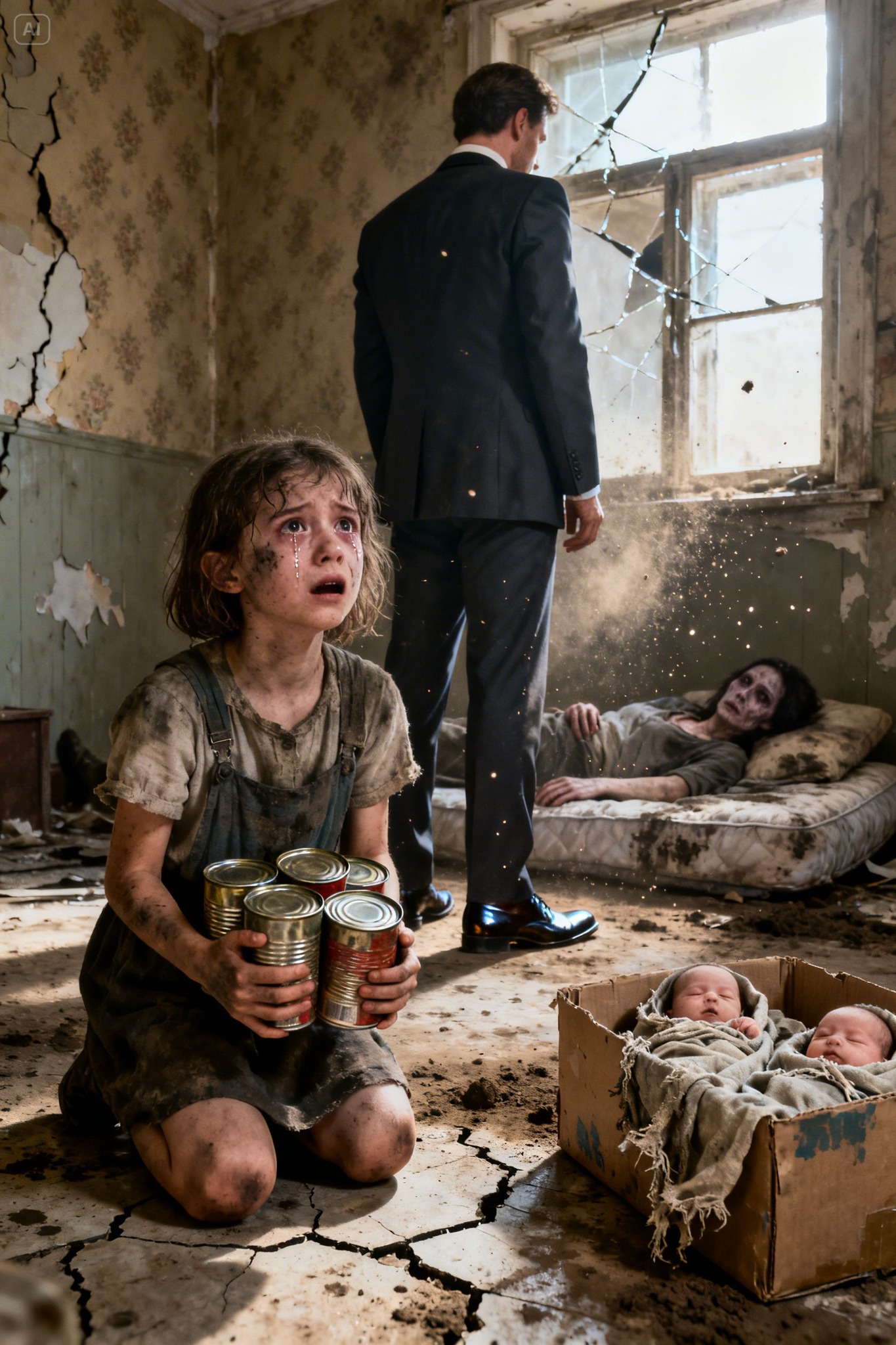
And when you reached that broken room and saw what hunger, neglect, and social indifference had done to a mother and her children, you were finally forced to confront what your fortune had hidden from you for years:
that the world is not divided between people who matter and people who don’t. It is divided, more often, between those whose suffering is witnessed and those whose suffering happens out of sight.
Lucía dragged that suffering into sight.
Everything after that was simply your decision not to look away.
If there is a lesson in the ending, maybe it is this:
Sometimes the person who changes your life is not the one who arrives strong enough to save you.
Sometimes it is the child who is already drowning and still has the courage to ask for milk.
And sometimes the holiest thing a person can do—whether rich or poor, broken or powerful—is answer that plea not with pity, not with spectacle, but with presence.
You stayed.
She survived.
And in the life that followed, all of you became something none of you had been when that storm began:
A family not built by blood alone, but by the night no one worth loving looked away.
Read more by clicking the (NEXT »») button below!