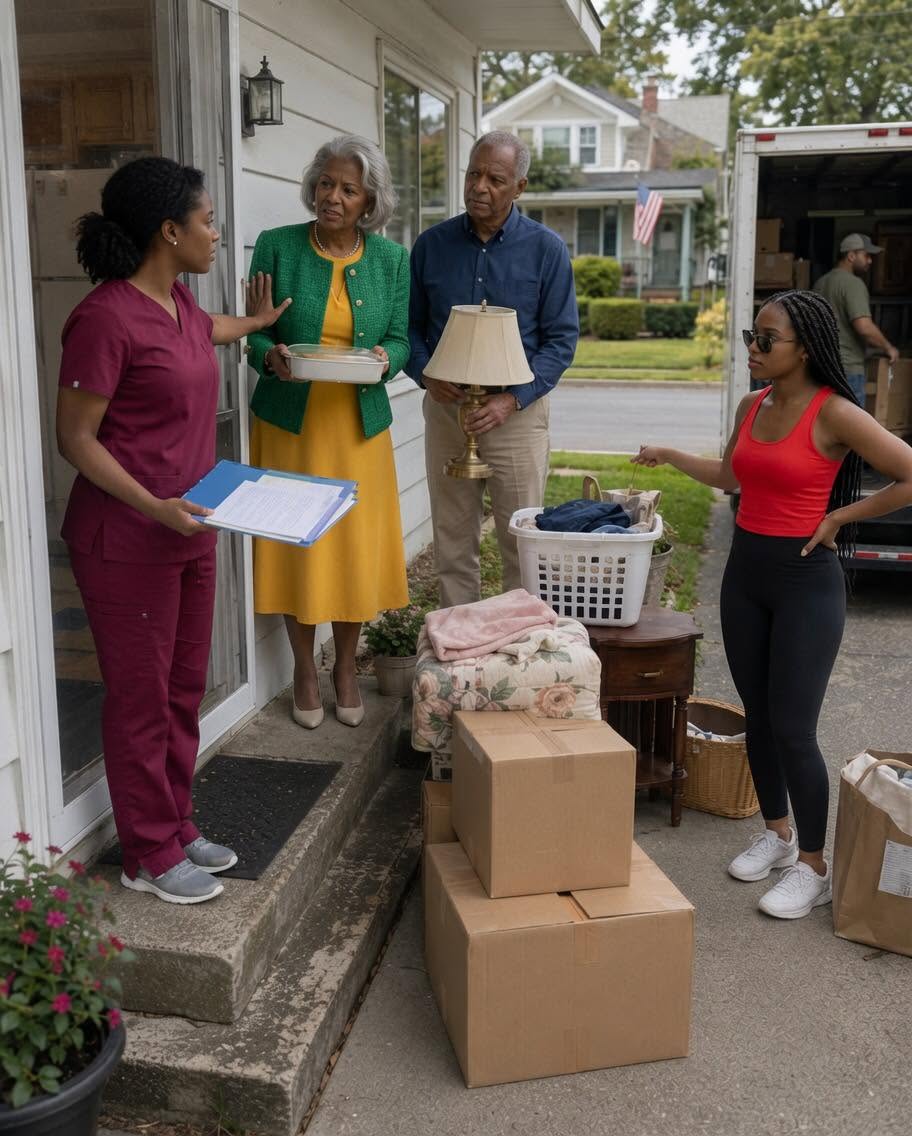
“No,” I said. “I’m locking my door.”
The moving truck left forty minutes later.
Not quickly.
Not cleanly.
Colleen cried, cursed, and accused me of making her look like a criminal.
My mother told me I would regret being so cold.
My father loaded in silence.
The driver kept his eyes down and moved fast.
When the last box was off my grass, I walked every room again and checked every window.
Then I changed the lock code on the garage keypad.
I texted my mother one sentence.
Do not come to my house without being invited.
She replied six minutes later.
After all we’ve done for you.
I almost answered.
I almost listed the years I had paid bills, covered repairs, bought groceries, loaned money that never returned, and swallowed every family meeting that ended with me giving something up.
But I was tired of presenting evidence to people who had already decided my life belonged to them.
So I did not write back.
Nana Ruth called that night.
I do not know who told her first.
Maybe my father.
Maybe the neighborhood gossip network that works faster than the internet.
She did not ask if I was okay in the soft, worried voice people use when they want you to fall apart.
She asked, “Did you hold the door?”
“Yes,” I said.
“Good,” she said. “Now keep holding it.”
The next week was ugly.
My mother called me selfish in the family group chat.
Colleen posted vague quotes about people who forget where they came from.
A cousin I barely knew messaged me that family should help family.
I sent none of them the folder.
I sent none of them the screenshot.
People who wanted the truth could ask for it.
People who wanted a villain already had one.
On Friday afternoon, my father came by alone.
He stood on the porch with both hands visible and did not try the door.
That mattered more than I expected.
When I opened it, he looked older than he had the week before.
“I brought your spare key back,” he said.
I had forgotten he even had one.
He held it out on his palm.
For a second, I saw all the years he had stayed quiet.
All the dinners where my mother volunteered me.
All the times he looked down instead of helping.
An apology does not erase a pattern.
But sometimes it names one.
“I should have asked you myself,” he said.
“Yes,” I said.
He nodded.
“I’m sorry.”
I took the key.
I did not invite him in.
That was new for both of us.
A month later, Colleen found another place with a roommate.
My mother did not speak to me for three weeks, which turned out to be quieter than I expected and less painful than I feared.
When she finally called, she started with, “I hope you’re happy.”
I looked around my kitchen.
The cabinets still stuck.
The floor still creaked.
There was a laundry basket of clean towels on the chair and a grocery bag on the counter I had not unpacked yet.
The house was ordinary.
It was imperfect.
It was peaceful.
“I’m getting there,” I said.
She hung up.
I set the phone down and stood in the middle of the kitchen where the old printer had spit out that payoff letter.
For most of my life, I thought being a good daughter meant keeping the family comfortable, even if I was the one who had to shrink.
I thought being a good sister meant opening my hand every time Colleen opened hers.
I thought peace meant letting my mother tell the story.
But peace that requires your surrender is not peace.
It is just a quiet room where everybody knows who is being used.
That night, I put the blue folder in the top drawer of my desk.
Then I locked the front door, checked the porch light, and made myself dinner.
No casserole.
No audience.
No boxes on my lawn.
Read more by clicking the (NEXT »») button below!