Especially not when the answer hurts.
—
I should’ve left.
I knew that.
But Mary looked at me with pleading eyes.
Not “save me.”
Just “please don’t leave me alone in this room with my own daughter.”
So I stayed quiet.
Claire paced once, then stopped at the foot of the bed.
“I’m arranging a facility,” she said. “Short-term. Rehab. Then we’ll see.”
Mary’s face tightened.
“A facility,” she repeated, like the word tasted bitter.
“It’s safer,” Claire insisted.
Mary shook her head slowly.
“I don’t want to die in a place where nobody knows my Wednesday,” she said.
Claire blinked.
“What?”
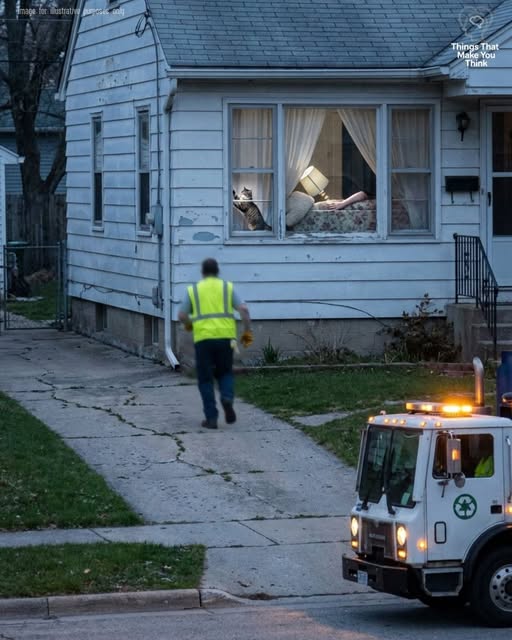
“My Wednesday,” Mary repeated, voice stronger. “My routine. My porch light. My cat in the window.”
Claire scoffed.
“That’s not a reason.”
Mary’s eyes flashed.
“It’s the only reason,” she said. “Routine is how you know someone is still here.”
Claire stared at her like she didn’t recognize her.
Then Mary said the sentence that made my throat sting.
“You used to call every Sunday,” she whispered.
Claire’s face tightened.
“I was in college,” she said quickly. “Things change.”
Mary nodded.
“Yes,” she said. “They do.”
Her voice dropped.
“And then you stopped.”
The room went silent.
Claire’s eyes flicked away.
For the first time, she looked… young.
Not in a flattering way.
In a scared way.
“Mom,” she said, softer, “you don’t know what my life is.”
Mary nodded again.
“You’re right,” she said. “Because you never tell me. And you never ask about mine.”
Claire opened her mouth.
Closed it.
Then she said something that surprised me.
Something messy.
Something human.
“I couldn’t,” Claire whispered. “Okay? I couldn’t keep… doing it.”
Mary’s brow furrowed.
“Doing what?”
Claire swallowed hard.
“Feeling guilty,” she said. “Every time you sounded lonely. Every time you made a joke about dying.”
Mary flinched.
Claire’s voice shook.
“I live three time zones away,” she said. “I have a job that eats me alive. I have… things. And every time I called, I felt like I was failing you anyway.”
Mary stared.
Not angry.
Just… stunned.
Claire blinked fast like she hated her own tears.
“So I stopped,” she said. “Because it was easier than listening to myself feel like a bad daughter.”
There it was.
Not a villain monologue.
A confession.
Still painful.
Still selfish.
But real.
Mary’s lips trembled.
“I didn’t want you to feel guilty,” she whispered. “I wanted you to feel… connected.”
Claire wiped at her face like it offended her.
“I’m here now,” she said, almost defensive.
Mary’s gaze held hers.
“I’m glad,” she said. “But you’re here because strangers saw me first.”
Claire looked away.
And the silence between them wasn’t hate.
It was grief.
For years that could’ve been different.
For calls that didn’t happen.
For a relationship that turned into a gap so wide a cat had to scream to bridge it.
—
After that, the neighborhood changed.
Not all at once.
Not magically.
But enough to make people uncomfortable.
Because discomfort is the first step toward doing something different.
Doug knocked on my truck window the next Wednesday and handed me a piece of paper.
“Sherry made a list,” he said.
It was names.
Addresses.
Phone numbers.
Emergency contacts.
All the people on the street who lived alone.
All the people who had routines.
All the people who could disappear quietly if nobody looked.
At the top, Sherry had written:
“PORCH LIGHT CHECK.”
I raised an eyebrow.
Doug shrugged.
“People were arguing online,” he said. “About privacy. About responsibility. About ‘mind your business.’”
He exhaled.
“And then Sherry said, ‘Fine. Let’s make it everybody’s business—voluntarily.’”
So they did.
They started a simple plan.
Nothing official.
Nothing fancy.
Just human.
If an older neighbor’s porch light stayed on past morning? Someone knocked.
If the newspaper stacked up? Someone checked.
If the blue cart didn’t show up on pickup day? Somebody asked why.
And if nobody answered?
They didn’t break doors down.
They didn’t play hero.
They called for help.
They used the lockbox—if there was one.
They stopped pretending silence meant “fine.”
Not everyone loved it.
One guy on the corner snapped, “I don’t want people watching my house.”
A woman across the street said, “This feels invasive.”
Doug answered, blunt and honest:
“Then opt out. But don’t call it invasive when it saves someone’s life.”
That started a whole new argument.
People in the comments section went crazy.
Some said, “Community is dead.”
Others said, “This is how you bring it back.”
Some said, “It’s not my job.”
Others said, “It’s everyone’s job.”
And here’s the truth nobody likes:
Both sides have a point.
Because nobody wants to be judged.
And nobody wants to be forgotten.
So where’s the line?
That’s the question.
That’s the controversy.
That’s the conversation we avoid until a cat screams at a window.
—
Lollie came back a week later.
I brought her home myself.
Mary wasn’t home yet—still recovering, still rebuilding strength.
But Claire met me at the house.
She looked different.
Not softer exactly.
Just… less polished.
Like she hadn’t slept much.
“Thank you,” she said quietly, taking the carrier handle.
I nodded.
Lollie stared at Claire through the plastic door like she was evaluating her.
Claire huffed a small laugh.
“I know,” she murmured. “I know. I’m late.”
She looked at me, then down at the ground.
“I saw the comments,” she said.
“Yeah,” I answered.
Claire’s jaw tightened.
“Some people called me a monster,” she said.
I didn’t respond.
Because what do you say to that?
Sometimes the internet is cruel.
Sometimes it’s accurate.
Sometimes it’s both.
Claire exhaled.
“I’m not a monster,” she said, like she needed to convince herself. “I’m just… tired.”
I nodded slowly.
“Tired doesn’t turn off love,” I said. “It just makes it harder to show.”
She swallowed.
Then she surprised me again.
“I didn’t know she left you water,” Claire said.
I blinked.
“She never told me,” Claire whispered. “About you. About the honks. About the cat in the window.”
She stared at the cottage like it was a stranger.
“I didn’t know she had a whole life that didn’t include me,” she said.
That line hit me.
Because that’s what happens.
People keep living.
Even when someone stops showing up.
Mary had built small connections like bricks.
A bottle of water.
A cat at the window.
A wave to the garbage truck.
Little proof that she existed.
Claire had missed all of it.
Not because she didn’t love her mother.
Because love without presence turns into a story you tell yourself.
And stories don’t answer porch lights.
—
The day Mary came home, Sycamore Terrace lined the curb like it was a parade.
Not with balloons.
With normal clothes.
With awkward faces.
With people who didn’t know what to say but finally understood that silence is not kindness.
Mary stepped out of the car slow, leaning on a cane.
Her hair was brushed.
Her face still thin.
But her eyes had that same stubborn spark.
Lollie walked out of the house like she owned it.
She trotted straight to the front window.
Jumped up.
And sat.
Like a guard returning to her post.
Mary saw her and laughed—real laughter this time.
“I told you,” Mary said to Claire, voice loud enough for the street to hear. “She runs this place.”
Claire smiled, small and crooked.
Then Mary looked around at the neighbors.
Doug cleared his throat.
“We, uh… we made you a schedule,” he said.
Mary blinked.
“A schedule?”
Sherry stepped forward, holding a piece of paper.
“Check-ins,” she said. “Just… hellos. Not to hover. Not to invade. Just to notice.”
Mary stared at it like it was a foreign language.
Then her eyes filled up.
“Oh,” she whispered.
She pressed a hand to her chest.
“You mean… you’re going to look?”
Sherry nodded.
Mary swallowed.
And she said the thing that made the whole street go still.
“I prayed for that,” she said simply. “On the floor.”
Nobody had a comeback for that.
Because there isn’t one.
—
Later, when the crowd thinned and the porch light clicked on for the evening—on purpose, not forgotten—
Mary handed me a small envelope.
“For you,” she said.
I opened it in my truck.
Inside was a note in shaky handwriting.
Marcus,
You honk like the world still has rules.
Thank you for being the kind of person who notices when a rule breaks.
And tell Lollie she’s grounded for scaring everyone.
—Mary
I laughed and wiped my face with my sleeve like it was sweat.
It wasn’t.
—
Here’s what I can’t stop thinking about.
A street full of people didn’t notice.
A grown daughter didn’t call.
But a cat did.
A cat turned a window into a siren.
And a trash truck became the first responder.
That’s not a cute story.
That’s a warning.
Because this isn’t rare.
It’s happening everywhere.
Older folks living alone in quiet houses.
Kids living busy lives in loud cities.
Neighbors living ten feet apart like strangers.
We’ve built a culture where “minding your business” is treated like a virtue.
Even when it becomes a cover for neglect.
So I’m asking you something, and I genuinely want the comments to get messy:
Where’s the line?
When does “privacy” become “abandonment”?
When does “independence” become “danger”?
When does “I don’t want to bother anyone” become a death sentence?
And if you were Mary—
Would you want your neighbors to check?
Or would you rather lay there quietly so nobody feels inconvenienced?
Be honest.
Because the answer tells you what kind of world you’re helping build.
And whether it’s a world where someone notices…
Or a world where it takes a cat screaming at glass to make anybody look.
Thank you so much for reading this story!
I’d really love to hear your comments and thoughts about this story — your feedback is truly valuable and helps us a lot.
Please leave a comment and share this Facebook post to support the author. Every reaction and review makes a big difference!
This story is a work of fiction created for entertainment and inspirational purposes. While it may draw on real-world themes, all characters, names, and events are imagined. Any resemblance to actual people or situations is purely coincidental.
Read more by clicking the (NEXT »») button below!
ADVERTISEMENT ADVERTISEMENT