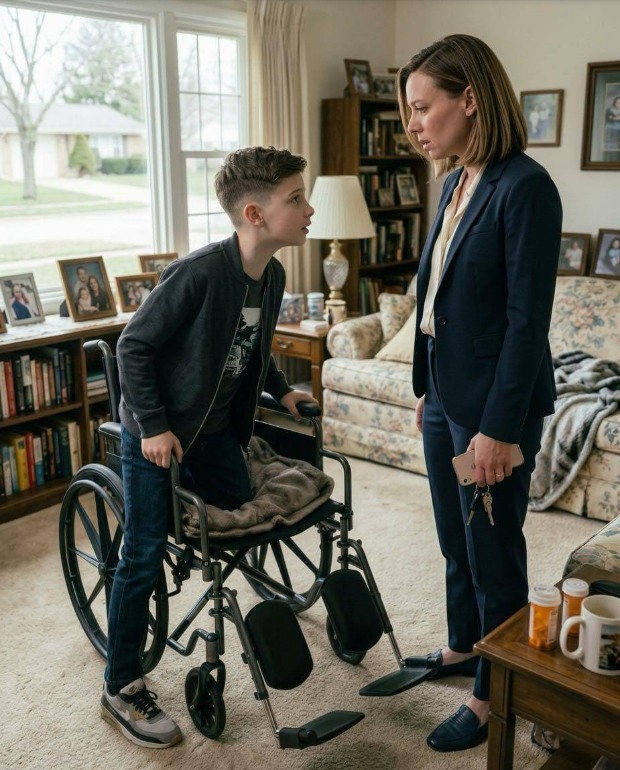
“You can walk,” I finally managed. It was not a question so much as my mind attempting to process something it had no framework for.
He nodded. His wide eyes were fixed on my face, and his hands — both of them, hanging loosely at his sides — were trembling with visible effort to remain still.
“You need to listen to me right now,” he said. “Right now, today. You need to run.”
Every nerve ending in my body responded to those words as though they had been spoken directly into the center of my chest.
“What are you talking about?” I whispered.
He reached out and closed his hand around my wrist. His grip was surprisingly firm, grounded in something beyond his twelve years.
“He is not coming back,” Eli said.
Chapter Three: What the Boy Had Already Lived Through
The kitchen seemed to tilt around me. I gripped the edge of the counter with my free hand and steadied myself, staring at this boy who had just dismantled everything I believed I understood about my own life with six quiet words.
I took a breath. I forced myself to think.
“Eli,” I said, as evenly as I could manage. “Tell me exactly what you mean.”
He turned toward the front windows first and looked out across the long driveway toward the road, checking — I understood immediately — whether Daniel’s SUV might somehow still be visible. Then he turned back to me, and the expression on his face was something I was not prepared for. It was not simple fear. Fear I might have managed. What I saw instead was something flatter and more worn than fear — the particular expression that settles onto a person’s face after they have already survived something devastating once and are now watching the same machinery begin to turn again.
“He leaves them,” Eli said. His voice was quiet and deliberate, like someone reciting something they had rehearsed many times in private. “He has always done this. He leaves, and then something happens.”
“Leaves who?” I asked.
He swallowed. “You are the third one.”
The tightening in my chest was immediate and physical. My mind moved on its own toward the things Daniel had told me. His first wife — a woman I had never met and knew only through his descriptions — had died due to a medical error. A tragic, senseless loss, he had said, with the careful grief of a man still carrying the weight of it years later. His former fiancée had simply disappeared one day without warning or explanation, which he described with a specific kind of quiet hurt, as though her absence had been an abandonment rather than anything else.
I had accepted both of those stories completely. Why would I not? They were delivered with such consistency. Such practiced, convincing sorrow.
I looked around the kitchen. At the house I had moved into four months ago. The iron gate at the end of the drive. The security system on every exterior door, the passcode for which only Daniel had ever entered in front of me. The landline phone mounted beside the refrigerator.
“Tell me everything,” I said.
Eli took a slow, steadying breath. “This morning,” he said, “before you were awake, I heard him in the basement. He was talking to a man he called Mr. Grady. I listened from the top of the stairs.”
“What did they say?”
“Mr. Grady said something about a leak. He said it would spread faster if all the windows stayed closed.” Eli paused. “Daniel said that was fine. He said that by the time it got dark, there would be no one left in the house.”
The blood pulled away from my face so completely that the kitchen briefly went gray at the edges.
And then, in the silence that followed his words, I heard it. A sound from beneath us — faint, almost imperceptible, the kind of sound you might easily explain away as the house settling. A soft, metallic click from somewhere under the floor.
“He locked the gate when he drove out,” Eli continued, his voice dropping further. “And before he left, he switched off the phone signal booster. The one in the utility room.”
I stood completely still and felt the full weight of where I was settle down around me.
Chapter Four: When Quiet Danger Finally Shows Its Shape
There is a particular quality to the moment when real danger becomes undeniable. It does not feel the way fear usually feels — sharp and sudden and moving. It feels instead like stillness. A terrible, comprehensive stillness in which everything you thought you understood about your situation rearranges itself into a shape you should have seen far sooner.
I stood in that kitchen and felt exactly that kind of stillness.
Eli reached out and took my hand. “Not the front door,” he said. “The basement door is still open. He didn’t lock it from outside.”
We moved.
We moved quickly and quietly, out of the kitchen and into the hallway and down the stairs that led to the basement. Even before we reached the bottom step, I could smell it — sharp, immediate, utterly unmistakable. Natural gas. Not the faint background trace of an old appliance. Concentrated and deliberate and already filling the lower level of the house with steady, invisible purpose.
The light coming through the small basement windows was thin but sufficient. Sufficient to show me a gas line that had been deliberately disconnected from the wall fitting. Sufficient to show me a timing device attached to the main utility box — small, compact, the kind of thing you would miss entirely unless you were specifically looking. Sufficient to show me wires running from that device toward the ignition panel, everything connected with the methodical precision of someone who had done this kind of preparation before and understood exactly how long each step would take.
My legs went soft beneath me. I caught myself against the wall.
Eli tightened his grip on my sleeve. His eyes were steady. “I told you,” he said.
I pulled him back up the stairs and into the kitchen and tried to think through what came next.
“Phone,” I said. “We need a phone.”
“No signal,” he said. “He shuts off the booster every time he leaves. I’ve seen him do it.”
The landline. I crossed to it and lifted the receiver and held it to my ear. Silence. Nothing. The night before, Daniel had mentioned the recent storm had disrupted the line. He had been so casual about it. So completely, effortlessly casual. I had believed that, too.
“Car keys,” I said.
“He takes them,” Eli said quietly. “He always takes both sets. Every time.”
That single repeated word — always — landed with a weight that no longer needed explanation.
I looked at the locked front gate. At the security panel by the door. At the empty driveway. And then I looked at Eli and made a decision.
“Shoes,” I said. “Get your shoes on. Right now.”
Chapter Five: What Was Hidden Behind the Wall
Eli ran to the mudroom at the back of the house and returned quickly, holding something small in his hand — a compact remote control, older-looking, slightly worn. He held it out toward me.
“This opens the service gate,” he said. “The small one at the far side of the property, on the back road. He doesn’t think I know where he keeps it.”
That remote was our exit. It was enough. We could have left the house that very moment and it would have been precisely the right decision.
But I found that I could not bring myself to walk out of that house without understanding what I had truly walked into four months ago. Without holding in my hands something that could not be undied or dismissed or reframed later. Without making sure that whatever had happened to the two women who had come before me would not simply be absorbed quietly and forgotten.
“Is there anything else?” I asked. “Anything he kept hidden?”
Eli’s eyes moved toward the closed door of Daniel’s private office at the end of the hall.
We went in together.
The room smelled exactly like Daniel — cedar, leather, the particular expensive cologne he wore every single day, a scent I had once associated with safety and now associated with something else entirely. The desk was large and dark-stained and completely cleared of surface clutter in the way that overly controlled spaces always are. Eli crossed the room without hesitating, crouched beside the desk, and pressed a hidden latch built into the side panel near the base.
A small section of the panel clicked and swung inward.
Inside the hidden compartment, neatly arranged: a flash drive. A passport — second one, different name, same photograph. A stack of insurance paperwork, crisp and organized. And a manila folder with my full name written across the front in Daniel’s recognizable, precise handwriting.
I opened the folder.
A life insurance policy. My name on the insured line. My signature on the consent page — forged, but done with enough care that someone unfamiliar with my handwriting would never question it. The amount was substantial. The named beneficiary was Daniel Whitmore. The date the policy had been originated was eight days prior.
Eight days before this Thursday afternoon.
I set the folder aside and looked at what lay beneath it.
Files. Two of them. Each labeled with a woman’s name I did not recognize. Inside each file were pages of handwritten notes — detailed, methodical, written in the same cold and efficient language that Daniel brought to everything he considered a practical matter. Notes about each woman’s daily schedule. Observations about how isolated they were. Assessments of how many close family members lived within driving distance. Evaluations, written plainly and without any apparent emotion, of how quickly — or rather, how slowly — anyone might begin to ask difficult questions if something were to happen to them.
I read enough to understand everything.
I put every document, every file, the flash drive, and the passport into my bag.
“We go now,” I said.
Chapter Six: The Run Across Open Ground
We left through the back of the house, moving quickly through the rear hallway and out the back door into the yard. The afternoon light was still bright, the sky clear, the kind of beautiful autumn weather that made the whole situation feel even more surreal — ordinary sky, ordinary trees, ordinary sounds of birds and distant traffic, and underneath all of it, a gas line counting down toward something catastrophic.
Eli kept pace beside me without any difficulty. More than that — he moved with the confidence of someone intimately familiar with every path, every fence line, every shadow of that property. He had clearly spent years memorizing it, maybe for exactly this kind of moment.
We moved across the rear lawn toward the tree line, following the edge of the property toward the service road that ran along the back boundary. Eli had the remote in his hand.
“My mother did not die because of her medication,” he said suddenly, his voice controlled and even, like someone reporting a fact they had long since come to terms with.
I glanced at him as we moved.
“She was screaming,” he said. “Before it got quiet. I was very young, but I remember it.”
There was nothing I could say to that. Nothing that would have been sufficient.
We reached the service gate. Eli held up the remote and pressed the button, and there was a soft mechanical sound as the lock disengaged and the gate swung slowly inward. We stepped through onto the narrow road on the other side.
I turned back once.
Behind us, the house sat at the far end of the property, quiet and still in the afternoon light, nothing visible from outside to suggest what was building beneath it. And then, just as we turned away to run, the sound came — not the sharp explosion I had anticipated, but something deeper and more hollow, a pressurized groan moving through the structure from the inside out, as if the house itself were pulling one long final breath inward before releasing it.
Then the windows blew.
The force reached us even at that distance — a wave of hot air and pressure that knocked us both forward. I pulled Eli down and we stayed low against the ground while pieces of glass and roof material and burning debris scattered across the yard behind us. When I raised my head and looked back, the rear of the house was already fully engulfed, orange fire rising fast and thick against the pale afternoon sky, black smoke beginning its long climb above the treeline in a column visible for miles.
We ran the rest of the distance to the nearest neighboring property — a farmhouse half a mile down the road — without stopping once.
By the time we arrived and the neighbor opened her door and took one look at our faces and immediately reached for her phone, every false story and carefully maintained lie that Daniel Whitmore had constructed and tended over years was burning in that same fire he had intended to use to destroy any evidence of who he actually was.
Chapter Seven: The Face of a Man Whose Plan Had Collapsed
I was convinced, standing in that neighbor’s kitchen while emergency services were dispatched and the smoke from Daniel’s burning house rose visibly above the tree line in the distance, that the hardest part was finished. We were out. We were safe. The evidence was in my bag. The truth had a shape now, solid and documented and impossible to simply dismiss.
Twenty-three minutes later, Daniel called emergency services from Hartford.
He reported his wife and son as missing persons.
Read more by clicking the (NEXT »») button below!