Harrison looked at Celeste. “You coordinated access to my medication.”
Celeste went white. “How dare you.”
“You changed the dosage schedule through a private nurse who has already spoken to the police.”
Paige began crying, but no tears fell. Andrew stared at the floor.
Then Harrison turned to him.
“And you, Andrew,” he said. “You brought Claire into this family because you thought a woman with a generous heart would be easy to manage.”
Your stomach dropped.
Andrew looked up sharply. “That’s not true.”
Harrison’s eyes did not move from him. “You told your mother she was perfect because she wanted to help people, and people who want to help are easy to guilt.”
The room blurred at the edges.
You remembered the early days with Andrew, how quickly he had admired your work, how often he had said his family needed someone real, someone grounding, someone with a conscience. You had mistaken being selected for being loved. Now the truth sat in the room like a body no one wanted to bury.
“Claire,” Andrew said, stepping toward you.
You stepped back.
Harrison’s voice softened, but only for you. “I am sorry.”
You looked at Andrew. “Was any of it real?”
His face twisted. “It became real.”
That answer was worse than no.
Celeste snapped, “For God’s sake, Andrew, stop talking.”
But Andrew’s control had cracked. “I didn’t know they would hurt him. I thought it was about the foundation. I thought Grandfather was paranoid.”
Richard shouted, “Enough.”
Harrison lifted his cane slightly, and the room quieted.
“No,” Harrison said. “Let him speak. Cowards often confess only when they feel abandoned.”
Andrew swallowed hard. “Dad said the foundation was ours. He said Grandfather was giving everything away to strangers. He said if I married Claire, it would help the family image when the board questioned the changes.”
You felt something inside you go very still.
“You were going to use me,” you said.
Andrew’s eyes filled. “At first.”
“At first,” you repeated.
He reached for you again, but you moved away before his hand could touch you. The space between you felt wider than the room.
Harrison nodded to Marianne.
She removed several documents from the folder. “Effective immediately, Mr. Whitmore has revoked all management authority previously granted to Richard Whitmore, Celeste Whitmore, and Andrew Whitmore regarding the Whitmore Charitable Trust, Whitmore House Holdings, and associated voting proxies.”
Richard lunged to his feet. “You can’t do that.”
“I already did,” Harrison said.
“You’ll destroy this family.”
Harrison looked around the foyer, at the marble, the portraits, the staircase, the people who had mistaken inheritance for immunity. “No, Richard. I am simply refusing to finance its rot.”
Marianne continued. “The trust will now be overseen by an independent board pending investigation. Mr. Whitmore has also created a new emergency housing initiative in partnership with local nonprofit networks.”
You looked up, confused.
Harrison turned toward you. “If you want it, the first director’s seat is yours.”
The room erupted.
Celeste shouted that you were a gold digger. Richard accused Harrison of senility. Paige sobbed that everyone was ruining her life. Andrew said nothing.
You raised your hands. “No. I didn’t help you for a job.”
“I know,” Harrison said. “That is why you are qualified.”
You shook your head. “I can’t accept something like that just because I found you.”
“You are not accepting it because you found me,” he said. “You are accepting it because every day, you choose to see people this family trained itself to ignore.”
That silenced you.
For years, you had fought for shelter beds, medical vouchers, donated coats, safe rooms, late-night rides, and second chances. You had begged wealthy donors for crumbs while sitting across from people who wanted applause for giving away money they would never miss. Now a man who had nearly died alone was offering you a door wide enough to push real change through.
Still, you looked at Andrew.
Maybe some part of you wanted him to redeem himself. Maybe some foolish, bruised part of your heart wanted him to say he was sorry without excuses. But he only stared at you as if your dignity had betrayed him.
That was when you knew you were free.
“I’ll consider it,” you said to Harrison. “But not today.”
A faint smile touched his face. “Good.”
Celeste laughed bitterly. “She’s pretending to be noble now. How charming.”
You turned to her. This time, you did not feel small in her house. You did not feel underdressed, late, or ashamed.
“No,” you said. “I’m making sure I don’t become you.”
Her face cracked.
You walked out of the mansion for the second time. But this time, you did not leave your ring behind as proof of heartbreak. You left nothing behind at all.
The investigation took months.
Richard Whitmore was indicted for fraud, elder abuse, and conspiracy. Celeste avoided prison at first through expensive lawyers and careful denials, but the nurse’s testimony and pharmacy records eventually cornered her. Paige disappeared to Europe and posted photos beside fountains, pretending exile was vacation.
Andrew tried to reach you in every way available to a man who had lost access to power. Emails, letters, flowers, messages through mutual friends. He apologized beautifully, which was perhaps the saddest thing, because it proved he had always known the right words and simply chosen not to use them when they mattered.
You never answered.
Not because you hated him every day. Hate would have required too much loyalty to the wound. You simply learned to put your life where his voice could not reach it.
Three months after the night at the bus stop, you accepted Harrison’s offer with conditions. You would not be a decorative director for rich donors to admire. You would build an emergency response housing program that worked with hospitals, shelters, legal aid groups, and transportation services.
Harrison agreed to all of it.
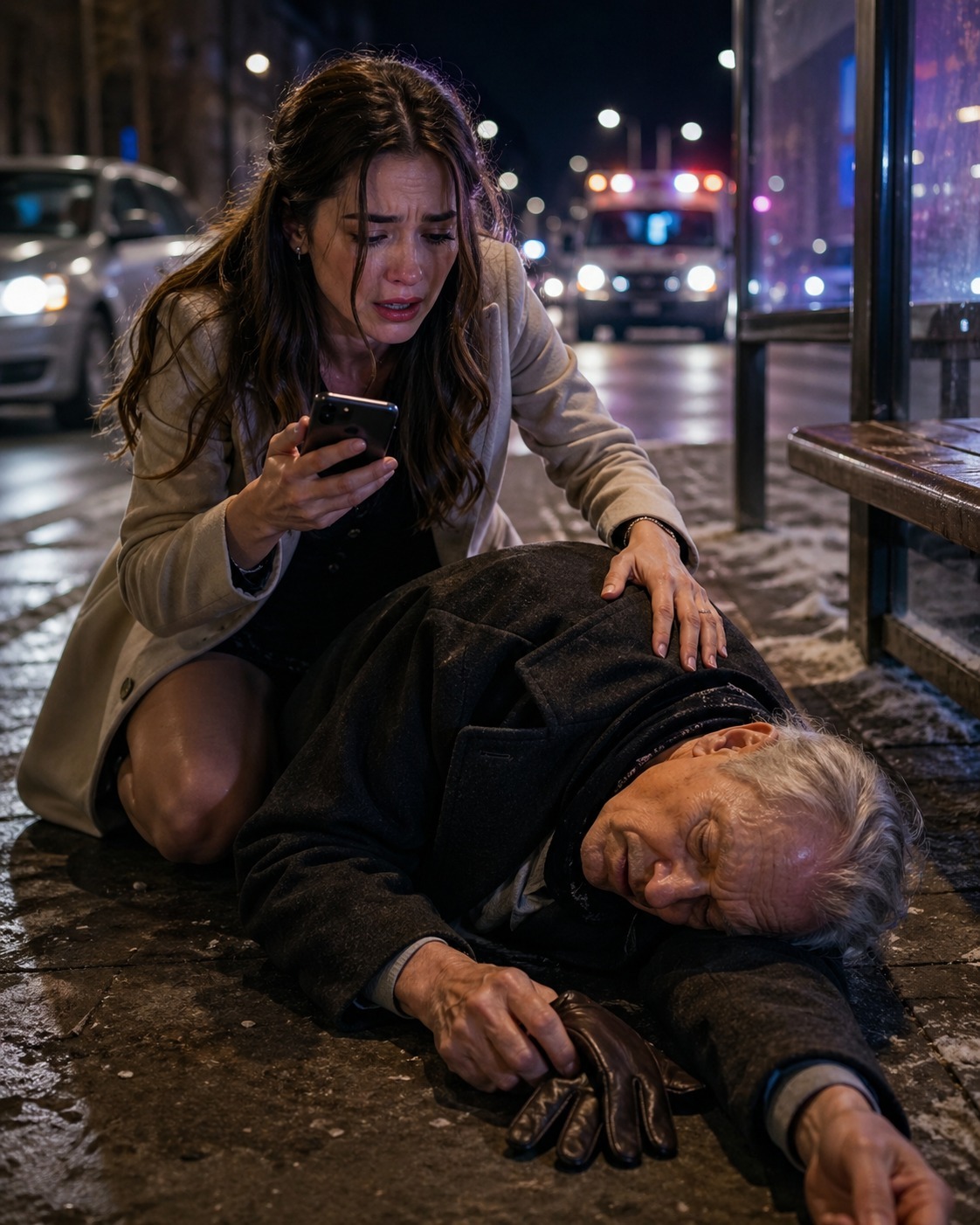
The first Whitmore Community Night Shelter opened in a renovated building in Roxbury the following winter. It had clean beds, private family rooms, case managers, laundry access, medical referrals, and a van that ran late-night routes near transit stops. Above the front desk hung a small bronze plaque.
No one should be left alone in the cold.
You stood under that plaque on opening night, wearing a simple navy dress and shoes comfortable enough to move in. Harrison stood beside you with his cane, thinner now but still sharp-eyed. Reporters came, donors came, city officials came, but the people you watched most closely were the families walking through the doors with stunned expressions, as if warmth itself had become unbelievable.
Near the end of the evening, you saw Andrew across the street.
He stood under a streetlamp in a dark coat, hands in his pockets, looking at the building his family money had created only after his family cruelty had been exposed. For a second, the old ache moved through you. Then a little girl inside the shelter laughed, and the sound pulled you back to the life you had chosen.
Andrew did not cross the street.
You were grateful for that.
Harrison saw him too. “Do you want me to have security move him along?”
You smiled faintly. “No. Let him look.”
Harrison nodded. “Sometimes that is the only punishment a person truly understands.”
Years passed differently after that.
Not easily, but honestly. You worked harder than you had ever worked, but now your work had walls, funding, staff, vans, attorneys, nurses, and heat. You stopped begging powerful people to care and started building systems that made their indifference less deadly.
Harrison became more than the man you saved. He became your mentor, your fiercest critic, and eventually something like family. He never softened in the sentimental way people expected old men to soften, but he remembered every name at the shelter and sent handwritten notes to children who got into college.
On the third anniversary of the night you found him, he asked you to drive him to Brookline Avenue.
The bus stop was still there. The bench had been replaced, the advertisement changed, and the pavement repaired where winter had cracked it. Traffic moved past in silver streams, careless as ever.
You parked by the curb and helped him out.
For a long moment, neither of you spoke.
“I was angry that night,” Harrison said finally. “Before it happened. Angry at my son, angry at my own blindness, angry that I had built so much and understood so little.”
You stood beside him, your coat pulled tight against the cold. “And then?”
“And then I woke up to a stranger telling me I wasn’t alone.” He looked at you. “That is a difficult thing to forget.”
Your throat tightened.
“You changed my life too,” you said.
“No,” Harrison replied. “You changed it first. I merely had the sense to follow.”
A year later, Harrison died peacefully in his sleep.
There were no dramatic hospital machines, no family battle at the bedside, no last-minute forgiveness scene for people who wanted inheritance without repentance. He left letters, instructions, gifts, and one final act of defiance.
At the reading of his will, Richard appeared in a prison-issued suit through a video feed. Celeste came in black with diamonds at her throat. Andrew attended alone, older, thinner, and quieter than you remembered.
You came because Marianne asked you to.
The estate lawyer read through the expected legal language first. Personal items, charitable allocations, property transfers, board structures. Then he reached the part that made Celeste grip the arms of her chair.
Harrison had left the mansion not to his family, but to the foundation.
Whitmore House would become a transitional residence for families recovering from medical crisis, domestic violence, and sudden homelessness. The dining room where Celeste had humiliated you would become a communal meal hall. The foyer where you had removed your engagement ring would become intake and welcome services.
The portrait would remain.
Not as a monument to wealth, Harrison had written, but as a warning that a man may build a mansion and still need a stranger to teach his family humanity.
Celeste walked out before the lawyer finished.
Andrew stayed.
When everyone else had left, he approached you in the hallway. For the first time, he did not look polished. He looked like a man who had finally run out of rooms to hide in.
“Claire,” he said. “I know I don’t deserve a conversation.”
“You’re right,” you said gently.
He nodded, absorbing it. “I’m sorry.”
This time, there was no performance in it. No reaching hand, no soft voice designed to pull you backward, no promise that things could be fixed. Just two words, too late but finally clean.
You looked at him and realized forgiveness was not a door you owed him.
“I hope you become someone who means that,” you said.
Then you walked away.
Six months later, the Whitmore Family Residence opened.
You stood again in that grand foyer, but everything had changed. The chandelier still sparkled, the marble still shone, and Harrison’s portrait still watched from above the fireplace. But beneath it, children dragged backpacks across the floor, a tired mother cried into a social worker’s shoulder, and volunteers carried boxes of blankets through rooms once reserved for people who had mistaken luxury for worth.
You walked into the dining room and paused.
The long table was gone. In its place were round tables, warm lamps, high chairs, donated books, and a coffee station that never emptied. The same room that had once held your humiliation now held people being fed without having to earn kindness first.
You thought about the night Andrew told you not to make helping someone into a declaration.
He had been wrong.
Every act of mercy was a declaration. Every time you stopped, stayed, called, listened, defended, or refused to look away, you declared what kind of person you were willing to be. That declaration had cost you a fiancé, a future you thought you wanted, and a family that had never planned to love you.
But it had given you your life.
That evening, after the ribbon was cut and the last reporter left, you stepped outside alone. Snow had started falling, soft and silver under the estate lights. You stood on the steps where Andrew had once scolded you for being late and breathed in the cold.
Behind you, the mansion glowed with people who needed it.
Ahead of you, the driveway stretched toward the gates and the world beyond them.
You smiled, because you finally understood the truth.
You had not arrived late that night.
You had arrived exactly in time to miss the wrong life and step into the right one.
Read more by clicking the (NEXT »») button below!