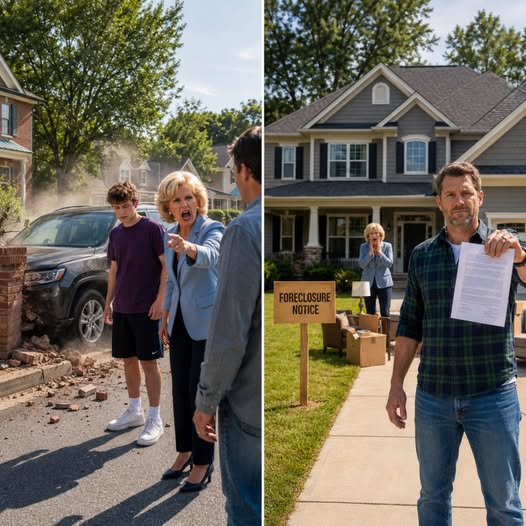
Dolores Hartwell’s son drove her cherry-red Jeep through my retaining wall at thirty-four miles an hour while my coffee was still hot in my hand.
Bricks exploded across my driveway, half my garden slid down the slope, and the kid climbed out in flip-flops looking annoyed that my wall had scratched his bumper.
Then his mother arrived in pearls and heels, pointed at the wreckage, and said, “That wall shouldn’t have been there. My son could have been killed.”
For a few seconds, I just stared at her.
The engine was still ticking. Dust hung in the air like pale smoke. Cinder blocks were scattered across the driveway, one of them resting against my garage door, another buried in the tulips I had planted after my divorce because I needed something living to look at in the mornings.
My name is Garrett Winslow. I’m forty-four years old, an electrician by trade, and I bought my house on Millbrook Lane with fifteen years of overtime, second jobs, and cheap dinners eaten in my truck between service calls.
That wall was not decoration.
It held back forty tons of hillside.
I built it myself when I moved in, with help from my neighbor Theo, a retired civil engineer who still owns more levels than most hardware stores. We pulled the county permit. We measured the property line. We set the blocks right. That wall sat six feet inside my land, doing exactly what it was designed to do.
Dolores knew that.
Or she would have, if facts mattered to her.
She was president of the Cedarbrook Estates HOA, the kind of woman who could turn a mailbox color into a legal crisis and make a Christmas wreath feel like an act of rebellion. For three years, she had fined me for my workshop lean-to, my holiday lights, my grass after a storm, and once for “excessive visibility of tools” because I left a ladder beside my own garage.
Every time, I documented. Every time, she backed down when my attorney sent one clean letter.
But this was different.
This was not a fine.
This was her son standing beside a wrecked Jeep and my broken retaining wall while she tried to turn his reckless driving into my fault before the dust had even settled.
“Dolores,” I said, keeping my voice flat, “your son just drove through a structural wall on my property.”
Her smile tightened.
“And I’m sure we can all agree not to make this uglier than it has to be.”
Behind her, Preston Hartwell kept scrolling his phone, not once looking at the damage. He was twenty-two, maybe twenty-three, wearing basketball shorts and a college hoodie, with the particular blank arrogance of a young man who had spent his whole life watching his mother make consequences disappear.
I took pictures.
The skid marks.
The speed curve.
The hole in the wall.
The soil slumping down behind it.
The broken cap rail.
Dolores watched me do it, and for the first time that morning, her eyes sharpened.
“What are you doing?”
“Documenting.”
Her chin lifted. “You always were difficult.”
A chair scraped on Theo’s porch next door. He had come outside in his old Carhartt jacket, coffee thermos in hand, eyes narrowed at the wall like he was already measuring failure points in his head.
“Garrett,” he said quietly, “call code enforcement.”
Dolores turned on him. “This is an insurance matter.”
Theo didn’t blink. “No. It’s a structural hazard.”
That was the first moment her face changed.
Not fear.
Not yet.
Just the little flicker of someone realizing the script might not be hers.
Three weeks later, her son sued me for forty-five thousand dollars, claiming my wall traumatized him, damaged his Jeep, and created a road hazard.
Dolores smirked through every hearing.
She thought the lawsuit would scare me into settling, bury the records, and keep anyone from looking too closely at the HOA books she controlled.
What she didn’t know was that while her son’s Jeep broke my wall, her lawsuit cracked open something much bigger.
Read more by clicking the (NEXT »») button below!