“He called before they took his phone, I guess. Or from the station. I don’t know. He said you’ve been under a lot of pressure and that maybe you mixed medications with wine.”
You laughed so sharply it hurt your throat.
“I don’t even drink.”
Silence.
Then, quietly, your mother said, “I know.”
Some betrayals come with knives. Some come with the fact that even after everything, a good liar still finds people willing to hold part of the door open for him.
The unknown text kept bothering you.
REVISE LA BASURA. HAY PRUEBA. ÉL VA DE REGRESO.
The detective traced it through a prepaid app number routed through public Wi-Fi, but the timing narrowed possibilities. Someone had been close enough to know what Sergio planned and scared enough not to call openly. Someone had wanted you alive.
It took another week for the answer to surface.
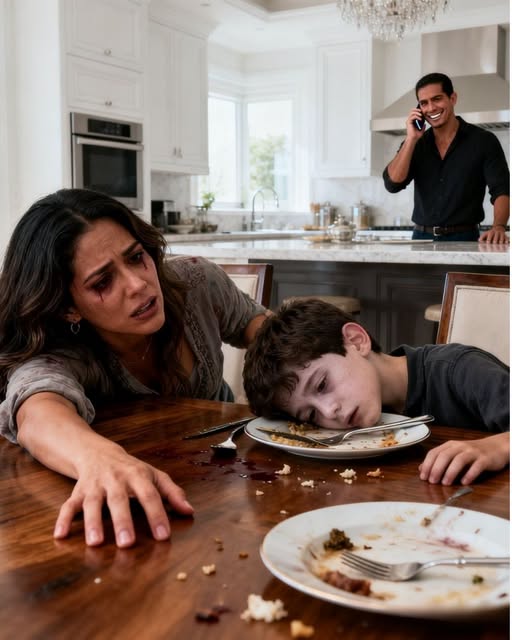
Her name was Maribel Ortega, and she cleaned offices in the same commercial building where Dana worked. Two days before the poisoning, Maribel had gone into Dana’s office after hours and accidentally overheard Dana on speakerphone with Sergio. They were arguing about dosage, about whether a sedative could “look like bad chicken,” about how quickly kids “go under.” Maribel froze outside the partially open door and listened long enough to understand that a child was involved.
She wanted to go to police.
Then she panicked.
Her husband was undocumented. Her brother had an old warrant. She had spent most of her adult life learning that official systems could become danger just as quickly as help. So she did what frightened people sometimes do when courage and fear arrive together: something imperfect but lifesaving.
She memorized your number from an emergency contact sheet she once saw on Dana’s desk during a work event.
The night Sergio poisoned dinner, she waited and prayed she was wrong. Then she saw Dana leave the office early, dressed up, carrying a tote bag and smiling at her phone. Maribel borrowed a stranger’s hotspot outside a gas station, sent the text from a burner app, and kept driving because she was terrified they’d trace her.
When Detective Bennett told you this, you cried harder than you had since the hospital.
Not because the story was dramatic.
Because your son was alive partly because a scared working woman with every reason to stay silent chose not to.
You asked if you could meet her someday.
The detective said maybe, once things settled.
Things did not settle quickly.
Sergio’s attorney first floated an absurd story that he had intended only to “sedate” everyone so he could leave without confrontation. Then, when the toxicology and messages destroyed that, the defense shifted to Dana as mastermind and Sergio as manipulated participant. Dana, in turn, blamed Sergio for everything and claimed she believed the plan was only to stage illness so he could gain sympathy in a custody fight.
Neither explanation survived the evidence.
Not the life insurance. Not the search history. Not the return to the house. Not the bathroom door. Not the messages about “one incident.” Not Tomás’s near-fatal bloodwork.
The district attorney filed attempted murder charges for both of you, plus conspiracy, child endangerment, insurance fraud, and related counts. The first time you saw Sergio in court, he looked smaller than you expected. Jail does that to certain men. It strips away the comfortable staging and leaves only appetite in a wrinkled shirt.
But his eyes were the same.
Calculating. Searching. Not sorry.
He tried to catch your attention as deputies led him in. You kept your gaze on the prosecutor’s table and felt Tomás’s fingers tighten around yours. He was allowed to attend only part of the hearing, and even then only because the child advocate thought seeing the system take it seriously might help him feel safer.
When the judge denied bond, Sergio’s face changed.
For the first time, he looked afraid.
Tomás leaned toward you and whispered, “He can’t come home now, right?”
“No,” you said.
That word mattered more than anything the judge had said all morning.
The next months were not cinematic.
They were therapy appointments, legal filings, school counselor meetings, bad dreams, medication side effects, and the weird numbness that hits when you’re choosing new dishes because the old ones are evidence bags. They were changing passwords at midnight, explaining to your son why he couldn’t answer calls from unknown numbers, and relearning that a kitchen smell can make your whole body tense for reasons logic can’t fix.
Tomás stopped eating chicken for a while.
Then rice.
Then anything green.
The therapist told you not to force progress by pretending the fear was silly. Trauma hates being mocked. So you adapted. Toast, applesauce, crackers, plain pasta, whatever made food feel separate from danger again. Trust, like appetite, returns in humiliatingly small bites.
You moved.
Not because the old house was cursed, though some nights it felt that way. Because the floor plan itself had become a map of betrayal. The dining room. The bathroom door. The hallway where you heard heels. Tomás had started freezing at thresholds, and you knew then that love sometimes looks like letting walls go.
You sold the place six months later.
The buyer never knew why the kitchen had been renovated down to the studs before listing.
There were moments of ugliness from relatives too.
Sergio’s mother called you once from an unknown number and cried that her son had “made a mistake” and was “under pressure.” You listened until she used the phrase your side of the story, and then something inside you went cold as river stone.
“He poisoned your grandson,” you said.
She started sobbing harder.
You hung up.
There are women who spend their whole lives cleaning blood with denial and calling it loyalty. You decided you would not become one of them.
The real turn came from Tomás.
About nine months after the poisoning, he stood in your new kitchen while you made boxed mac and cheese and asked, very casually, if he could help cook. The question nearly brought you to your knees. Not because it was big. Because it was ordinary, and ordinary had felt unreachable for so long.
So you handed him the wooden spoon.
Read more by clicking the (NEXT »») button below!