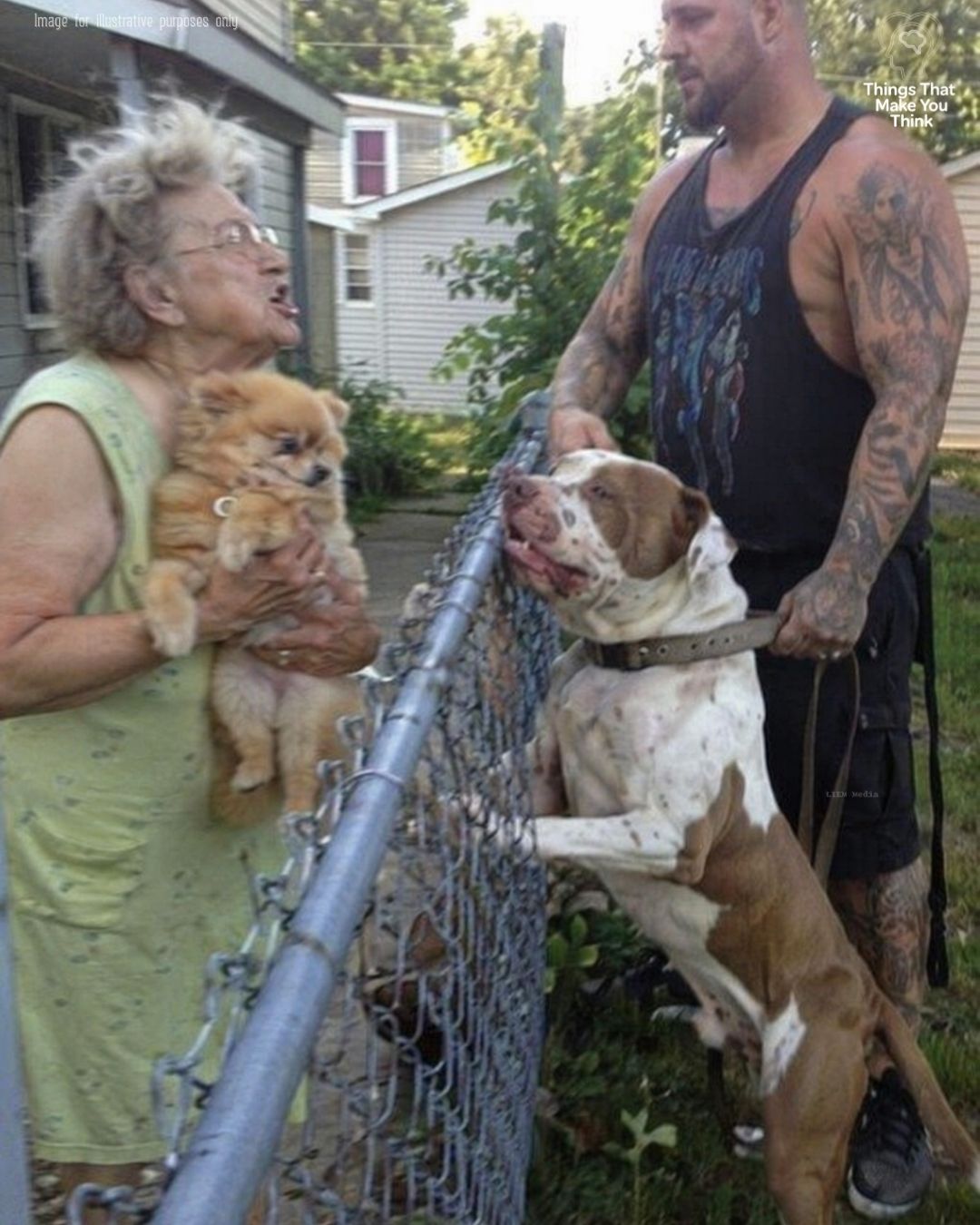
“You make a lot of expressions when you’re mad,” he said. “Less when you’re scared. Easier to miss.”
For a moment I could only look at him. At this man I had reduced, in my mind, to an outline: tattooed, dangerous, problem. I had never once wondered if he was observant. Or funny. Or patient. Or tired.
I had not seen a person. I had seen a warning label.
“I’m sorry,” I whispered, the words too small for what they needed to carry.
David glanced toward the hall doors where residents were still spilling out. “You said that already.”
“I know. It’s just not enough.”
“No,” he said gently. “It isn’t.”
That honesty should have hurt, but it didn’t. It steadied me.
I nodded. “They’re going to use the complaints anyway, aren’t they?”
He rubbed the back of Samson’s neck once. “Probably.”
“I told them they were false.”
“Doesn’t matter much now.”
His tone was so calm it frightened me more than anger would have.
“How can you say that so quietly?”
He looked at me then, really looked.
“Because I’ve learned something,” he said. “Once people decide what kind of danger you are, they start collecting proof. Doesn’t have to be good proof. Doesn’t even have to be true. It just has to fit.”
I thought of every form I had signed. Every anonymous note I had left. Every time I had repeated some exaggerated version of what I feared until it sounded like neighborhood wisdom instead of my own private panic.
“David…”
He shook his head. “I’m not saying that to punish you.”
“I know.”
He gave a tired half-smile. “Good. Because I’m too worn out to punish anybody.”
Barnaby squirmed in my arms, reaching his little nose toward Samson. The big dog stepped forward, slow and careful, and touched noses with him as delicately as if Barnaby were made of thin glass.
I swallowed hard.
“What is his name?” I asked softly.
David blinked. “Samson.”
The answer hit me with ridiculous force.
For six months I had called him that beast, that animal, that thing.
He had a name. Of course he had a name.
“The first shock,” I said, more to myself than to him, “is how quickly cruelty makes a person stop using names.”
David did not answer that. He just opened the passenger door of his truck.
“I’ll follow you home,” I told him.
He glanced at my slippers, my cardigan, the shaky way I was standing. “No, you won’t.”
And because I was seventy-two years old and had spent most of those years disliking being told what to do, I almost argued on principle.
Then Samson yawned. Barnaby leaned toward him. David waited.
And for one blessed, humbling moment, I did not pretend I was stronger than I was.
“All right,” I said.
That was the beginning of the strangest spring of my life.
Not because some miracle occurred and my neighborhood suddenly transformed into a warm little painting of forgiveness and porch swings and moral clarity.
It did not.
What happened was much harder than that.
I changed first.
And then I had to live long enough to see what my old self had set in motion.
David began stopping by in the mornings for coffee, mostly because Barnaby had decided Samson belonged to him and refused to behave with any dignity if he saw them pass my window. The sight would send my tiny old Pomeranian into a fit of hopping, spinning outrage until I opened the front door and let him wobble out onto the porch like a retired duke expecting his carriage.
Samson, for his part, accepted this with saintly patience.
He would lower his huge body to the porch boards and let Barnaby climb onto his side as if conquering a mountain. Then the tiny fool would settle right into the warm dip behind Samson’s shoulder like it had always been his spot.
The first time I saw that, I laughed so hard I had to sit down.
David looked up from his coffee. “What?”
“I tried to get a dog evicted,” I said, tears of laughter in my eyes, “and now mine thinks that dog is upholstered furniture.”
Even David laughed at that, though with him it always seemed to arrive by surprise, as if the sound had to travel a long distance before it remembered the way out.
He fixed the back door latch without my asking. He replaced a broken porch bulb. He trimmed the cracked oak limb that had threatened my roof since the storm. He did all of it with the same quiet competence, never making me feel indebted, which somehow made me feel even more indebted.
One morning, as he stood on a ladder tightening a loose gutter, I noticed a tattoo on the inside of his forearm that I had never seen clearly before.
It was not menacing. It was a line of dates.
Just dates.
There were five of them.
I didn’t ask what they meant. Not then.
He climbed down and caught me looking. For a second, something shuttered in his face. Then he pulled his sleeve down without comment.
That evening I cried in my kitchen over a casserole I’d burnt because grief can sneak in sideways when guilt opens the door wide enough.
It wasn’t just guilt over how I had treated David and Samson.
It was the humiliation of realizing how much of my life I had spent mistaking discomfort for danger.
I had told myself a thousand flattering stories about who I was. Careful. Decent. Sensible. A good judge of character.
It turns out those stories had gaps big enough to swallow a man whole.
And still, despite all that, David kept showing up.
He never asked me to defend him publicly again. He never milked my guilt. He never once said, You owe me.
That made the rest of the neighborhood’s behavior stand out even more sharply.
Because once people realized I had changed my mind about David, they changed their attitude toward me.
The women who used to save me a seat at church luncheons stopped texting quite so often. Melissa, who had once complimented my rosebushes, now waved from a distance with the strained smile people use when they suspect age has softened your brain. Mr. Becker spoke to me the same way pharmacists speak to customers who might forget their dosage.
Even my daughter, Elaine, called with a tone I recognized from when her children were toddlers and she’d catch them trying to stick pennies into an outlet.
“Mom,” she said, after I told her about the storm and everything that followed. “I’m happy your dog was saved. Really. But you need to be careful.”
“I am careful.”
“I mean emotionally. People can seem wonderful and still be unstable.”
I stood at the sink, staring out at my yard where Barnaby was snuffling around Samson’s paws like a tiny old cloud.
“What does unstable look like, Elaine?”
“Oh, come on. You know what I mean.”
“No,” I said. “I don’t think I do anymore.”
She exhaled sharply. “Mom, a big scarred pitbull and a retired soldier with trauma—”
“With tattoos,” I interrupted. “You forgot the tattoos. Everybody always remembers those.”
“That’s not fair.”
“Neither was what I did to him.”
There was silence on the line.
Then she softened in that maddening, careful way adult children do when they think they’re handling a parent who is slipping.
“I just don’t want you getting taken advantage of.”
I almost said something cruel then. Something about how the loneliest people are always assumed to be easiest to fool, as if solitude makes you stupid.
Instead I said, “I’ll call you Sunday,” and hung up before my voice gave out.
That same week, David got a letter.
I knew because I found him sitting on my porch steps at eight-thirty in the morning, envelope in hand, Samson pressed against one side of him and Barnaby pressed against the other. It would have been almost comical if David’s face hadn’t looked so empty.
I lowered myself onto the step above him.
“What is it?”
He handed me the paper.
The letterhead read Cedar Glen Residential Holdings, a name bland enough to sound trustworthy and soulless enough to mean business. The wording was polite in the way all institutional cruelty is polite.
Due to documented nuisance concerns, resident complaints, and liability review, his lease would not be renewed at the end of summer.
My hands started shaking before I reached the bottom paragraph.
“That’s because of me.”
Read more by clicking the (NEXT »») button below!