David kept his eyes on the street. “Not just you.”
“But I started it.”
He said nothing.
I folded the letter and unfolded it again. “You can fight this.”
“Maybe.”
“We will fight this.”
At that, he finally looked up.
There was no gratitude in his face. Only a kind of tired warning.
“You don’t have to do that because you feel guilty.”
“I’m not doing it because I feel guilty,” I said, though guilt was roaring in my chest like an engine. “I’m doing it because it’s wrong.”
He gave a humorless little huff. “Most wrong things don’t get fixed.”
“No,” I said. “But some do. And the rest at least deserve trouble.”
That got a real smile out of him. Small, but real.
Still, I noticed he did not say yes.
Later that afternoon, I walked over with banana bread I’d baked badly and a legal pad I’d found in my junk drawer. He let me in, which was still new enough to feel like entering another country.
David’s house was cleaner than mine. Sparer too. No clutter. No framed family photos. No decorative nonsense. Just a couch, a recliner, a sturdy coffee table scarred with use, and shelves with neatly lined paperbacks and veterinary care manuals and first-aid guides.
The absence of personal mess felt less like discipline and more like someone who didn’t fully plan on staying.
Samson stretched out on the rug while Barnaby waddled around inspecting corners he would never remember later.
“I don’t want you wasting your energy,” David said as I set the legal pad down. “They’ve wanted me out since before the first complaint.”
“Then why did they rent to you?”
“Because they had an empty house and I had cash for the deposit.”
The simplicity of that made me furious.
“And now?”
“Now they have enough resident concern to call it a business decision.”
Business decision.
Such a clean phrase for pushing someone out of the only place they can sleep.
I sat across from him. “Do you know what they’re really counting on?”
He lifted one shoulder.
“That you’ll leave quietly. That you’re too tired to make them uncomfortable.”
David stared at the table. “You say that like you know me well.”
“I know enough,” I said. “I know tired when I see it.”
That earned me another long glance.
Then he looked away and rubbed two fingers over his eyebrow, where a pale old scar disappeared into the hairline.
“They’re not entirely wrong,” he admitted. “I am tired.”
The room went soft and sharp at the same time.
Because there are sentences so honest they split you open.
I reached for the legal pad and clicked my pen.
“Then you let me be loud for a while.”
For the first time since I had met him, David looked like he might actually argue.
Instead he leaned back and shut his eyes for three whole seconds.
“Fine,” he muttered.
And that was how I became an old woman on a mission.
Every morning for the next two weeks, I went door to door.
Not because I enjoy rejection. At my age, I have had plenty of practice with disappointment, and I prefer mine seated, with tea.
I went because I had learned a brutal thing: harm does not vanish when your conscience wakes up. It goes on living in mailboxes, in meeting minutes, in other people’s mouths. If you build a lie sturdy enough, it keeps working even after you stop believing it.
So I knocked.
At some houses I was barely through hello before people stiffened.
At Melissa’s, she listened with her arms folded around herself as if the mere topic of Samson might bite.
“I’m sorry, but no,” she said. “I have children.”
“So does kindness,” I replied before I could stop myself.
Her expression cooled.
“That’s exactly the problem. Everybody wants to be kind until something happens.”
I looked past her shoulder at the family photos in the hallway. Smiling boys. Matching pajamas. School portraits. Protection framed in wood.
“What if something is already happening?” I asked quietly. “What if the harm is what we’re doing right now?”
She did not answer. She just shut the door as gently as possible, which somehow felt worse than slamming it.
At Mr. Becker’s house, he lectured me about actuarial tables and liability.
“Certain risk factors are simply objective,” he said, chin lifted.
“Is a tattoo a risk factor too?” I asked.
“That’s not what I said.”
“It’s what you meant.”
He colored slightly and signed nothing.
At the little blue rental near the corner, a teenage boy named Luis opened the door and grinned when he heard why I was there.
“You mean Samson?” he said. “That dog is awesome.”
His mother appeared behind him wiping her hands on a towel, suspicious until I explained.
“Oh,” she said. “Well. He helped me carry groceries last month when my wrist was in a brace. Never asked for anything.”
“Would you be willing to write that down?”
She took the pen from me right there on the porch.
By the end of the week I had a stack of statements. Not enough to drown out fear, but enough to prove fear was not the whole story.
From the mail carrier who wrote that Samson always sat back from the gate and waited for permission before approaching.
From the widower across the alley who admitted David had mowed his lawn twice during his recovery from surgery.
From a middle-school girl who wrote, in careful purple ink, that Samson let her read to him on Tuesdays at the shelter because he “made hard words feel less scary.”
That was how I learned David volunteered there every Wednesday morning.
I started going with him.
The shelter sat on the outskirts of town beside an overgrown lot and an abandoned garden center, the sort of place most people only notice when they need it and prefer to forget once they don’t. The paint peeled. The office smelled like disinfectant and coffee. The kennels carried the dense, heartbreaking scent of longing.
And yet it was one of the gentlest places I had ever been.
David repaired broken latches, unloaded food donations, cleaned out runs nobody else volunteered to clean, and sat on the concrete floor with dogs that the staff described as “shutdown,” which turned out to mean they had gone quiet enough to make everyone nervous.
Samson moved through that place like a dignified old nurse.
The dogs that barked at everybody stopped barking at him.
The frantic ones settled when he lay near their kennels.
The children who came in timidly for reading hour always drifted toward him even if their parents initially tugged them away.
He had a kind of gravity that embarrassed every assumption I had once made about what safety looks like.
Sometimes, sitting in a plastic chair with Barnaby under my cardigan and Samson’s warm flank against my shin, I would watch a skinny child stumble through a library book to a scarred rescue dog and think: We are all so hungry for gentleness, and still we reject it the minute it comes in an unfashionable body.
One Wednesday, the shelter director mentioned offhandedly that donations had dropped after someone in the community had posted online about “aggressive breeds being pushed on families.”
David kept cleaning a stainless-steel bowl as if he hadn’t heard.
But I had.
“Who posted that?”
She gave a helpless little tilt of her head. “One of those neighborhood pages. People share screenshots. A cropped photo here, a rumor there. It spreads.”
Cropped photo.
There it was again, the perfect phrase for what we do to one another now.
We crop.
We cut away context until all that remains is the angle that justifies our fear.
I knew exactly how powerful that could be because I had done a version of it in my own mind for months. I had cropped David down to his size. His tattoos. His silence. Samson’s scar. I had cut out tenderness, history, discipline, service, patience, every single inconvenient detail that might have forced me to behave like a decent human being.
At home that night, I could not stop thinking about it.
So I did a foolish thing.
I joined the neighborhood discussion page.
I will not repeat most of what I read there because I am old-fashioned enough to believe filth should not be recopied for sport. But I will say this: people are much bolder with their ugliness when they can call it concern.
There were comments about “keeping standards.”
Comments about “that type of renter.”
Comments about veterans being “better off in communities with proper resources,” which sounded compassionate until you noticed it always meant somewhere else.
And of course the dog.
Always the dog.
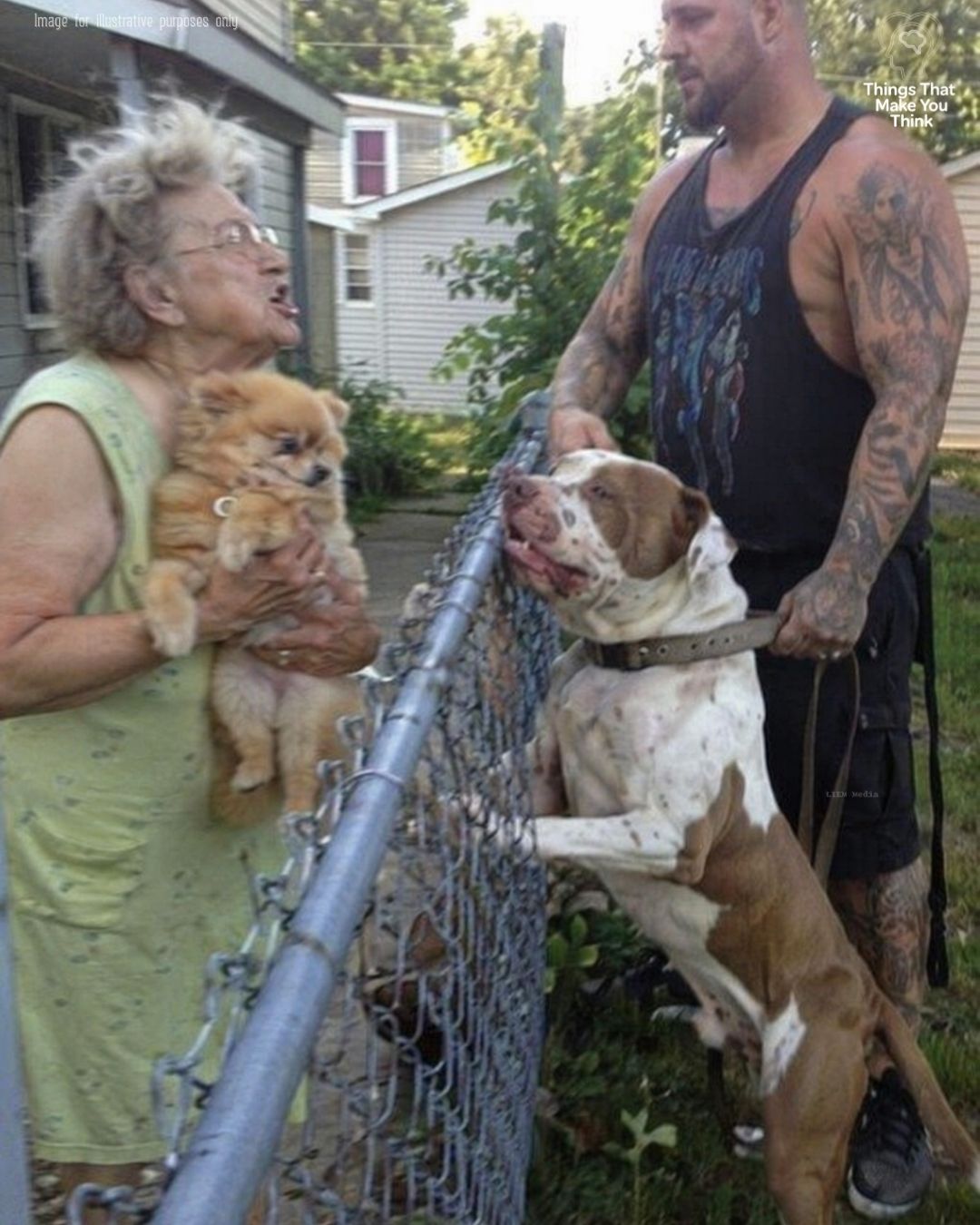
Pictures of Samson walking on his leash, captioned as if he were a prowling threat. A grainy clip of him standing at David’s fence while a delivery truck backed up, posted with warnings about aggressive posture. Somebody had even reposted one of my old complaints from the meeting minutes as if it were objective evidence instead of the record of one frightened widow’s ignorance.
I sat there at midnight with the light from the laptop turning my kitchen blue, and I felt something I had not felt in years.
Not merely guilt.
Rage.
Not loud rage. Not throwing-things rage. The colder kind. The kind that clarifies.
The next morning I printed every page.
David found me at my dining room table surrounded by stacks of paper.
He set a carton of eggs on the counter. “What happened?”
“I’m becoming a menace for good,” I said.
He read the top sheet, jaw tightening.
“Don’t do this to yourself.”
“Too late.”
“I mean it.” He set the paper down. “They’ll turn on you.”
I looked up at him. “They already have.”
He was quiet for a moment.
Then he pulled out a chair and sat.
“Okay,” he said. “Then let’s at least organize the mess.”
That was another thing I learned about David: he was good in a crisis because he refused to worship panic. While I raged, he sorted. Screenshots in one stack. Character statements in another. Lease documents. Shelter letters. Training certificates. Veterinary records. Even a thick folder from a behavior specialist Samson had worked with after being rescued from the shelter.
I picked up one certificate and stared at the date.
“This was only four days after you moved in.”
David nodded.
“You knew they’d assume the worst.”
His mouth flattened. “I’ve been assumed before.”
The room went quiet except for Barnaby’s snoring.
I reached for the tattooed forearm that had once scared me and touched the line of dates as gently as I would have touched a bruise.
“You never told me about these.”
David looked down.
“People I lost.”
There was no drama in the way he said it. No invitation to pity. That made it worse.
“All five?”
“Yes.”
“In combat?”
“Some there. Some after.” He paused. “Sometimes the body comes home and the rest doesn’t.”
I withdrew my hand slowly.
I had lived through my husband’s long decline from heart disease. I knew something about bodies staying while the person you loved thinned out in front of you. But what David was describing carried another layer altogether—the weight of duty, the cruel arithmetic of deciding who can still be saved and who cannot.
“No wonder you don’t sleep,” I whispered.
At that, his expression changed. Not defensive. Not embarrassed. Just tired enough to tell the truth.
“Some nights I do. Some nights I hear rain and my brain decides it’s somewhere else.”
“And Samson?”
“Brings me back.”
I looked at the dog then, this giant creature I had once tried to ban from my street.
Samson lifted his head and thumped his tail once without opening his eyes.
Read more by clicking the (NEXT »») button below!