Within thirty, there were people standing along the wall waiting for to-go plates.
Within forty-five, Naomi was on the phone with Marisol so fast she forgot to breathe between sentences.
“I need you to come in now. And call your cousin if she can carry plates. And if your brother’s free, tell him I’ll pay him cash to bus tables. No, I’m not kidding. No, don’t laugh. Marisol, I have maybe sixty bikers in here.”
She listened.
Then corrected herself as she looked around.
“Eighty. Maybe more.”
Roy was already helping move boxes when the first emergency supply truck pulled up.
Naomi nearly dropped a stack of plates.
“Wait. What is that?”
Linda, who was tying her braid back with a rubber band like she planned to work, said, “Food.”
“From where?”
“From your suppliers.”
Naomi turned so fast she almost lost her footing.
“I didn’t order that.”
Roy opened the back door as two delivery men started unloading crates.
“Linda called around last night. We covered the first round.”
Naomi stared at him.
“You what?”
Linda came over and touched Naomi’s arm.
“Breathe first. Then argue.”
Naomi tried.
It did not work particularly well.
Subscribe to Relationaire!
Get updates on the latest posts and more from Relationaire straight to your inbox.
Website
Your Email...
Subscribe
We use your personal data for interest-based advertising, as outlined in our Privacy Notice.
“You can’t just—”
“We can,” Roy said gently. “And before you worry, nobody’s trying to buy your place.”
“That’s exactly what I’m worrying.”
Linda nodded.
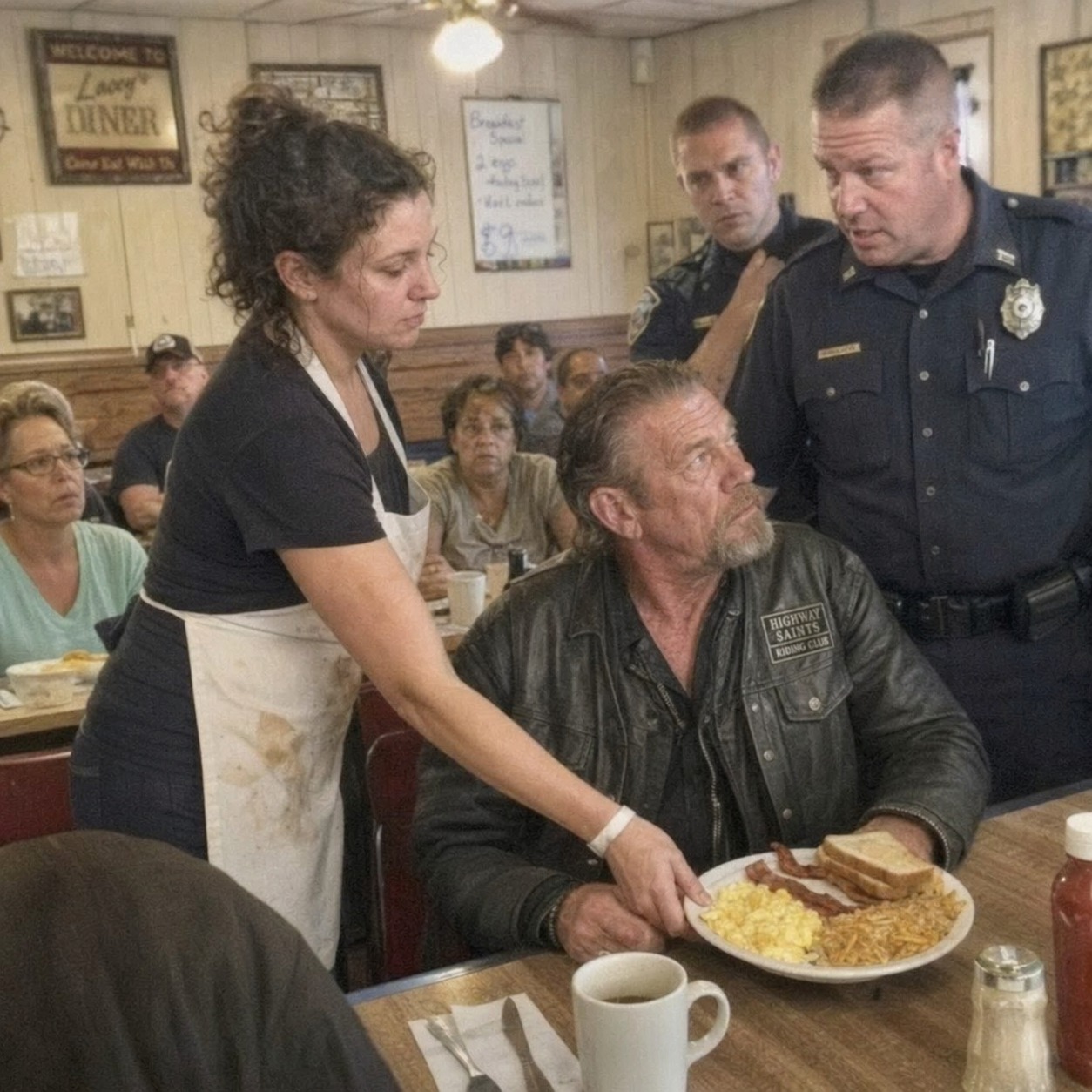
“I know. Which is why this matters. We’re not here to take anything from you. We’re here because Hank said a woman in a coffee-stained apron gave him one decent moment in a terrible day and reminded him there are still places in this country where a person can sit down and be treated like a human being.”
Naomi looked at the crates.
Eggs.
Bread.
Potatoes.
Coffee.
Lettuce.
Tomatoes.
Bacon.
Enough to keep the grill moving through the evening.
Her eyes stung.
“I don’t know how to thank you.”
Linda smiled.
“Feed people. You seem good at that.”
So Naomi did.
She tied her apron tighter, pulled her curls back, and went to work.
The next three hours moved like a living thing.
Orders flew.
Coffee poured.
The grill hissed and spat and filled the diner with the smells she had grown up inside.
Bacon.
Onions.
Toasted buns.
Butter hitting hot bread.
Fresh pie crust warming near the pass-through.
Marisol arrived breathless, then stopped dead in the middle of the room.
“Naomi.”
“I know.”
“You got a parade in here.”
“I know.”
Marisol took one quick look around, rolled up her sleeves, and shouted, “Who ordered six cheeseburgers and three grilled cheese?”
A cheer went up from the back booth.
The whole diner laughed.
And that, more than anything, broke the tension.
It turned something strange into something shared.
Outside, townspeople gathered along the sidewalks.
At first they only watched.
From across the street.
From parked trucks.
From the doorway of the pharmacy.
From porch steps.
The word had spread again, but this time it moved with curiosity.
Carter’s Diner had been nearly empty that morning.
Now motorcycles lined Main Street like silver beads on black string, and every few minutes another rider walked in holding flowers or a card or cash or nothing at all except an appetite and gratitude.
Naomi saw Mrs. Worthington first.
She was standing under the awning of the closed dress shop, one hand on her purse strap, lips pressed tight in thought.
Naomi could almost see the battle happening in her.
Pride versus interest.
Judgment versus manners.
Then Malik Reed came striding across the street in grease-stained coveralls from his garage, glanced once at the bikes, and pushed right through the door.
“You still got biscuits?”
Naomi laughed before she meant to.
“Somehow, yes.”
“Then I’m staying.”
He slid into an open seat across from a broad-shouldered woman with a shaved sidecut and kind eyes. She moved her basket of fries to make room and introduced herself before he’d even gotten settled.
Two minutes later they were arguing cheerfully about college football.
After Malik came Joe Larkin.
Then the retired mail carrier.
Then one of the church ladies.
Then, very carefully, as if crossing a line painted only in her own head, Mrs. Worthington herself.
The room quieted just a little when she entered.
She ignored it.
Naomi did not know whether to be amused or touched when Mrs. Worthington walked directly up to the counter, set down a glass pie dish still warm through the towel wrapped around it, and said, “Peach. I had already baked it. It seemed wasteful not to bring it.”
Naomi bit back a smile.
“That was thoughtful.”
Mrs. Worthington lifted her chin.
“It was practical.”
Then she leaned closer and lowered her voice.
“And the gentleman near the window asked very nicely whether I would consider teaching him how to make proper cobbler, so apparently I’m in demand.”
Naomi looked toward the window.
An older rider with a snowy beard gave a small wave and an embarrassed smile.
Naomi looked back at Mrs. Worthington.
“Seems you are.”
Mrs. Worthington straightened.
“Well. Don’t let it go to my head.”
By midafternoon, Carter’s Diner no longer felt split between locals and outsiders.
It felt like a room of people who had all walked in carrying assumptions and were slowly setting them down beside their plates.
One rider showed pictures of his grandsons.
A woman in a vest with a tiny enamel angel pin told Marisol about caring for her husband through heart surgery.
A man from Birmingham admitted he had not eaten pie this good since his grandmother died.
Two teenagers asked for pictures sitting on parked motorcycles only after the riders insisted on wiping the seats down first.
Nobody postured.
Nobody bragged.
Nobody demanded to be feared.
They just showed up.
And the town, faced with the stubborn ordinariness of their humanity, began to soften in spite of itself.
Around four, Deputy Laura Miles slipped in quietly out of uniform.
Jeans. Plain blue blouse. Hair down.
Naomi almost did not recognize her at first.
Laura took the last stool at the counter and wrapped both hands around the menu without reading it.
“What can I get you?” Naomi asked.
Laura looked up.
“Coffee, if that’s okay.”
Naomi poured it.
Laura watched the dark stream fill the mug.
Then she said, “I’m sorry.”
Naomi held the pot in midair a beat too long before setting it down.
“For what part?”
Laura gave a tight, unhappy smile.
“That I stood there yesterday and let Dean make a man’s worst day worse.”
Naomi said nothing.
Laura nodded once, like she had expected that.
“My dad looked like that when my sister was in treatment,” she went on softly. “Same eyes. Same shaking hands. Same trying-not-to-fall-apart in public.”
Naomi’s expression shifted.
“Then why didn’t you say something?”
Laura stared into the coffee.
“Because Dean’s been riding fear hard ever since the layoffs started. He thinks if he keeps control of every little thing, the town won’t notice how much is slipping. And I—” She exhaled. “I got used to stepping around him.”
Naomi leaned one hip against the counter.
“That’s not a good habit.”
“I know.”
Laura looked up then, and there was no defensiveness left in her face.
“I just wanted you to know that what you did yesterday? Not everybody in town thinks it was wrong.”
Something in Naomi loosened.
Not all the way.
But enough.
“You want pie with that apology?”
Laura blinked.
“Am I earning pie?”
“No. But I’ve got extra peach now.”
For the first time, Laura laughed.
And that small laugh, in that packed diner, with engines cooling outside and Main Street watching itself become a little more honest, felt like a hinge turning.
Near five o’clock the bell over the door rang again.
This time the room quieted on its own.
Not because people were afraid.
Because respect arrived with him.
The man who stepped inside looked to be in his sixties, built like an old oak, white beard trimmed close, reading glasses hanging from the front of his shirt beneath a black vest. He carried himself with the calm of someone who had spent a long time learning where his strength was useful and where it was not.
The winged-road emblem on his vest was larger than the others.
Below it, stitched in clean block letters, were the words:
MARCUS TURNER
STATE RIDE COORDINATOR
He removed his cap before taking another step inside.
Naomi noticed that.
A lot of men did not know how much a small gesture could reveal.
He did.
“You must be Miss Carter.”
Naomi wiped her hands on her apron and came around the counter.
“Naomi’s fine.”
Marcus took her hand in both of his and shook it gently, as though it mattered to him not to overwhelm.
“Hank told me you’ve got steel in your backbone and grace in your hands.”
Naomi blinked.
“That sounds nicer than I usually look by five in the afternoon.”
Marcus smiled.
“Most people worth admiring are tired when you meet them.”
A few heads in the diner bobbed at that.
Marcus turned, took in the room, and lifted one hand.
The conversations faded.
Not snapped off.
Settled.
Like everybody understood this was a moment they would remember later.
Marcus looked at the riders first.
Then at the townspeople.
Then at Naomi.
“I’m not much for speeches,” he said.
That got a laugh, because clearly some people knew better.
He smiled and went on.
“But every now and then, a story deserves to be spoken aloud while the people in it are still standing there to hear it.”
He gestured toward Naomi.
“Yesterday, one of ours walked into this diner carrying the kind of fear that empties a person out from the inside. He was worried about his daughter. He was tired. He was trying to keep himself together. And instead of giving him one quiet meal, the world decided to remind him what it thought it saw when it looked at his vest.”
The room stayed silent.
Marcus nodded slowly.
“A woman behind this counter chose not to join in.”
He did not raise his voice.
He did not need to.
“She chose decency in public. That’s rarer than people admit.”
Naomi felt heat climb her face.
She wanted very badly to disappear into the pie case.
Marcus went on.
“This riding club was built by people who know something about being misread. Veterans. Mechanics. Grandmothers. Nurses. Retired teachers. Single dads. Former truckers. Caregivers. Folks who found each other on long roads and decided to keep each other company.”
Several riders smiled down at their plates.
Read more by clicking the (NEXT »») button below!