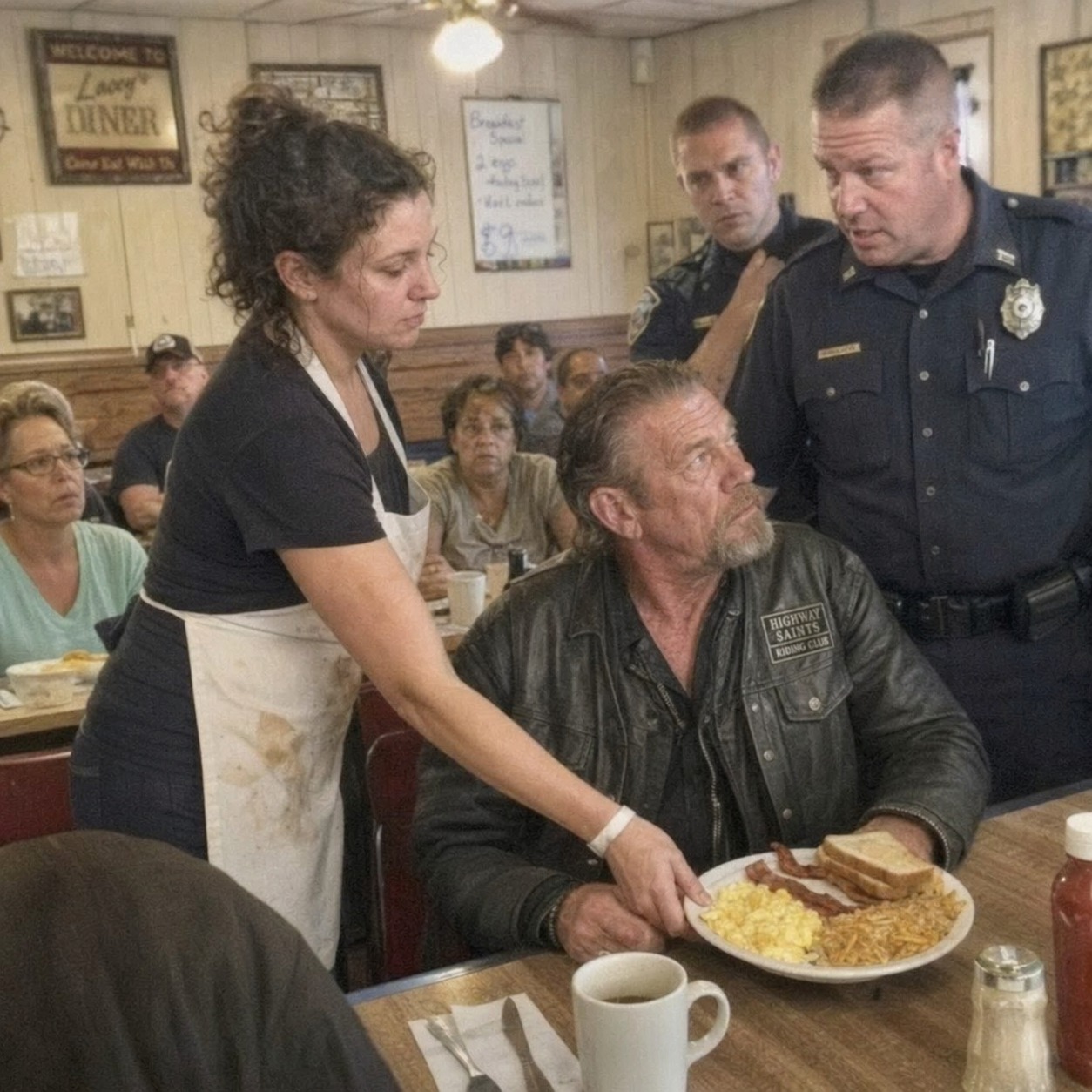
“You really want to lose this whole town over a man in that jacket?”
Officer Dean Harper’s voice cut across Carter’s Diner so hard even the coffee spoons seemed to stop moving.
Naomi Carter did not look at him right away.
She set the plate down first. Two eggs, toast, hash browns, and the last strip of bacon from the warming tray. Then she slid the coffee mug a little closer to the man at the counter, because his hand was shaking and he was trying not to let anyone see it.
Only after that did she turn.
“I’m not losing a town, Dean,” she said. “I’m serving breakfast.”
The diner went still.
Not quiet. Still.
There was a difference, and Naomi knew it.
Quiet was what Carter’s Diner had become over the past year, after the feed mill closed, after the hardware store went dark, after half the storefronts on Main Street got papered over with FOR LEASE signs that turned yellow in the sun.
Still was something else.
Still was fear.
Still was Mrs. Worthington freezing with her crossword pencil in the air.
Still was Joe Larkin lowering his mug so carefully it barely made a sound.
Still was Deputy Laura Miles standing half a step behind Dean like she already knew this was wrong but not enough to stop it.
Still was the man in the black leather vest sitting alone on the end stool, broad shoulders curved inward as if he had spent the last few days trying to take up less space in the world.
Naomi had seen that kind of posture before.
Not in bikers.
In waiting rooms.
In hospital corridors.
In family members who had run out of strong.
Dean gave a short laugh that carried no warmth at all.
“That’s one way to put it,” he said. “Another way would be you’re picking a side.”
Naomi folded her arms over her apron.
“Breakfast isn’t a side.”
A few people shifted in their booths.
Dean’s smile thinned.
The man on the stool kept his eyes on his plate, but Naomi saw his jaw tighten. Saw the red rims around his pale blue eyes. Saw the hospital wristband he had tried to keep hidden under his cuff. Saw the dusty miles baked into his boots and the exhaustion in the set of his mouth.
She had noticed all of it the moment he walked in.
Before Dean. Before the whispers. Before the whole room decided what kind of man he must be.
Naomi knew what that felt like.
Not the leather vest. Not the silver patch stitched over his chest that read HIGHWAY SAINTS RIDING CLUB.
But the being-sized-up part.
The being-decided-for part.
She knew that before a word was spoken, some people made a story about you in their heads and then treated you like their version was the truth.
Dean leaned against the counter like he owned the place.
“Folks in this town don’t want trouble at their breakfast table.”
The biker finally looked up.
His voice, when it came, was low and worn down to the grain.
“I didn’t come in here to bother anybody.”
“That right?”
“Yes, sir,” the man said.
Not mocking. Not sharp.
Just tired.
Dean glanced at the patch on his vest, then back at Naomi.
“You know who you’re feeding?”
Naomi looked right at him.
“A hungry man.”
The silence cracked wider.
Mrs. Worthington’s pencil finally dropped onto her puzzle.
Dean straightened.
“You think that’s all he is?”
Naomi did not answer right away, because if she did, her temper would get ahead of her mouth, and she did not have the money to be reckless.
Not this month.
Not with the electric bill folded in her bag, stamped FINAL NOTICE in angry red.
Subscribe to Relationaire!
Get updates on the latest posts and more from Relationaire straight to your inbox.
Website
Your Email...
Subscribe
We use your personal data for interest-based advertising, as outlined in our Privacy Notice.
Not with the pharmacy receipts tucked behind it.
Not with her father in a rehab room across town and her savings leaking out one tiny payment at a time.
Not with Carter’s Diner hanging by a thread so thin she could feel it every time she opened the register drawer and heard more empty air than bills.
But then she looked at the man’s wrist again.
The hospital band.
The tired eyes.
The untouched food that he had been too tense to eat.
And Naomi heard her father’s voice the way she always did when life pressed her into a corner.
If a person walks through that door hungry, you feed them first and ask your fear to wait outside.
Isaiah Carter had said that so many times while she was growing up, it had become part of the walls.
He had said it to travelers.
To preachers.
To mechanics.
To grieving widowers.
To women with crying babies.
To people who could only afford toast and coffee.
To people who could not afford even that.
He had said it until Carter’s Diner became less of a business and more of a witness.
Now he lay in a hospital bed, half his body refusing to cooperate, his speech caught behind damage and effort.
But the lesson still stood.
Naomi lifted her chin.
“I think he sat down, ordered coffee, and minded his own business,” she said. “That’s what I think.”
Dean let out a breath through his nose.
“This town’s already on edge.”
“Then maybe it could use less edge and more eggs.”
Joe Larkin made a sound into his mug that might have been a cough and might have been a laugh he did not want anyone to notice.
Dean heard it too.
That made his face harden.
He moved his attention back to the man on the stool.
“What’s your name?”
“Hank Morrison.”
“What are you doing in Willow Creek?”
“Visiting my daughter at the medical center.”
That landed in the room with more force than shouting would have.
Even Dean paused.
Hank swallowed once before continuing.
“She’s in treatment.”
No one said anything.
Naomi didn’t know who in the diner looked down first, but several people did.
Because illness had a way of leveling a room when pride failed.
Dean recovered before the decency could stick.
“For all I know, that’s a story.”
Naomi’s hand flattened against the counter.
“For all you know,” she said quietly, “it’s the truth.”
Dean turned to her again, and this time there was warning in it.
“You keep putting yourself in the middle of things that aren’t your business.”
“This is my business,” Naomi said. “My diner. My counter. My customer.”
The last word seemed to bother him most.
Customer.
Not suspect. Not outsider. Not problem.
Customer.
Equal.
Dean glanced around the room, probably expecting the town to back him on sight.
Some of them did. Naomi could see it.
A few worried frowns.
A few tight mouths.
A few people already imagining how this would sound by lunchtime.
But no one spoke.
Because everybody in Willow Creek knew Carter’s Diner.
They knew Isaiah.
They knew Naomi had come back from Atlanta six months earlier, packed up her tiny apartment, walked away from a decent hospital job, and returned home when the stroke knocked her father flat and the diner started slipping under.
They knew she worked fourteen-hour days, then sat by her father’s bed at night reading the paper to him because the doctors said familiar voices mattered.
They knew she never let the coffee pot go empty, even on mornings she had tears drying at the corners of her eyes.
They knew all of that.
And knowing that made it harder to shout over her.
Dean seemed to realize it too.
He pointed at Hank’s vest.
“You can wear whatever costume you want,” he said, “but people know what this kind of thing means.”
Hank’s face changed.
Not much.
Just enough for Naomi to see hurt move under discipline.
He looked like a man who had spent years learning how not to answer cruelty with more cruelty.
“My daughter is upstairs fighting for her life,” he said. “I’m trying to eat two eggs before I go back in there.”
That did it.
Naomi took the twenty-dollar bill Hank had laid near his plate and pushed it back toward him.
“Breakfast is on me.”
Hank stared at her.
“You don’t have to do that.”
“I know.”
Dean made a disgusted sound.
“You’re making a mistake.”
Naomi met his eyes.
“Then it’s mine to make.”
For one moment, Dean just stood there, jaw working, all that authority with nowhere clean to go.
Then he looked at Laura.
“Come on.”
Deputy Laura Miles hesitated.
Not long. Barely a heartbeat.
But Naomi saw it.
Saw the apology in her face before Laura lowered her eyes and followed him out.
The bell over the door gave a sad little jingle behind them.
Nobody moved for a second after that.
Then Hank reached for his fork.
His hand shook again.
He tried to hide it.
Naomi pretended not to notice, because dignity was a kind of kindness too.
“You should eat while it’s hot,” she said.
He nodded once.
“Thank you.”
She turned away before the whole room could see her throat tighten.
By ten-thirty, the story had already outrun the truth.
That was Willow Creek for you.
A place where bad news moved faster than rain and good intentions showed up late to their own funeral.
By noon, Naomi had heard three versions without leaving the diner.
In one, she had thrown the officers out.
In another, she had invited a biker gang to take over Main Street.
In a third, she had announced to the whole county that Carter’s Diner was now a hangout for trouble.
Small towns did not need facts to get started.
They just needed a sentence with enough sting in it.
By one o’clock, the lunch rush that wasn’t much of a rush on good days became almost nothing.
Two high school boys came in for fries to split.
A retired mail carrier drank a coffee and kept looking like he wanted to say something kind but was worried somebody might see him do it.
Mrs. Worthington left early without finishing her pie.
Joe Larkin stayed longer than usual, then stood up, put cash on the counter, and said, “You did what you thought was right.”
Naomi looked at him.
“That sound like a compliment?”
He scratched the side of his neck.
“Sounds like trouble, mostly. But it also sounds like your daddy.”
That was the closest thing to support she got all afternoon.
After closing, she counted the register twice because she thought maybe she had done it wrong the first time.
She had not.
The number sat there ugly and small.
Not enough for the electric bill.
Not enough for next week’s supplier order.
Not enough for the rehab co-pay she had to make on Friday.
She lowered herself into a booth and pressed the heels of her hands into her eyes until bright shapes flashed against the dark.
A lot of people thought courage arrived like thunder.
They thought it felt bold.
Clean.
Victorious.
They were wrong.
Sometimes courage felt like sitting alone in a nearly empty diner that still smelled like bacon grease and coffee, wondering if your principles were about to get your father’s lights shut off.
Sometimes courage felt almost exactly like fear, except you stayed anyway.
When she finally got up to lock the front door, she saw the sign taped to the glass.
White poster board.
Red marker.
Crooked letters big enough to read from the parking lot.
IF YOU LOVE OUTSIDERS SO MUCH, LET THEM FEED YOU.
Naomi stared at it.
Not because it was clever.
It wasn’t.
But because somebody had taken the time.
Somebody had stood outside the diner her father built with his bare hands, pressed tape to the glass, and tried to turn kindness into shame.
She ripped it down so hard the tape snapped.
Then she crumpled it in both fists and stood there breathing through her nose until her hands stopped shaking.
“Not tonight,” she whispered to the empty room.
But fear didn’t leave because you told it to.
It just got quieter and followed you home.
Willow Creek Medical smelled like antiseptic, microwaved soup, and tired hope.
Naomi had worked in hospitals long enough to know every building had its own version of that smell.
This one carried an extra note of old floor wax and pine cleaner.
She walked the familiar hallway toward Room 214 with her purse on one shoulder and the paper bag of sugar-free pudding balanced against her hip. Her father didn’t always want it. Some nights he ate half. Some nights he only took two bites.
Some nights he turned his face away and shut the whole world out.
Stroke recovery was not a staircase.
It was a room full of locked doors.
Isaiah Carter lay propped slightly on one side when she entered, the television murmuring low in the corner. He had always been a large man. Not tall enough to be imposing, but solid enough to feel like shelter when Naomi was little.
The stroke had made him look narrowed.
As if the strongest parts of him had been folded inward.
Still, when she came to the bedside, his eyes found her right away.
That mattered.
“Hey, Daddy.”
She kissed his forehead, then set the pudding on the tray table.
“I brought the good kind tonight. Which means hospital good. So don’t get too excited.”
One corner of his mouth moved.
Not a full smile.
But enough.
Naomi pulled the chair close and sat.
She took his hand carefully, mindful of the stiffness that still came and went.
“It was rough today.”
His fingers twitched once inside hers.
“That’s putting it polite.”
She exhaled and leaned back.
“There was a man in the diner this morning. Older biker. Looked like he had slept in his truck and forgotten how. Everybody saw the vest before they saw anything else. Dean Harper came in with Laura and decided breakfast needed a public trial.”
Her father’s eyes sharpened.
Even now, laid flat by a body that wouldn’t obey him, he could still listen with his whole face.
Naomi smiled sadly.
“Yeah. I know. You can already tell where this is going.”
She looked down at their joined hands.
“He had a hospital band on. Said his daughter’s upstairs in treatment.” Her voice softened. “He sounded like somebody holding on with both hands.”
A slow blink.
Isaiah’s way, lately, of telling her he understood.
“I stood up for him.”
This time her father’s fingers squeezed. Faint. Brief.
But real.
Naomi swallowed against the sudden ache in her throat.
“Everybody’s mad,” she said. “Or disappointed. Or suspicious. Or all three. Business dropped off by lunch. Somebody left a sign on the door.”
His brow creased.
She laughed once, with no humor in it.
“Exactly. Childish.”
She leaned forward.
“But here’s the thing. I knew what they wanted me to do. They wanted me to step back. Smile politely. Let Dean do his little performance so nobody would think I was siding with the wrong person.”
She shook her head.
“And I just couldn’t.”
Her father’s eyes filled then.
Not with tears exactly.
With something older.
Pride, maybe. Pain. Recognition.
Naomi looked away for a second because if she stared too hard she would cry, and she was tired of crying where machines could witness it.
“You’re the one who did that to me,” she whispered. “You and your rules.”
She counted them off with her free hand.
“Feed people while the food is hot. Don’t let the coffee burn. Never humiliate anybody in public. And judge by what they do, not what they wear.”
His thumb moved against her skin.
One small drag.
Naomi closed her eyes.
“It’s expensive being your daughter.”
The sound that came out of him was not a word.
More of a breath with meaning in it.
But she knew it anyway.
Sorry.
And because she knew him, she also knew the rest.
Still right.
She stayed an hour.
Read him the local paper.
Skipped the gossip column.
Told him Malik Reed still had the same crooked grin he wore at sixteen.
Told him Mrs. Worthington was back to doing the Sunday crossword in pen because apparently she had decided she earned the right.
Told him the azaleas outside the front window had finally quit trying to impress anybody and just bloomed.
Then, when visiting hours nudged toward ending, she stood and touched the blanket near his arm.
“I’ve got the diner,” she said. “Even if the diner doesn’t seem too sure about me.”
His eyes held hers.
And that time, slowly, carefully, painfully, he made the shape of a word.
Proud.
It came out in pieces.
Barely sound.
Mostly effort.
Naomi put both hands over her mouth and cried anyway.
The next morning was worse.
Not dramatic.
Worse.
No shouting.
No confrontation.
Just absence.
The breakfast regulars did not show.
Not the retired brothers who split an omelet and argued about baseball from opposite sides of the same booth.
Not Mrs. Worthington.
Not Joe Larkin.
Not the county road crew.
Not even the church secretary who always picked up biscuits for the office on Thursdays.
Naomi turned on the OPEN sign at six and by nine had served exactly three people.
A salesman from Macon who had never been there before.
A nurse from the medical center still in scrubs.
And a teenage boy with earbuds who asked for pancakes to go and never looked up from his phone.
At ten-thirty the coffee was old, the grill was too clean, and the silence had started sounding personal.
At eleven, the produce supplier called.
Naomi braced herself before answering.
“Morning, Eddie.”
There was a pause.
Then a careful voice.
“Naomi, I just wanted to check on this week’s order.”
Her grip tightened on the phone.
“That bad already?”
Another pause.
“You know how folks talk.”
“I do.”
“You still need the usual?”
Naomi stared out the window at a Main Street so empty it looked staged.
The right answer was yes.
The true answer was she did not know if she could move enough food to justify the invoice.
“If I’m being honest,” she said, “I should probably cut it down.”
Eddie sighed softly.
“That’s what I figured.”
Naomi swallowed.
“Can I call you back by noon?”
“Sure.”
When she hung up, she stood very still behind the counter.
This was how things died sometimes.
Not all at once.
Not with fire.
With reductions.
With smaller orders.
With fewer pies.
With booths staying empty long enough for the vinyl to cool.
With a daughter making practical decisions until one day the place her father built no longer had enough shape left to be called the same thing.
The bell over the door jingled.
Naomi almost didn’t turn.
She expected another stranger.
Maybe someone wanting directions.
Instead, an older couple stepped inside together.
The man was tall and weathered, all lean angles and patient eyes. His denim shirt was neatly buttoned. Over it he wore a black vest with a small winged-road emblem stitched above the pocket.
The woman beside him had silver hair in one thick braid over her shoulder and the kind of calm face that made people tell her the truth even when they hadn’t meant to.
She wore the same emblem.
No swagger.
No performance.
Just the same club as Hank.
Naomi felt her spine go careful.
The woman smiled first.
“Naomi Carter?”
“That’s me.”
“I’m Linda Morrison,” she said. “This is Roy. Hank’s older brother.”
Roy tipped his head.
“Ma’am.”
Naomi stepped out from behind the counter before she even realized she was doing it.
“How is he? How’s his daughter?”
The softness in Linda’s face changed.
Not vanished. Changed.
The way kindness does when grief lives under it.
“Still in treatment,” she said. “Rough morning, from what he told us. But he wanted us to come by.”
Naomi glanced between them.
“I’m sorry. Did he forget something?”
Roy let out the faintest huff of amusement.
“No. Hank doesn’t forget much. Especially not people.”
Linda rested her fingertips on the counter.
“He told us what happened yesterday. Said you were the only person in town who looked at him and saw a father instead of a problem.”
Naomi dropped her eyes for half a second.
“It wasn’t that big a thing.”
Roy and Linda exchanged a look that said they had lived long enough to know exactly how false that sentence was.
Roy said, “Sometimes the biggest things look small from the outside.”
Naomi motioned toward the stools.
“Can I get you coffee?”
“We’d like that,” Linda said.
Naomi poured two fresh mugs.
As she set them down, Roy looked around the empty room, and his eyes missed nothing.
He saw the cold pie case.
The clean grill.
The untouched stack of menus.
The too-neat dining room of a place that should have been busier by then.
He did not comment on it.
That made Naomi like him immediately.
Linda wrapped both hands around her mug.
“Hank said your daddy built this place.”
“He did.”
“Still around?”
“In rehab across town.” Naomi tried a smile. “Bossing people from bed with his eyebrows.”
Linda laughed softly.
“Then he and my mother would’ve gotten along.”
For a moment, they just drank.
The kind of quiet that settled between them did not feel awkward. It felt earned.
Then Roy reached into his vest pocket and laid an envelope on the counter.
Naomi stared at it.
“What’s that?”
“Something to hold you through the week.”
She did not touch it.
“I can’t take money.”
Roy shook his head.
“It isn’t charity.”
Linda added, “It’s trust. Hank asked us to make sure you had room to breathe.”
Naomi pushed the envelope back toward him.
“I appreciate that, I do, but I don’t know you.”
Roy smiled a little.
“That’s fair.”
Then he slid the envelope into his shirt pocket again without argument.
No wounded pride. No insistence.
Just respect.
Naomi noticed that too.
Linda glanced toward the front windows.
“How many people you got helping in the kitchen today?”
Naomi frowned.
“Just me and Marisol after noon. Why?”
Linda smiled over her coffee.
“You might want to start calling in favors.”
Naomi blinked.
“What kind of favors?”
Roy checked his watch.
“The kind that show up loud.”
At first Naomi thought it was thunder.
Low and distant.
A gathering roll somewhere beyond the feed store and the old tire shop.
Then the sound built.
Layered.
Many engines, not weather.
She stepped toward the window before her mind caught up.
From both ends of Main Street, motorcycles came into view.
Not two.
Not ten.
Dozens.
Chrome flashing in the midday light. Windshields glinting. Helmets, denim, leather, boots.
Men and women.
Gray-bearded riders and younger ones.
A woman with white hair tucked under a navy bandana.
A huge man with glasses and a careful posture.
A rider with one arm in a sling, riding pillion behind someone else, laughing at something Naomi couldn’t hear through the glass.
They turned off the road in patient rows, engines rumbling deep enough to shake the front windows, and lined both sides of Carter’s Diner without blocking traffic or crowding the sidewalk.
They parked with astonishing order.
One after another.
No revving for show.
No yelling.
No chaos.
Just presence.
Naomi’s mouth fell open.
“Oh my Lord.”
Linda’s smile widened.
“Hank made a few calls from the hospital.”
“A few?”
Roy stood and looked out with her.
“I’d say this is what affection looks like in our world.”
The first rider through the door was an older woman with deep laugh lines and a small bouquet of grocery-store carnations tied with curling ribbon. She wore a faded vest and orthopedic sneakers.
She walked straight up to Naomi and held out the flowers.
“Heard you fed one of ours when he looked like the world had forgotten him,” she said. “Thought we’d return the favor and remember you.”
Naomi took the bouquet with both hands.
“Thank you.”
Then came a man in his twenties with a sunburned nose and a baby photo tucked into his clear phone case.
Then a couple from Columbus.
Then two riders from Savannah.
Then three from Alabama who said they had been nearby for a memorial ride and rerouted after hearing Hank’s story.
More and more filled the doorway.
Every one of them polite.
Every one of them paying.
Every one of them asking what the house special was.
Within fifteen minutes, every booth was full.
Read more by clicking the (NEXT »») button below!