The first thing I noticed was the cold.
Not the kind that creeps into your bones on a winter morning, but a surgical cold. Clean. Artificial. The kind that smells faintly of disinfectant and metal and makes every sound feel louder than it should.
My wife was holding my hand.
Nicole’s fingers were cool but steady, her thumb brushing slow, reassuring circles against my knuckles as we waited under the fluorescent lights. The ceiling tiles above me blurred into pale squares as a nurse adjusted something near my shoulder.
“You’re going to be just fine,” Nicole said softly. “I’ll be right here the whole time.”
I nodded. I wanted to believe her. I did believe her. At least, that’s what I told myself in that moment.
The anesthesiologist leaned into my field of vision, her voice calm and practiced. She explained conscious sedation again, the same way she had in pre-op. Awake but relaxed. No pain. You may hear things.
I remember thinking, Fine. I’ve sat through zoning board meetings that lasted four hours. I can handle a little chatter.
The medication slid into my IV, a spreading heaviness that pinned my arms and legs without fully turning the lights off. My eyelids drooped, vision tunneling, but my mind stayed awake. Alert. Trapped.
That’s when I heard the surgeon’s voice.
Dr. Julian Mercer.
Low. Controlled. Careful.
“Lindsay,” he murmured, somewhere near my right side. “The envelope. Make sure his wife gets it after we’re done.”
A pause.
“He can’t know,” Mercer added. “No one can.”
My heart slammed so hard I thought it would tear free of my ribs. The monitor above me answered with a sudden spike, its rhythmic beeping accelerating.
The nurse’s voice dropped to a whisper. “Mrs. Brennan knows it’s coming.”
“I know,” Mercer said. “Just make sure he doesn’t see it.”
A chill ran through me that had nothing to do with the operating room.
I tried to move. Tried to open my mouth. Tried to say What envelope? or What the hell are you talking about?
Nothing happened.
My body didn’t respond. My tongue felt like it weighed fifty pounds. Panic clawed up my throat, sharp and suffocating, while my mind screamed inside a body that refused to obey.
So I did the only thing I could.
I stayed perfectly still.
I let my breathing even out. I forced my pulse to slow. I pretended to be unconscious while every instinct I had told me something was deeply, catastrophically wrong.
Half an hour later, they wheeled me into recovery.
By nightfall, I would pack a bag and vanish without a word.
But I’m getting ahead of myself.
Before all of this, before the envelope and the whispers and the look on my wife’s face that would haunt me for the rest of my life, I thought I had everything figured out.
Twenty-one years of marriage.
A daughter who made me proud every single day.
A company I’d built with my own hands.
From the outside, my life looked bulletproof.
And that’s exactly why I never saw the knife coming.
I used to believe in the American dream the way people believe in gravity. Not as an idea, but as something solid and unquestionable. You work hard, you build something, you protect your family, and life rewards you with stability.
I had all the proof I needed.
Nicole and I had been married for twenty-one years. Our daughter, Mia, was nineteen and halfway through her sophomore year at the University of Colorado, studying pre-law. Smart, driven, sharper than I’d ever been at her age.
I was fifty-four and the CEO of Redstone Building Corporation, a commercial construction firm I’d grown from a regional outfit into a $32 million operation headquartered in Denver. Cherry Creek house. Reserved table at Elway’s. Broncos season tickets that everyone “joked” about wanting.
The life people post about online with captions like grateful and blessed.
The kind of life that makes you think you’re immune to betrayal.
Except somewhere along the way, my wife became a stranger.
I didn’t see it all at once. It never happens that way. It was a series of small things, each one easy to dismiss on its own.
Nicole started keeping her phone face down on the kitchen counter. Not dramatically. Casually. Like it didn’t matter. But she never used to do that.
She started stepping outside to take calls. Even in February. Even when the temperature dropped to fifteen degrees and her breath came out in white clouds.
Client dinners that ran late. Meetings that didn’t line up with calendars. A new perfume that didn’t belong to any department store I recognized.
Distance that had nothing to do with physical space.
I noticed it, felt it, and told myself I was imagining things. That I was working too much. That marriage after twenty years just settles into something quieter.
I told myself anything that meant I didn’t have to ask questions.
Back in February 2003, when I first met Nicole, none of this existed.
She was twenty years old, working as an event coordinator at a children’s hospital charity gala. I was thirty-three, wearing a rented tux and trying to look like I belonged in rooms full of donors and executives. I’d been working alongside my father for eleven years by then, learning the business, learning how to carry his expectations.
Nicole wore an emerald dress that matched her eyes. When she laughed at a stupid joke I made about load-bearing walls, something in me folded.
We talked for hours that night. About the event. About my work. About nothing important and everything important at the same time.
By November, we were married.
Nine months from meeting to vows.
Everyone told us we were rushing it. My business partner, Brandon Walsh, said I’d lost my mind. Even my mother asked if I was sure.
I didn’t care.
Nicole made me feel alive.
Twenty-one years later, that feeling was gone. Replaced by something hollow and sharp around the edges.
And I still didn’t see the truth.
The hernia happened on a Tuesday in July.
I was at our RiNo project site, a mixed-use redevelopment we were converting from an old warehouse. I’d always been hands-on, even after stepping into the CEO role. I liked being around the crews. Liked knowing what was happening with my projects firsthand.
That day, we were short-staffed. I grabbed one end of a steel I-beam to help move it.
Stupid. Reckless. A fifty-four-year-old desk jockey trying to prove he could still hang.
The pain was immediate. Sharp. Radiating low in my abdomen and down toward my groin.
I knew exactly what it was. I’d watched my father deal with the same thing years ago.
That night at dinner, I mentioned it casually. We were standing at the kitchen island, Mia up in Boulder for summer classes. Nicole was scrolling on her phone.
“I think I pulled something today,” I said. “Pretty sure it’s a hernia.”
Nicole’s head snapped up.
“A hernia?”
Her voice had an edge to it I couldn’t place. Not fear. Not concern. Something tighter.
“And you need to get that checked. Soon.”
“It’s not that bad,” I said. “I’ll see how it feels.”
She set her phone down. Face up.
“Hernias don’t just go away,” she said. “They can get dangerous.”
I blinked. “Nicole, I just told you about it.”
She was already opening her laptop.
“There’s a surgeon,” she said. “Dr. Julian Mercer. Presbyterian St. Luke’s. Five-star reviews. Best in Denver.”
She turned the screen toward me.
His photo stared back. Mid-forties. Clean-cut. The kind of confidence that comes from being very good at what you do.
“You already looked him up,” I said.
“I’m being proactive,” she replied quickly. “You work too hard. Someone has to take care of you.”
It should have felt loving.
Instead, something cold settled in my gut.
I smiled anyway. Nodded. Agreed to call in the morning.
Nicole smiled back. Relief softening her face in a way I didn’t understand at the time.
“Good,” she said. “I just want you to be okay.”
That was the moment everything was set in motion.
I just didn’t know it yet.
September 15th, 2024.
The last day I trusted my wife.
The sun rose over the Rockies, painting the mountains orange through our bedroom window. Nicole made coffee I couldn’t drink, insisting it was “just to smell.” She held my hand during the drive down Colorado Boulevard to UCHealth University Hospital, squeezing it at every stoplight.
“You nervous?” she asked.
“It’s outpatient surgery,” I said. “I’ll be home by lunch.”
She smiled, but it didn’t reach her eyes.
In pre-op, Dr. Julian Mercer introduced himself. Younger than I expected. Expensive watch. Calm, efficient demeanor.
He barely looked at me.
“Straightforward inguinal hernia repair,” he said, glancing instead at Nicole. “Mesh reinforcement. Conscious sedation.”
“How long until I’m back to normal?” I asked.
“Six weeks before heavy lifting,” he said, still looking at her. “Your wife can handle post-op instructions.”
Nicole leaned forward. “I’ll take good care of him, Doctor.”
Something passed between them. A look too quick to call obvious, too long to ignore.
I told myself I was paranoid.
An hour later, I was on the operating table.
And fifteen minutes after that, I heard about the envelope.
In recovery, my head cleared enough to walk.
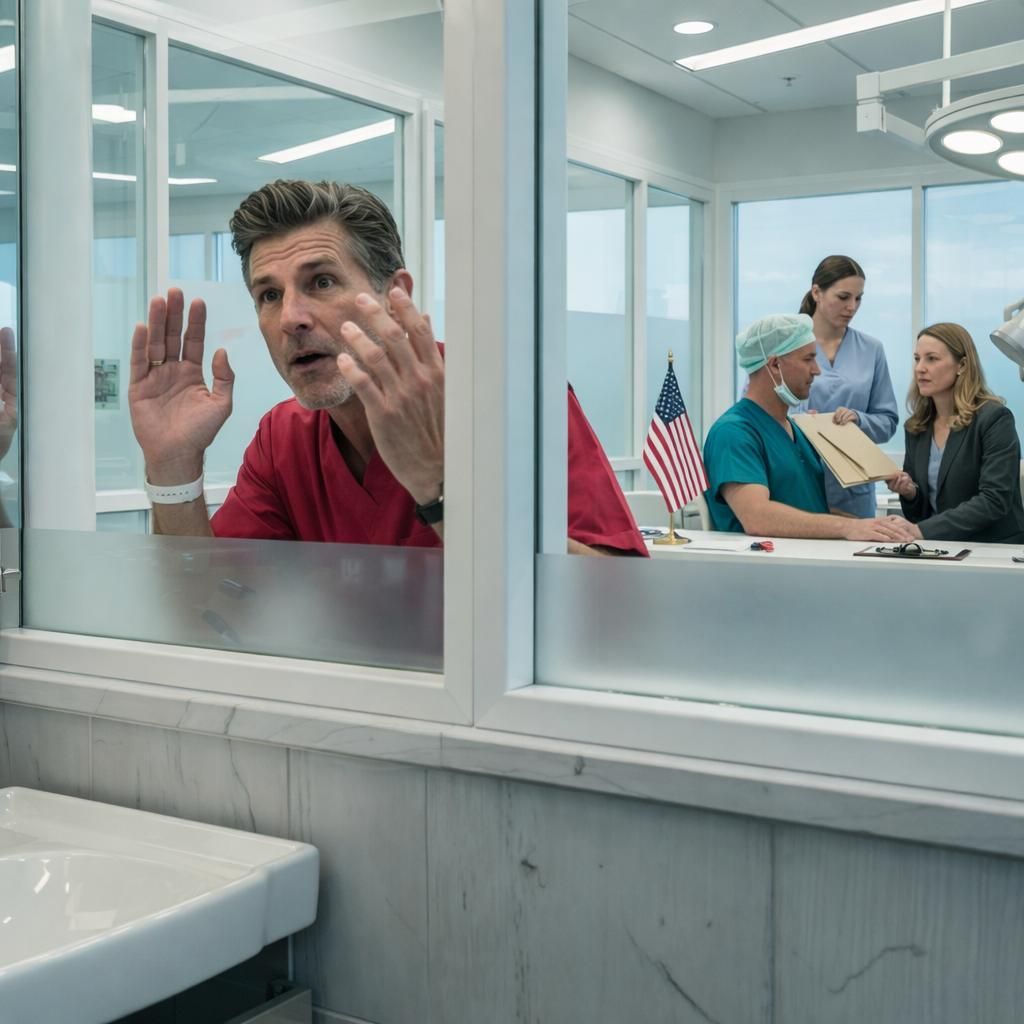
Nicole was in the consultation room. I shuffled toward the bathroom, hands shaking, every instinct screaming that I needed to see what I wasn’t supposed to.
The small frosted window above the sink gave me just enough view.
I saw Nurse Lindsay hand Nicole a manila envelope.
I saw Nicole open it.
I saw her face change.
Shock first.
Then something else.
Satisfaction.
Relief.
Tears welled in her eyes, but these weren’t tears of fear or grief. These were tears of someone who had just gotten confirmation.
Then Dr. Mercer walked in, closed the door, and sat beside her.
His hand covered hers.
His thumb brushed her knuckles.
I vomited into the sink.
Back in the recovery bed, I texted Brandon Walsh.
I need you. Something’s very wrong.
He replied instantly.
Where are you? UCHealth?
Can you pick me up? Don’t tell Nicole.
I didn’t know what was in that envelope.
But I knew my wife had lied to me.
And whatever she was hiding had just crossed a line I couldn’t walk back from.
The night after I texted Brandon, I barely slept.
Every time I closed my eyes, I heard Mercer’s voice again. He can’t know. I replayed the sound of the monitor spiking, the way my heart had tried to escape my chest while my body stayed frozen. I lay next to Nicole in the dark, listening to her breathing, steady and calm, and wondered how long she’d been able to sleep beside me while keeping secrets big enough to destroy everything.
She woke before I did and kissed my cheek softly.
“How are you feeling?” she asked.
“Fine,” I said. “Sore. Tired.”
She nodded, already distracted, already moving on.
I watched her leave the room and felt something inside me harden into resolve. Whatever was in that envelope, whatever she and Mercer thought I couldn’t know, I was done being the last person in my own life to find out the truth.
Brandon picked me up later that morning in his battered Tacoma, the one he refused to replace because, as he put it, “It’s paid for and it doesn’t ask questions.” He didn’t say much on the drive to his office. He didn’t need to. The look on my face told him this wasn’t about an affair or a midlife crisis.
This was about survival.
His office smelled like burnt coffee and old paper. The same dented filing cabinets lined the walls, the same framed photo of him in his Army CID uniform sat crooked on the shelf. He closed the door, sat across from me, and listened without interrupting as I told him everything.
The hernia. Nicole’s insistence. Mercer. The envelope. The look on her face.
When I finished, Brandon leaned back and exhaled slowly.
“That wasn’t nothing,” he said. “And that wasn’t innocent.”
“What was in the envelope?” I asked.
“I don’t know yet,” he said. “But I’m going to find out.”
He slid a yellow legal pad between us.
“If we do this, we do it clean. You don’t confront her. You don’t tip her off. You act normal. You let me dig.”
I nodded. “Do whatever you need to do.”
“Then you need to be ready,” Brandon said quietly. “Because if your gut is right, this isn’t just cheating.”
I went home that night and played my role.
I laughed when Nicole laughed. I thanked her for dinner. I asked about her day. I held her hand on the couch while she scrolled on her phone, face down, like always.
Inside, I was unraveling.
Two days later, Brandon called.
“Come in,” he said. “Now.”
The tone of his voice told me everything.
I sat across from him as he spread folders across his desk, one after another, like pieces of a puzzle that didn’t want to be solved.
“Julian Mercer,” Brandon said, tapping the first file. “Phoenix General Hospital. Early 2000s. Rising star. Then a quiet resignation after an ethics violation.”
He slid a page toward me.
Read more by clicking the (NEXT »») button below!