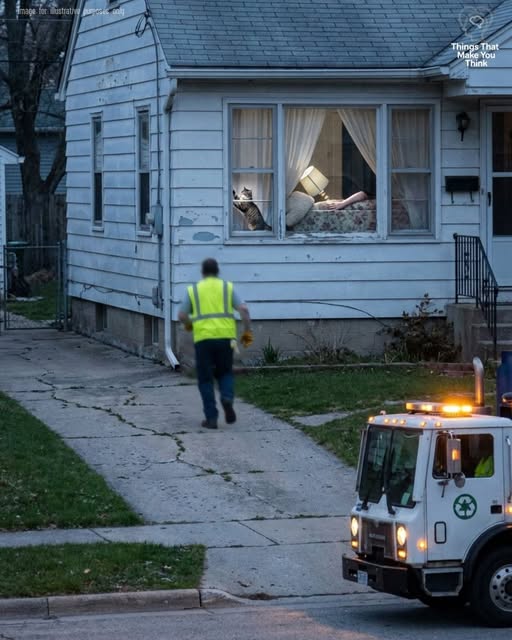
A small, broken meow that felt like a question.
I whispered, “I know. I know.”
And then I did the thing that made the rest of my day fall apart.
I got back in my truck.
And I drove away.
—
I tried to finish my route like normal.
Tried to pretend my hands weren’t still shaking on the steering wheel.
Tried to treat the next blue cart like it meant the same thing it did yesterday.
But the whole street looked different now.
Every cart felt like a heartbeat.
Every porch felt like a closed mouth.
Every window felt like it might be hiding something.
At the next stop, a man waved from his driveway and shouted, “Morning!”
And my brain did this awful thing:
It immediately wondered what his last morning would look like if he fell in his kitchen.
If anyone would notice.
If his dog would scream at a window.
If his porch light would burn until it felt like a confession.
I hated that thought.
But I couldn’t unthink it.
Because once you’ve seen the quiet up close, you stop trusting it.
—
By noon, the story had already started traveling.
Not the truth.
A version.
Doug’s nephew had been there, apparently.
He’d filmed the ambulance from across the street.
He’d filmed me standing on the porch.
He’d filmed Mary being wheeled out, her face turned toward the sky like she was trying to remember what air felt like.
And then he posted it somewhere.
No names at first.
Just captions.
“Recycling guy saved elderly neighbor after her cat alerted him.”
That’s all it took.
By the time I hit my lunch break, I had three missed calls from an unknown number.
Two from a hospital line.
And a text from Sherry that said:
“This is blowing up. People are asking questions. Please call me.”
I sat in my cab with my sandwich untouched.
The sun baked the windshield.
My radio crackled.
My stomach felt hollow.
Because I already knew what questions people would ask.
The ones that always come after something like this.
Not “Is Mary okay?”
Not “Where’s the cat?”
Not “Why didn’t anyone check sooner?”
No.
The questions that are easier to throw than answers.
“Why didn’t her family call?”
“Why didn’t the neighbors do anything?”
“Why is it always a stranger who shows up?”
“Why do we live like this?”
And the worst one, the one nobody says out loud but everybody thinks:
“Could it be me next?”
—
I went to the hospital after my shift.
Still in my boots.
Still smelling like diesel and summer heat.
I didn’t bring flowers.
Didn’t bring balloons.
Just me.
Because I didn’t know what else to bring to a woman who’d spent two nights on the floor praying someone would notice.
The front desk asked who I was.
I hesitated.
Because I didn’t know what I was to Mary.
Friend?
Stranger?
Witness?
“Marcus,” I said finally. “I… I’m the driver from her route.”
The woman behind the desk softened a little.
“Oh,” she said. “You’re him.”
That hit me like a slap.
Not because it felt good.
Because it felt wrong.
I wasn’t “him.”
I wasn’t a headline.
I was just the guy who honked twice every Wednesday.
I followed the signs down a hallway that smelled like sanitizer and quiet worry.
Mary’s room door was open.
She was propped up in bed, thin and small under white blankets.
Her skin looked less blue now.
Her lips still dry, but not dangerous.
And when she saw me, her eyes filled up like somebody had turned on a faucet behind them.
“Marcus,” she whispered.
Her voice sounded like paper.
But she was here.
I walked in slowly, like I might spook her.
Like the moment might break if I moved too fast.
She reached out her hand.
I took it.
Her grip was weaker than it had been behind the sofa.
But it was still Mary.
Still stubborn.
Still here.
“You came,” she said.
“Yeah,” I answered. “I did.”
She swallowed hard.
“I didn’t want to be… dramatic,” she whispered.
That word—dramatic—made my throat burn.
Because only lonely people apologize for almost dying.
Only lonely people feel guilty for needing help.
“You weren’t dramatic,” I said. “You were human.”
Her eyes darted toward the door like she was afraid someone might hear her needing that.
Then she whispered, “They called her.”
My stomach tightened.
“Your daughter?”
She nodded once.
A tiny, tired nod.
“She didn’t answer at first,” Mary said. “They left a message.”
Mary stared at the blank TV screen like it might show her something kinder.
Then she said, “She texted. The hospital. Not me.”
That sentence landed heavy.
Not because it was shocking.
Because it was familiar.
A lot of older folks don’t say it out loud, but you can see it.
The way they watch their phones like they’re waiting for permission to matter.
The way they keep excuses ready like spare change.
Read more by clicking the (NEXT »») button below!