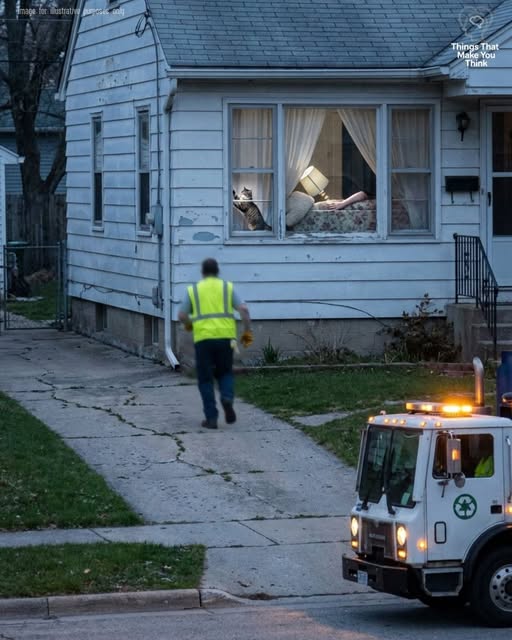
“She’s busy,” Mary whispered quickly, like she had to defend her even now. “She has her life.”
I didn’t say what I wanted to say.
I didn’t say, A call is not a mortgage.
I didn’t say, Five minutes doesn’t ruin a life.
I didn’t say, Busy is not the same as gone.
I just squeezed Mary’s hand and said, “How are you feeling?”
Mary gave a small laugh that didn’t have humor in it.
“I feel old,” she said.
Then, quieter: “I feel… embarrassed.”
“Don’t,” I said immediately.
She looked at me with that stubborn fire flickering behind exhaustion.
“I laid there and I listened,” she whispered. “For everything.”
“For what?” I asked.
“My refrigerator,” she said. “It hummed. Then it stopped.”
I felt chills.
“My clock,” she said. “Ticking. Like it didn’t care.”
She stared at me, eyes wet.
“And I listened for your truck,” she said. “Because your truck means… morning.”
My chest went tight.
I swallowed.
“You’re not allowed to disappear on my route,” I tried to joke.
Mary smiled just a little.
Then she said the thing that made my blood pressure rise.
“They said it’s on the internet.”
—
I didn’t show Mary my phone.
I didn’t want her seeing strangers turning her life into content.
But later, in the parking lot, I sat in my truck and read the comments anyway.
I shouldn’t have.
But curiosity is a sickness.
And anger is gasoline.
Some people were kind.
“God bless that driver.”
“Cats are angels.”
“This is why community matters.”
But then came the other kind.
The ones that sound reasonable until you taste the poison.
“Why didn’t her family handle it?”
“Not the neighbors’ responsibility.”
“Mind your business. People fall all the time.”
“If she can’t live alone, she shouldn’t.”
And the one I saw over and over like a chant:
“Where are her kids?”
That one sounds innocent.
But it isn’t.
Because it’s not just a question.
It’s a verdict.
It’s a way of saying, If you don’t have family, you don’t have a safety net.
It’s a way of punishing people for being alone.
As if loneliness is a personal failure instead of a modern epidemic.
As if being eighty-eight is a crime.
As if needing help is something you should’ve planned better for.
I stared at the screen until my eyes hurt.
Then my phone buzzed.
Unknown number.
I answered.
A woman’s voice, sharp and controlled.
“Is this Marcus?”
“Yes.”
“This is Claire.”
I went still.
Mary’s daughter.
She didn’t say hello.
Didn’t ask how her mother was.
She went straight to the part that mattered to her.
“Why is my mother’s situation online?” she snapped.
I closed my eyes.
“I didn’t post anything,” I said.
“I don’t care who posted it,” she shot back. “It’s humiliating. It’s invasive.”
There it was.
Not concern.
Control.
Image.
I kept my voice calm.
“Ma’am,” I said, “your mom was on the floor for two days.”
Silence.
Then, colder: “That’s not what they told me.”
My jaw tightened.
“That’s what she told me,” I said.
Another pause.
Then, like she was choosing her words for a courtroom:
“My mother exaggerates. She’s always—”
I cut in before I could regret it.
“Always what?” I asked.
Claire inhaled sharply.
“Look,” she said. “I’m flying in. I’ll handle it.”
I wanted to say, You already didn’t.
I wanted to say, Handling it would’ve been calling before she hit the floor.
But I didn’t.
Because Mary was still alive.
And if you care about someone, you don’t light matches near their fragile hope.
So I just said, “Okay.”
Then Claire said, “Don’t go back to the hospital.”
I blinked.
“Excuse me?”
“This is family,” she said. “You’re… the driver.”
My grip tightened on the phone.
And it hit me—clear as day—that some people would rather their loved one almost die in private than be saved in public.
Some people love the idea of family more than they love the actual person.
I exhaled slow.
“I’m not trying to replace anybody,” I said. “I just showed up.”
Claire’s voice softened for half a second, like something human tried to peek through.
Then she hardened again.
“Just don’t make this… a thing,” she said.
And she hung up.
—
Two days later, Claire arrived.
I know because Sherry texted me like it was breaking news.
“She’s here. Tall. Expensive suitcase. Looks angry.”
I stared at that text longer than I should’ve.
Then I did what I told her I wouldn’t.
I went to the hospital anyway.
Not to start drama.
Not to be a hero.
But because Mary had asked me, in that small paper voice, “Will you come back?”
And I couldn’t shake the way she said it.
Like she didn’t believe she deserved a “yes.”
When I walked into Mary’s room, Claire was already there.
Perfect hair.
Sharp blazer.
A face built for boardrooms and boundaries.
She looked up and her eyes narrowed like I was a stain.
Mary looked between us like a kid caught in the middle.
“Marcus,” Mary said softly, relief slipping through her exhaustion.
Claire stood.
“You came,” she said, flat.
Mary’s fingers tightened on the blanket.
Claire turned to her mother.
“Mom,” she said, voice overly calm, “why didn’t you press your emergency button?”
Mary’s cheeks flushed.
“I—” she started.
Claire didn’t wait.
“And why didn’t you call me?”
Mary blinked slowly.
“I did,” she whispered. “I left messages.”
Claire exhaled like she was dealing with a broken appliance.
“My voicemail was full,” she said.
Mary’s lips parted, stunned.
Full.
Not “I’m sorry.”
Not “I missed it.”
Full.
Mary looked at her hands.
“I didn’t want to bother you,” she whispered.
Claire’s eyes flashed.
“Bother me?” she repeated. “You were on the floor.”
“Yes,” Mary said. “And I still didn’t want to bother you.”
That line cracked something in the room.
Because it wasn’t about falling.
It was about the kind of loneliness where you don’t even feel entitled to your own emergency.
Claire looked at me like I’d somehow coached Mary into saying it.
Then she said, “This is exactly why you can’t live alone.”
Mary’s spine straightened.
“I’ve lived alone for years,” she said.
“And you almost died,” Claire snapped.
Mary’s eyes filled but she didn’t look away.
“I almost died quietly,” she said. “That’s the part you should be afraid of.”
Claire’s mouth tightened.
She turned to me again.
“And you,” she said, “you have no idea what you’re stepping into.”
I kept my voice even.
“I’m not stepping into anything,” I said. “I stopped because something was wrong.”
Claire laughed once, without humor.
“People like you always think you’re helping,” she said.
Mary flinched.
That’s when I saw it.
Not just anger.
Fear.
Claire wasn’t just mad that her mother was vulnerable.
She was mad that the vulnerability was visible.
Because visible vulnerability forces a question:
Where were you?
And that’s a question no one likes answering.
Read more by clicking the (NEXT »») button below!