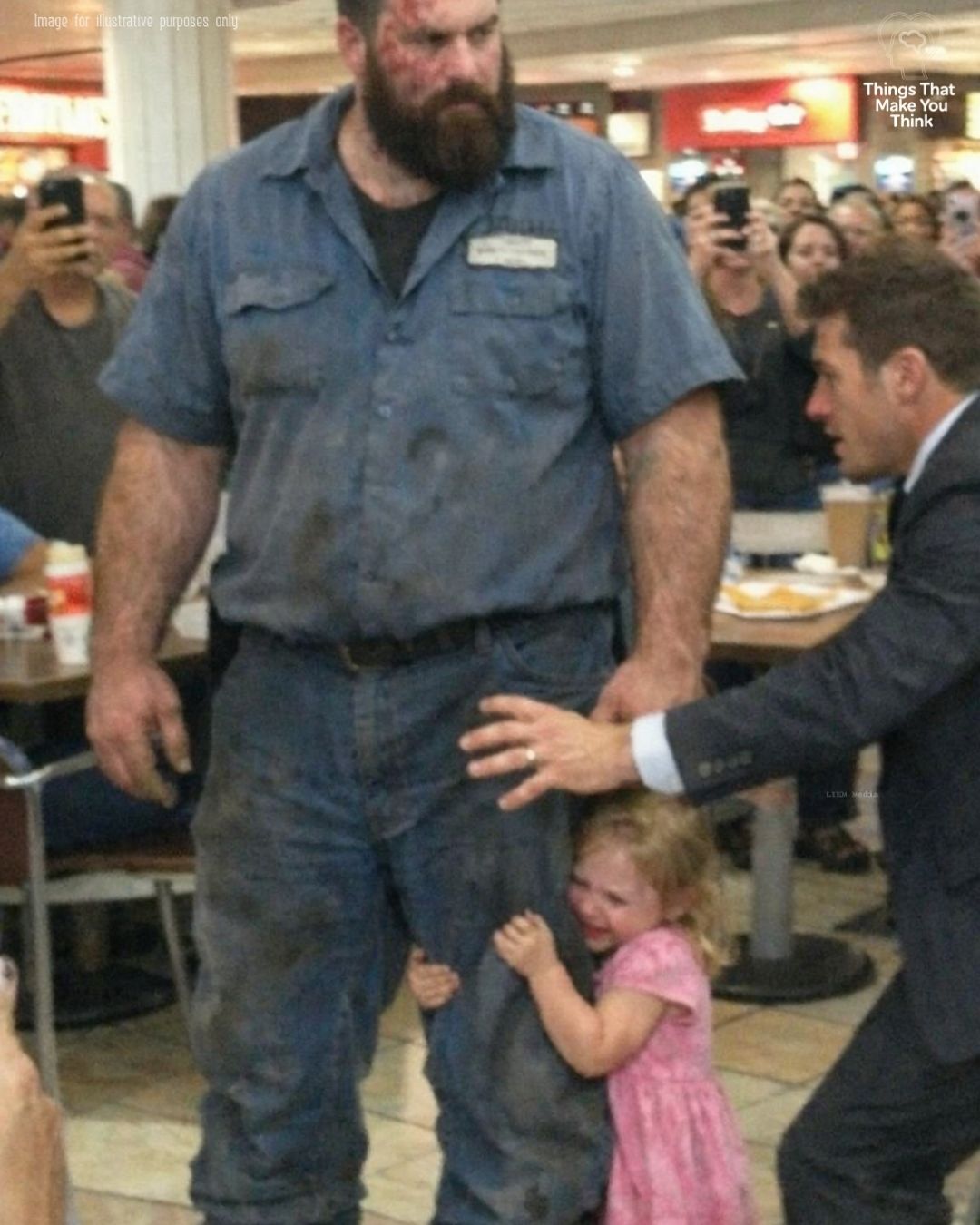
When a terrified little girl ran past a busy crowd to hide behind the most intimidating, heavily scarred janitor in the building, everyone froze.
“Please,” she sobbed, her tiny hands gripping his grease-stained uniform like a lifeline, “don’t let him take me.”
Arthur was just trying to finish his shift. He was a massive man, standing six-foot-four, with a thick beard and a jagged burn scar covering the left side of his face. He wore a faded blue work uniform, carrying a heavy mop bucket through the bustling food court of the local shopping center.
People usually avoided making eye contact with him. Mothers pulled their strollers a little closer when he walked by. He was used to the whispers and the wide-eyed stares. He knew his appearance made people uncomfortable.
Then, she slammed into his legs.
She was maybe five years old, wearing a pink dress, her face red from crying. She didn’t just bump into him; she actively scrambled behind his massive frame, pressing her face into the fabric of his trousers.
Her entire body was shaking violently.
Arthur froze, his hands still gripping the wooden handle of his mop. He looked down at the trembling child, utterly confused.
Before he could even speak, a man jogged up to them.
He was dressed in a sharp, expensive-looking suit. His hair was perfectly styled, and he had the bright, polished smile of a corporate executive. He looked like the safest, most respectable person in the entire building.
“There you are, sweetie!” the man said, his voice dripping with artificial relief. “I am so sorry about that, sir. She ran off when I turned my back for one second.”
The man reached out to grab the little girl’s arm.
The child let out a blood-curdling scream and dug her fingernails into Arthur’s leg. “No! He’s not my dad! Please!”
Arthur’s protective instincts kicked in instantly. He shifted his massive weight, stepping squarely between the well-dressed man and the sobbing child. He planted his work boots on the shiny floor like tree roots.
“Hold on a second, buddy,” Arthur said. His voice was incredibly deep, rumbling over the noise of the food court.
The man’s friendly smile immediately vanished, replaced by a cold, calculating glare. “Excuse me? That is my daughter. She is just having a tantrum. Step aside.”
A crowd was starting to form. Shoppers stopped with their bags, pulling out their phones. Arthur could hear them whispering. He knew exactly how this looked to them: a scary, scarred laborer keeping a wealthy, respectable father from his crying child.
“If she’s your daughter, why is she terrified of you?” Arthur asked, keeping his arms completely still by his sides.
“I said, step aside right now,” the man hissed, taking an aggressive step forward. “Or I will have you arrested for interfering with my family. Look at you. Who do you think the police will believe?”
The man in the suit pulled out his phone, holding it up like a weapon. “I am recording this! I am recording a deranged employee trying to kidnap my daughter!” he yelled to the crowd.
A few people in the crowd started nodding in agreement with the man. One woman shouted, “Just give him his kid back!”
Arthur felt the pressure of a dozen cell phone cameras pointing directly at him. He knew exactly what the internet would do to a man who looked like him. They would ruin his life. They would label him a monster. His heart pounded in his chest, and his palms sweat against the plastic handle of his mop.
But then he felt the little girl’s tears soaking through his denim pants. She was terrified, shaking like a leaf in a winter storm.
Arthur looked at the cameras, then looked directly into the eyes of the man in the suit.
“Record all you want,” Arthur’s voice boomed, echoing off the high ceilings of the food court. “But until the police arrive and prove who you are, this child is not moving one single inch.”
The man lunged forward, trying to violently grab the girl’s wrist.
Arthur didn’t strike him. He simply stepped fully into the man’s path, catching the man’s shoulder with his massive, muscular chest. The impact sent the man in the suit stumbling backward, completely overpowered by the giant janitor’s immovable stance.
“Do not touch her,” Arthur warned. It wasn’t a shout. It was a low, dangerous rumble that sent a chill through the entire crowd.
He reached into his pocket and pulled out his two-way radio. “Security, we need police officers at the food court immediately. Possible child abduction.”
The well-dressed man’s face turned completely pale. “You are making a massive mistake,” he growled.
“Then we’ll let the cops sort it out,” Arthur said, not breaking eye contact.
For a tense, agonizing three minutes, nobody moved. The man paced nervously, repeatedly glancing toward the exit doors. He tried twice more to approach the girl, but Arthur simply shifted his giant frame, remaining an immovable wall of muscle and denim.
When the local police arrived, they immediately put their hands on their duty belts. They saw exactly what the crowd saw: a frightening-looking man towering over a child.
“Sir, back away from the girl right now,” the lead officer commanded, pointing directly at Arthur.
Arthur slowly raised his large, calloused hands in the air. “I’m not holding her, Officer. She’s holding me.”
The officer knelt down. “Hi there, sweetheart. Is this man your daddy?” he asked, gesturing to the man in the suit.
The little girl shook her head frantically. “No! He broke the window! He took me from my room! I want my mommy!”
The atmosphere in the food court changed in an instant. The second officer immediately turned to the man in the suit. “Sir, can I see your identification?”
The man stuttered, taking a step backward. “This is absurd. The child is confused. I have photos of us together.”
“ID. Now,” the officer demanded.
While they ran his information, Arthur knelt carefully on the floor. He kept a respectful distance but looked the little girl in the eyes. “You’re doing great, kiddo. You’re completely safe now.”
The police radio crackled loudly, echoing through the silent crowd. The dispatcher’s voice confirmed the worst.
There was an active Amber Alert. The man in the suit was the mother’s estranged ex-boyfriend. He had multiple restraining orders against him and a long history of extreme domestic violence. He had violently broken into their home just an hour earlier while the mother was at work.
Before the man could even attempt to run, the officers tackled him to the floor. The handcuffs clicked shut, and they dragged the struggling, cursing executive out of the shopping center.
The crowd of onlookers stood in stunned silence. The “respectable” businessman was a dangerous predator. The “scary” janitor was the only thing standing between a child and a living nightmare.
Twenty minutes later, a woman rushed into the food court, sobbing hysterically. The little girl let go of Arthur and sprinted into her mother’s arms. They collapsed onto the floor, crying uncontrollably.
After speaking with the police, the mother wiped her eyes and walked straight over to Arthur. She didn’t look at his scars. She didn’t look at his dirty uniform. She just looked at the man who had saved her entire world.
“Thank you,” she wept, grabbing his large hands. “I don’t know how to ever repay you.”
“You don’t have to, ma’am,” Arthur said softly. “But I have to ask. Why did she run to me? There were a hundred other people in this room.”
The mother looked down at her daughter, who was clutching a stuffed bear.
“My daddy had scars,” the little girl said quietly. “Mommy told me that he got them because he was a brave soldier who protected people. She said that sometimes, bad guys look like princes, but real heroes wear their scars on the outside.”
Arthur, a man who hadn’t cried in over two decades, felt a hot tear roll down his cheek. For his entire life, his scars had been a source of shame, a reason for people to cross the street. Today, they were the exact reason a child knew she was safe.
That was three years ago.
Arthur doesn’t work at the shopping center anymore. After the story went completely viral online, a local community fund raised enough money for him to start his own small landscaping business.
But his most important job isn’t landscaping.
Subscribe for New Story Updates!
Sign up to get updates on the latest chapters, sequels, and exclusive content.
We use your personal data for interest-based advertising, as outlined in our Privacy Notice.
Every Tuesday and Thursday, Arthur parks his truck outside a local elementary school. He waits patiently by the front gates. When the bell rings, a little girl with a bright pink backpack comes running out of the building.
She doesn’t care that he’s a giant. She doesn’t care about the jagged scars on his face. She just runs as fast as she can, throwing her arms around his legs.
“Uncle Arthur!” she yells happily, right there in front of all the other parents.
And Arthur smiles, holding the little girl’s hand as they walk to his truck. He is no longer the scary stranger people avoid. He is exactly who he was always meant to be.
A protector. A hero. And family.
PART 2
On the first Tuesday Arthur was told he could no longer stand outside the school gates for the little girl who called him Uncle, the whole sidewalk heard her scream.
It was not the sound of a child throwing a fit.
It was the sound of a child hearing safety get taken away from her in real time.
Arthur had parked his truck in the same place he always did.
Second space from the fence.
Under the crooked maple tree that dropped those little helicopter seeds all over his windshield.
He had gotten there early, like always.
He always got there early.
Arthur believed children should never have to scan a crowd and wonder whether the grown-up who promised to come had forgotten.
So he stood where she could see him the second the doors opened.
Big boots.
Blue flannel.
Work hands.
Scarred face.
Steady as a wall.
The dismissal bell rang.
The side doors burst open.
Children flooded the sidewalk with backpacks bouncing and voices spilling everywhere.
Arthur’s eyes found the bright pink backpack before he found her face.
And then he saw something wrong.
Ellie was not running.
She was standing just inside the glass doors with both hands pressed flat against them.
One of the office women had a hand on her shoulder.
The principal was beside her.
Arthur frowned.
Ellie’s mouth was moving.
Fast.
Panicked.
Then she slapped both palms harder against the glass and cried out.
Even through the door, Arthur knew what she was saying.
“Uncle Arthur!”
The principal stepped outside before he could move toward the entrance.
She was new.
Mid-fifties.
Perfect haircut.
Careful smile.
The kind of face people trusted instantly because it looked organized.
“Mr. Hale,” she said, keeping her tone pleasant in the way people do when they are about to do something ugly and want to feel civilized while doing it. “I’m going to ask you not to approach the building.”
Arthur blinked once.
“I’m here for Ellie.”
“I understand that.”
Her voice stayed calm.
“That is the issue.”
For one strange second, Arthur thought maybe there had been some paperwork mix-up.
Maybe Sarah had forgotten to update something.
Maybe the office needed a signature.
Something normal.
Something fixable.
Then he noticed two other parents watching from the curb.
A man in a pressed quarter-zip.
A woman with a pearl headband and a phone already in her hand.
Both staring at Arthur like they had finally been proven right about something.
“What issue?” Arthur asked.
The principal folded her hands.
“We received multiple complaints from parents about an unrelated adult male repeatedly waiting alone at the gates and walking students to his vehicle.”
Arthur just looked at her.
Because sometimes language is so polished it takes a second to hear the insult hiding inside it.
Inside the building, Ellie started crying harder.
Not loud.
Not dramatic.
Just broken.
“Arthur, please!”
A few more heads turned.
The woman with the phone raised it slightly.
Arthur kept his hands at his sides.
He had learned a long time ago that people watched his hands before they watched his face.
He kept his voice low.
“Sarah knows I pick her up.”
“I spoke with Miss Sarah this morning,” the principal said.
Arthur’s chest tightened.
“You did?”
“She confirmed that you have been helping the family.”
Helping.
As if he was a temporary errand.
As if three years could be folded into one small safe word.
Arthur glanced through the glass again.
Ellie was shaking now.
The office woman behind her looked uncomfortable, but she did not move.
“Then open the door,” Arthur said quietly. “She’s scared.”
The principal’s smile thinned.
“Mr. Hale, we are not accusing you of anything.”
That was when Arthur knew she was.
Not with police.
Not with a courtroom.
But with the oldest accusation in the world.
You do not belong here.
You make people nervous.
You look wrong around what they love.
“We are updating our safety policies,” the principal continued. “From now on, only legal guardians, listed relatives, or approved school volunteers may wait on school grounds for student pickup.”
Arthur nodded once.
Slowly.
Like each word had weight.
“School grounds,” he repeated.
“Yes.”
He looked down at the crack in the sidewalk beneath his boots.
Then at the fence.
Then at the truck.
He had been standing outside the fence.
On the public sidewalk.
Not on school grounds.
The principal saw that he understood.
And knew that he also understood what she was really saying.
This was not about lines on a map.
It was about lines people draw around children once they decide certain adults look more dangerous than others.
Behind the glass, Ellie hit the door again.
“Don’t make him go!”
That one reached everyone.
The parents.
The crossing guard.
The first-graders dragging lunchboxes.
Arthur heard murmurs rise like wind through dry leaves.
The woman with the pearls said something under her breath to the man beside her.
He nodded.
The principal lowered her voice.
“Please do not make this harder.”
Arthur almost laughed at that.
Not because it was funny.
Because it was unbelievable.
A child was crying for the person she trusted.
And he was the one making it hard.
He swallowed.
“Can I at least tell her I’ll call later?”
The principal hesitated.
That told him everything too.
Not danger.
Optics.
Not truth.
Control.
“I think it would be better,” she said carefully, “if her mother handled the transition.”
Transition.
Arthur stood there for another heartbeat.
Then another.
He could feel people waiting to see what the giant scarred man would do when told he did not belong near a child who loved him.
He knew that feeling.
Half the world had been testing him for it since he was nineteen.
He looked through the glass one last time.
Ellie was sobbing openly now, both cheeks wet, pink backpack hanging off one shoulder.
Arthur lifted one hand.
Not high.
Just enough for her to see.
He pressed it flat over his own heart.
The signal he always used.
I’m here.
I’m still here.
She copied him instantly through the glass with a trembling little hand.
Then Arthur turned around, walked to his truck, got in, and shut the door.
He did not start the engine right away.
He just sat there with both hands gripping the steering wheel so hard the tendons stood out in his wrists.
Outside, the world kept moving.
Parents buckled kids into car seats.
A bus hissed at the curb.
Somebody laughed three spaces over.
Arthur stared straight ahead.
Then he heard a fist hit his passenger window.
Not hard.
Frantic.
He turned.
Sarah stood there.
Hair half-fallen from its clip.
Nursing-home scrubs under a cardigan.
Breathing like she had sprinted from the parking lot.
Arthur rolled down the window.
Before he could speak, she said, “I’m so sorry.”
He had heard a lot of apologies in his life.
From strangers after they learned they had judged him too fast.
From people who wanted to keep their own self-image clean.
From men who never really meant the word.
Sarah’s did not sound like any of those.
Her voice sounded cracked down the middle.
“What happened?” Arthur asked.
She closed her eyes for one second.
“Some parent committee sent emails over the weekend. They said it was inappropriate. That the school had a responsibility to review pickup protocols. The principal called me this morning before my shift.” Sarah looked back toward the entrance. “I told her you were family.”
Arthur’s jaw flexed.
“She said family in a legal sense.”
Sarah laughed once.
A terrible laugh.
“Funny how people only care about legal definitions when love starts looking different from what they expected.”
Arthur looked away.
Because that sentence went somewhere deep and old.
Inside the building, Ellie was still crying.
Sarah wiped her face.
“She refused to come out when they said you had to leave.”
Arthur nodded.
“I know.”
“I thought I could get here in time.”
“You got here.”
“Too late.”
Arthur finally looked at her.
“No.”
Sarah’s mouth trembled.
“I should’ve shut it down sooner. I should’ve gone to the school before it got to this point. I just…” She shook her head. “I was tired. I kept thinking if we stayed quiet, people would mind their own business.”
Arthur stared through the windshield.
“People don’t mind their own business when a poor woman and a scarred man build something they can’t label.”
Sarah did not answer.
Because there was nothing to argue with there.
After a second, she whispered, “Can you give me today?”
Arthur’s throat tightened.
“For what?”
“To get her home. To get her settled. To think.”
He nodded once.
“Yeah.”
Sarah put a hand on the truck door.
“She loves you.”
Arthur exhaled slowly.
“I know.”
“And I know what you are to her.”
Arthur swallowed.
“Do you?”
Sarah looked him right in the eye.
“Yes.”
That was the problem.
She knew.
Ellie knew.
Arthur knew.
And apparently half the town had decided that made things suspicious.
Sarah went back inside.
Arthur started the truck.
He drove away before Ellie could come running out and see empty space where he was supposed to be.
That afternoon, Arthur cut three hedges too low, forgot to collect payment from a client, and drove twenty minutes home with his turn signal still blinking.
He lived in a small one-story house on the edge of town.
White siding.
Green roof.
A porch that leaned a little.
It had once belonged to his aunt, who had never cared that he looked like trouble to strangers.
When she died, she left it to him with nothing more than a handwritten note in a kitchen drawer.
You have spent your whole life making other people feel safe. It is time you had a place that does the same for you.
Arthur had that note folded in his wallet.
He still carried it.
That house had become part home, part workshop, part greenhouse, part accidental refuge for whichever lonely person in town happened to need a quiet chair and a decent cup of coffee.
Sarah and Ellie had been drifting in and out of it for years now.
At first it had been small things.
A broken kitchen sink Arthur fixed because Sarah could not afford a plumber.
A leaky car battery Arthur replaced because he knew a place that sold used parts cheap.
A bag of groceries on her porch after she missed a week of work with the flu.
He never made a show of helping.
That was part of why she trusted him.
Arthur did not treat kindness like a spotlight.
Then came tomato seedlings.
Then homework at the kitchen table.
Then Ellie asking if she could paint one of Arthur’s flowerpots bright yellow because “plants probably get tired of brown.”
Then Tuesday pickups.
Then Thursdays.
Then the first time Ellie fell asleep in the truck after school and Arthur just sat in Sarah’s driveway for twenty extra minutes because he did not have the heart to wake a child who finally looked peaceful.
Nothing about it had happened fast.
That was the thing people outside never understood.
Real trust is rarely dramatic while it is being built.
It forms in little ordinary moments.
In remembered snacks.
In someone showing up five minutes early.
In noticing when a child is quiet in the wrong way.
In knowing which stuffed animal has to come on long drives.
In teaching a little girl how to plant marigolds because their roots keep the bugs away from tomatoes and because something about that sentence made her laugh for two solid minutes.
By the time Ellie was eight, Arthur knew the sound of her footsteps on his porch.
He knew the difference between her tired silence and her angry silence.
He knew she hated bananas, loved strawberry yogurt, and still checked door locks twice before bed if she had heard a raised male voice anywhere that day.
He knew Sarah had not really slept well in three years.
He knew some nightmares do not leave when the danger does.
And he knew none of that had ever mattered to people who preferred clean categories over messy truth.
At six-thirty that evening, there was a knock at Arthur’s front door.
He already knew who it was.
He opened it to find Ellie standing there in dinosaur pajamas, clutching her backpack straps like armor even though she was not wearing the backpack.
Sarah stood behind her.
Silent.
Exhausted.
Ellie did not say hello.
She marched straight into Arthur’s legs and wrapped both arms around him so hard he actually rocked back half an inch.
Arthur closed his eyes.
Then bent carefully and gathered her up.
She had gotten taller.
Longer limbs.
Sharper elbows.
But in that moment she felt exactly like the five-year-old who had clung to his uniform in the food court.
Only this time the people trying to pull her away were smiling and educated and certain they were protecting everybody.
“That principal is mean,” Ellie said into his shoulder.
Arthur rubbed one big hand slowly up and down her back.
“She’s scared,” he said.
“No,” Ellie snapped, lifting her wet face. “She’s mean.”
Arthur could have told her that sometimes mean and scared are roommates.
He could have explained that adults often polish fear until it sounds like policy.
But she was eight.
And her heart was split open enough for one day.
So he only said, “What happened after I left?”
Ellie’s mouth trembled.
“Mrs. Talbot said rules are rules and feelings can’t change them.”
Arthur felt something cold move through his chest.
Sarah leaned against the porch rail.
“She repeated that three times.”
Arthur looked at her.
Sarah looked away.
That told him Mrs. Talbot had not only said it to a child.
She had said it to a mother.
Ellie slid down from Arthur’s arms and grabbed his hand.
“Tell them you’re my family.”
Arthur looked down at her small fingers wrapped around two of his.
“I can say it,” he answered gently. “That doesn’t mean they’ll hear it.”
“Then say it louder.”
Sarah made a sound that was almost a sob.
Arthur squeezed Ellie’s hand.
“Come inside.”
They sat in the kitchen.
The same kitchen where Ellie had once decided Arthur’s sugar jar looked lonely and drawn it a smiley face with a marker.
The smiley face was still faintly there.
Arthur made hot chocolate for Ellie and coffee for Sarah.
Neither asked for it.
He knew.
When he set Sarah’s mug down, she said, “There’s more.”
Arthur sat across from her.
“Okay.”
Sarah twisted the mug in both hands.
“Mrs. Talbot says this started because a group of parents sent screenshots from local message boards.”
Arthur frowned.
“What message boards?”
Sarah laughed bitterly.
“The kind where people discuss school spirit, potholes, church bake sales, and somehow end up deciding who should and shouldn’t be allowed near children.”
Arthur leaned back.
“I’m not on school grounds.”
“They said that doesn’t matter.”
Read more by clicking the (NEXT »») button below!