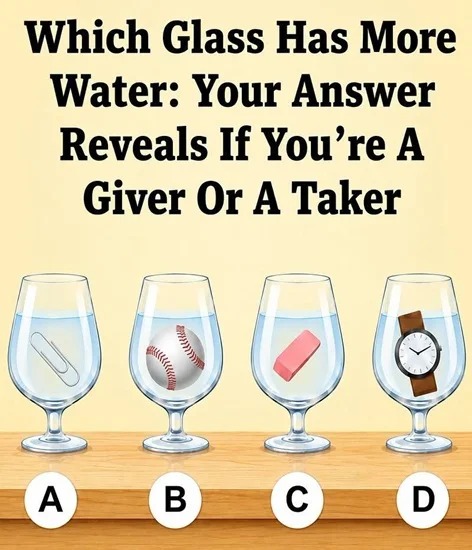
At first glance, this looks like a straightforward visual puzzle designed for children, but in reality, it has confused thousands of people online. Four identical glasses are placed side by side, each filled with water up to the same visible level. Inside each glass is a different object, and the challenge is to determine which glass actually contains the most water. What makes this puzzle so interesting is that the answer is not based on what we immediately see, but on how we interpret space, volume, and physical displacement.
The four glasses are labeled A, B, C, and D. Each glass appears to be filled equally, but each contains a different object submerged in the water. Glass A contains a small paperclip, Glass B contains a large baseball, Glass C holds a standard eraser, and Glass D contains a wristwatch. At first glance, the human brain assumes that identical water levels must mean identical amounts of water, but this assumption is where the illusion begins.
This type of puzzle works because the human brain is naturally designed to process visual information quickly. Instead of analyzing physical laws in detail, we rely on pattern recognition and instinct. When we see four glasses filled to the same level, our brain immediately categorizes them as equal. However, this is a shortcut that ignores an important scientific principle: displacement.
Displacement refers to the idea that when an object is placed into a liquid, it pushes aside a volume of that liquid equal to its own size. In a closed container, this means the object takes up space that would otherwise be filled with water. As a result, the actual amount of water in each glass depends not only on the visible water level, but also on how much space the submerged object occupies.
If we apply this principle to the puzzle, the situation becomes much clearer. Although all four glasses appear equally full, the objects inside them are not the same size. The baseball in Glass B is significantly larger than the other objects, meaning it displaces the most water. The wristwatch in Glass D and the eraser in Glass C also take up a noticeable amount of space, reducing the volume of water in their respective glasses.
Glass A, however, contains only a small paperclip. Compared to the other objects, it occupies a minimal amount of space inside the glass. Because it displaces the least water, Glass A must contain the largest volume of actual water among the four. Even though all the glasses appear visually identical in fullness, the internal volume tells a completely different story.
Read more by clicking the (NEXT »») button below!