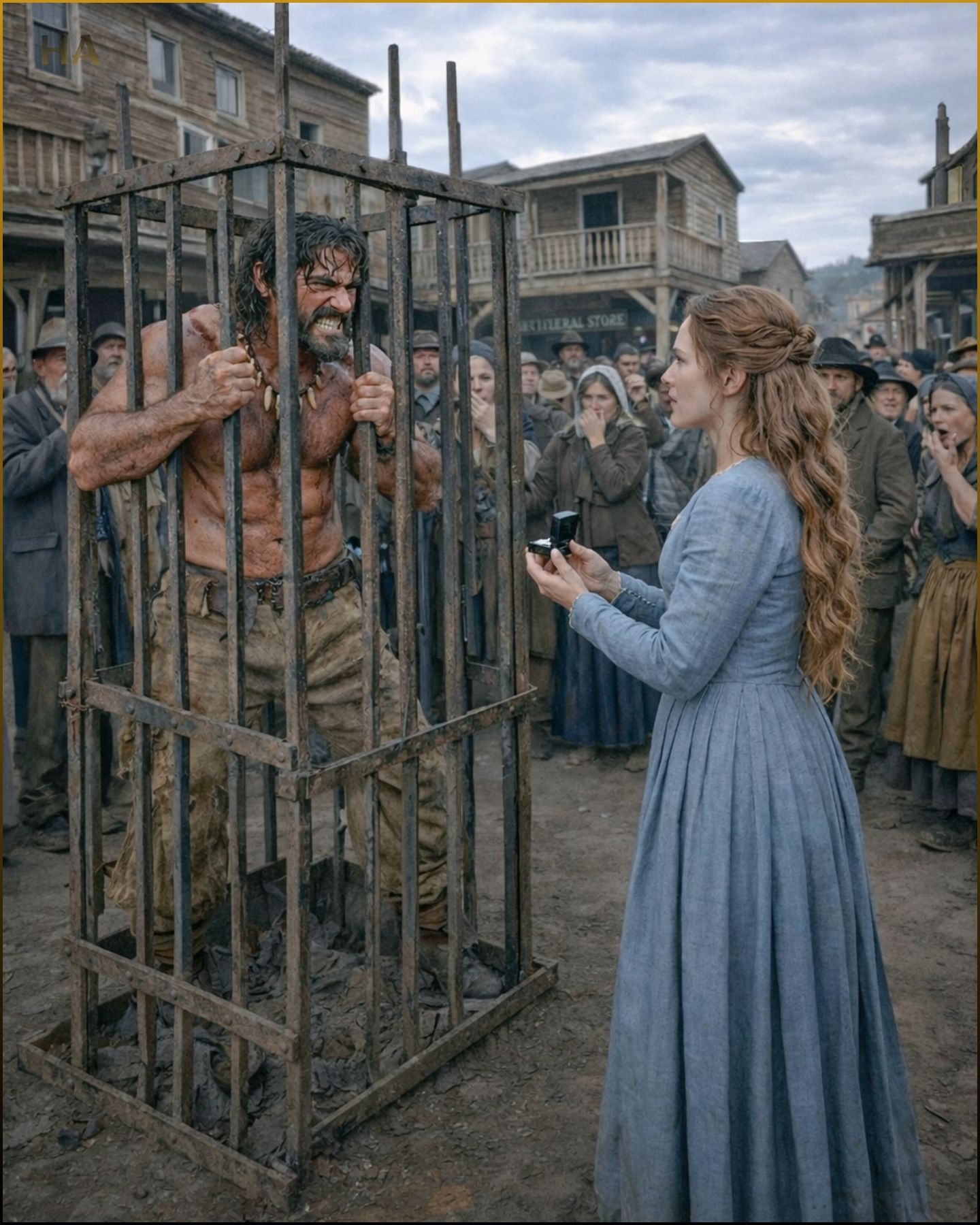
“Rafe Callahan.”
His brows rose faintly. “So you’ve been askin’ around.”
“I make it a point to know the names of men before I marry them.”
For the first time, the corner of his mouth tipped for real.
Then he said, too low for anyone else, “If you do this, you don’t get to pretend later you didn’t know I came with blood on me.”
Nell answered just as softly. “If you say no, I lose everything by tomorrow night.”
His eyes searched hers another second. Whatever he was looking for, he found enough of it.
“All right,” he said. “But don’t mistake me for tame.”
She slipped her hand between the bars.
“Didn’t ask for tame,” she said. “Asked for married.”
Rafe looked at her hand, small and callused and steady despite the heat. Slowly he placed his much larger hand around it.
Judge Bell fumbled out a Bible. “Then let’s get on with the damn thing.”
The vows were brief, stripped of ornament by haste, dust, and general disbelief. There, in the middle of Red Hollow, before a cage meant to humiliate and break a man, Nell Hart and Rafe Callahan were married with one set of fingers wrapped through iron bars and half the town staring like Judgment Day had come early.
When Bell finished, the square remained silent.
Then Nell turned to the sheriff. “Unlock the cage.”
Sloane looked to Crowley.
That was the moment everyone saw it. Not proof, not enough for court—but enough for the soul. The sheriff looked at the banker before he looked at the judge.
Crowley spoke through his teeth. “Do not do this.”
Judge Bell snapped, surprisingly sober all at once, “I’ll not be publicly made a clown after sayin’ the words. Open it.”
Sloane jerked the key ring from his belt and shoved it at a deputy. The man’s hands shook so badly he missed the lock twice before getting it right. The cage door shrieked open.
Rafe stepped out.
A visible tremor moved through the crowd. It was one thing to fear a chained man. Another to watch him stand free in the square with the woman who had bought him out.
He rolled one shoulder, then the other, as if reacquainting himself with space. The shackles were removed from his wrists but not his ankles until Nell insisted. When the irons finally dropped away, he flexed his hands once. The skin around them was torn raw.
He looked down at her.
“Where to, wife?”
The word landed in her harder than she expected. Not because it was tender. Because it was practical. He was accepting the bargain aloud in front of everyone.
Nell lifted her chin. “Home.”
The ride to the Hart ranch began in silence and stayed there for five miles.
Red Hollow dwindled behind them in a wash of dust and low roofs. Ahead lay open country—rolling yellow grass, dry creek beds, cottonwoods along a distant bend, and blue mountains broken sharp against the sky. Nell drove the wagon with her shoulders stiff. Rafe sat beside her, hatless, his forearms resting on his thighs, scanning the ridges the way other men scanned saloon mirrors.
Eventually he said, “You always solve your problems by proposing to strangers?”
“Only on difficult days.”
He nodded. “And how often are those?”
“Lately?”
He glanced at her. “Fair enough.”
After a while he added, “Crowley won’t let this stand.”
“I know.”
“Sloane either.”
“I know that too.”
“Then why do you look surprised by nothing?”
Nell kept her eyes on the road. “Because if I let myself look surprised, I might also look afraid.”
He was quiet a moment. “Are you?”
“Yes.”
“Good.”
That made her turn. “Good?”
“Fear keeps fools alive long enough to become cautious. It’s panic that gets them buried.”
She studied him. “Is that mountain wisdom?”
“That’s blood wisdom.”
Something in the way he said it—flat, worn, not proud—made her look away before she asked too much.
They dropped into a narrow draw an hour later, wagon wheels grinding over stone. The walls rose on either side in scrub and broken rock. The air seemed to tighten.
Rafe’s head lifted.
“Stop the wagon.”
Nell kept the team moving. “Why?”
“Stop it.”
His voice had changed.
She hauled the reins. The horses snorted and stamped. Before she could ask again, Rafe bent, reached under the seat, found the lockbox where she kept her sidearm, and ripped the cheap clasp apart with one violent twist.
“Hey—”
“Get down,” he said.
A rifle cracked from the ridge.
Wood exploded from the back rail where her shoulder had been a heartbeat earlier.
Nell dropped with a gasp, hitting the wagon floor hard. The horses screamed and lurched. Another shot. Then another. Dirt showered down from the bank.
“Hold the lines,” Rafe barked.
She caught the reins in both hands as the team tried to bolt. Through the spokes of the wheel she saw him jump from the wagon and roll behind a boulder, revolver now in hand.
“Three shooters,” he called. “Maybe four.”
“Sheriff?”
“Who else moves this fast?”
The answer was both terrifying and clarifying. Whatever doubt she had clung to about the depth of Crowley’s corruption died right there in the draw.
A bullet punched through the wagon bench.
Rafe leaned around the rock, fired once, and ducked back. “When I move, drive for the cottonwoods. Don’t look behind you.”
“I’m not leaving you.”
“You absolutely are.”
He rose before she could argue and ran uphill at an angle so reckless it looked like madness. Rifle fire chased him. He moved with brutal efficiency, using brush, stone, and slope as if he had been born from the terrain itself.
“Go!” he shouted.
Nell snapped the reins and the wagon surged forward out of the draw. She drove blind through fear, wheels jolting, harness leather straining, heart battering her ribs so hard it hurt. Branches from the cottonwoods slapped her sleeves as she reached the tree line.
Safe.
Safe enough to run, at least.
She pulled the team behind the trunks, breathing in ragged bursts. Gunfire still echoed from the draw.
He had bought her time.
He had also bought it like a man who had already made peace with dying there.
Nell stared back toward the ridge, then at the blanket-wrapped shape in the wagon bed: her father’s old double-barreled shotgun, kept for coyotes and late-season wolves.
“Damn you,” she whispered—not to Rafe, not exactly, but to every man who had ever assumed a woman’s survival instinct must be smaller than a man’s idea of honor.
She loaded both barrels with buckshot.
Then she went back.
The world narrowed to grass, breath, and the weight of the gun. She kept low, moving through scrub until she reached a rise overlooking the draw. Below, one masked rider was circling left while another pinned Rafe behind a limestone outcrop. A third body lay still farther up the slope.
Rafe had already taken one down.
Nell found the nearest gunman through the bead sight just as he stood to get a cleaner angle.
She fired.
The shotgun boomed so violently it bruised her shoulder on the spot. The rider spun backward with a scream, rifle flying from his hands. Before the smoke cleared, the second man wheeled toward her—
—and Rafe hit him like an avalanche.
He didn’t shoot. He closed. His fist smashed into the man’s jaw with a crack Nell heard even over her own ringing ears. The rider went limp and tumbled down the bank.
Silence dropped in pieces.
Nell’s hands shook. The shotgun suddenly felt heavier than a plow.
Rafe stood over the unconscious man, chest heaving. Then he crouched, ripped off the man’s face covering, and said with cold disgust, “Deputy Larkin.”
Nell stumbled down toward him. The wounded man she had hit was clutching his shoulder and moaning, face also exposed now.
Deputy Brice.
Both wore sheriff’s stars.
For a second she could only stare. It wasn’t that she hadn’t believed Sloane capable of murder. It was that seeing lawmen lying in the dirt after trying to kill her with masks over their faces turned corruption from rumor into texture. It had weight. Smell. Blood.
“They were going to leave us for road agents,” she said.
Rafe looked at her. “Or Indians. Or bad luck. Men like Crowley always prefer a story that cleans itself.”
He pried loose the deputies’ rifles and tossed them aside. “Can you stand?”
“Yes.”
“That ain’t what I asked.”
She swallowed. “Yes.”
He looked at the smoking shotgun in her hands, then at the man bleeding in the dirt because of it.
“You come back for me?”
“I came back because I dislike being a widow on the first day.”
A beat passed.
Then, unexpectedly, his mouth moved.
“Mean streak,” he said.
“Family trait.”
“Good. We’ll need it.”
By the time they reached the ranch near sundown, the light had gone copper across the valley.
The Hart place sat wide and strong beside Willow Creek—a two-story log house with a deep porch, a red barn, fenced pasture, and a windmill that turned slow in the evening breeze. From a distance it looked secure. Up close it looked isolated enough to be swallowed whole if the wrong men rode up after dark.
Rafe noticed everything.
“The slope behind the barn gives cover.”
“I know.”
“East window’s too low.”
“I know.”
“Front gate hinge sags.”
She looked at him sharply. “Are you criticizing my ranch before supper?”
“I’m explaining how strangers would enter it.”
That irritated her enough to keep panic at bay. “Then I suppose you’ll fix it.”
“I suppose I will.”
Inside, the kitchen smelled faintly of coffee grounds and dried sage. Nell set water to heat while Rafe sat at the table and let her clean the raw skin at his wrists, the cut along his ribs, and the scrape at his temple. Now that the fight was over, exhaustion showed plainly on him. His eyes were bloodshot. Hunger had carved shallow hollows beneath his cheekbones. Whoever had kept him in that cage had not meant for him to step out of it with strength left.
When she dabbed whiskey on the torn flesh around one wrist, he hissed.
“I thought you’d had worse,” she said.
Read more by clicking the (NEXT »») button below!